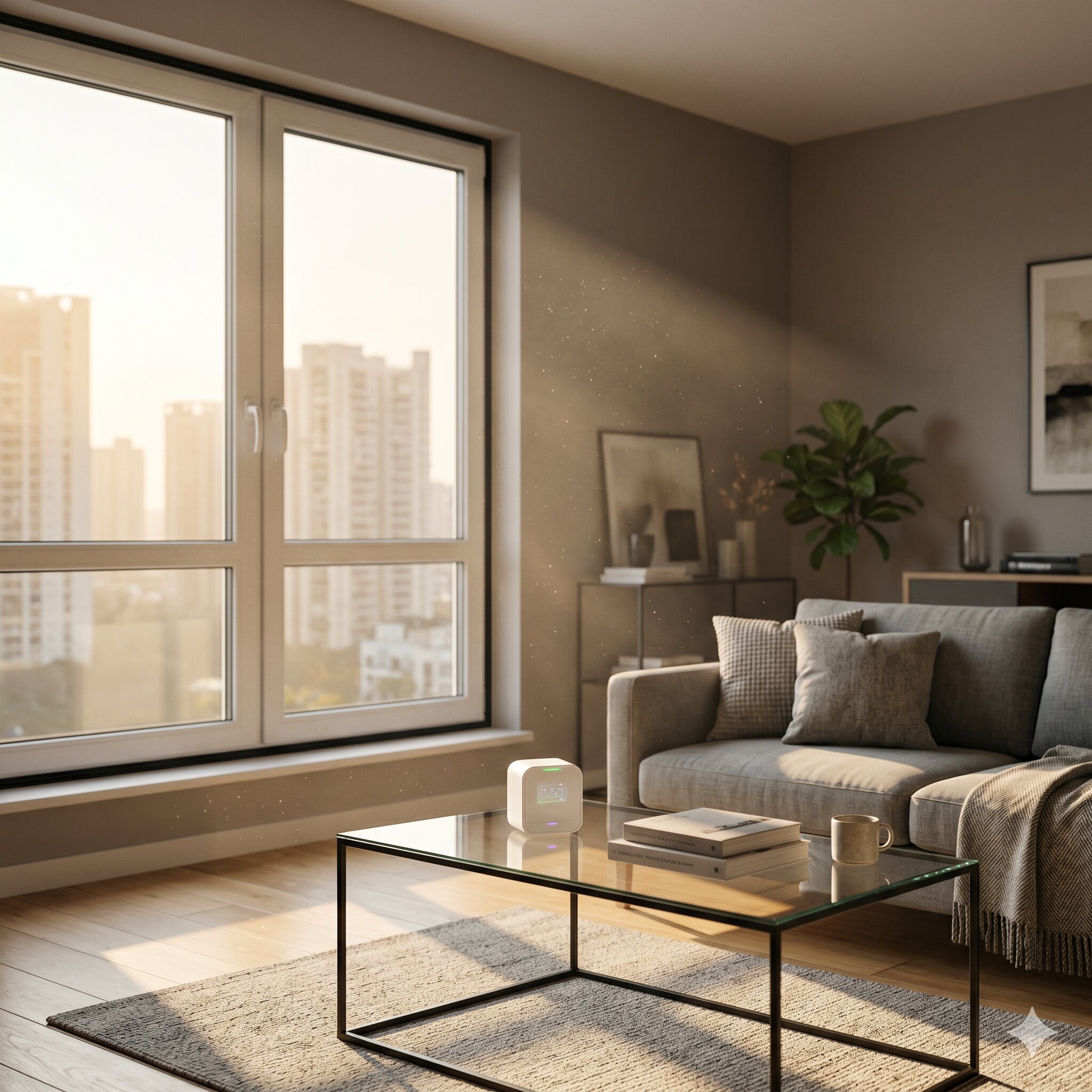
Indoor Air Quality in India
Most Indian homes have worse indoor air than their owners realise. Not because someone’s cooking — because the same outdoor air you’re trying to escape leaks in within an hour, and the CO₂ from breathing has nowhere to go. Two metrics, one structural problem, one solution.
You filter your drinking water. The air is one upgrade behind.
Every middle-class Indian household has an RO or candle filter on the tap. The decision was made years ago and nobody re-debates it — clean water is non-negotiable. You drink about 2 litres of water a day.
You breathe about 11,000 litres of air a day. The volume is roughly 5,500× larger. The contaminants are arguably worse — PM2.5 reaches deeper into the body than waterborne pathogens, and CO₂ buildup is something water has no equivalent for.
The category called “indoor air quality” exists to ask the same question for air that your household already answered for water. The answer in India is more uncomfortable than people want it to be.
What “indoor air quality” actually means in India
Internationally, indoor air quality (IAQ) covers maybe a dozen pollutants. In an Indian home, two of them dominate everything else:
PM2.5 — fine particulate matter, 2.5 microns or smaller. Reaches the alveoli, enters the bloodstream, links to cardiovascular disease, stroke, lung-function decline, cognitive impairment, and an estimated 11.9-year life-expectancy hit in Delhi NCR (AQLI).
CO₂ — carbon dioxide from human breathing. Not toxic at indoor concentrations, but a sensitive proxy for stale air. Above 1,000 ppm cognitive function drops measurably (Harvard / SUNY Upstate, Allen et al. 2016). Sealed bedrooms with two adults sleeping hit 1,500-2,500 ppm by morning.
Other indoor pollutants matter — VOCs from furniture, cooking-source smoke, ozone, allergens. We have separate guides for VOC emissions, cooking and the kitchen, furniture formaldehyde, indoor combustion. But PM2.5 and CO₂ are the two numbers that decide whether your indoor air is helping or hurting your family right now.
Why indoor PM2.5 in India tracks outdoor PM2.5 within an hour
The intuition most people have is that closing windows seals the home and indoor air becomes its own thing. That intuition is wrong for almost every Indian home.
The number that determines this is called the infiltration factor — the ratio of outdoor PM2.5 that leaks indoors over time, through gaps in doors, around windows, through kitchen exhaust paths, and during the routine open-and-close moments of a normal day.
| Climate / construction | Typical infiltration factor |
|---|---|
| US single-family home | ~0.26 |
| Indian home (typical) | ~0.71 |
| Sealed glass-façade modern Indian high-rise | ~0.40-0.55 |
Indian construction leaks roughly three times faster than US homes. The reason is mostly the way doors and windows are built, kitchen exhaust paths that route through the home, and the fact that someone is opening a door every few minutes in any normal day.
In practical terms: when outdoor PM2.5 sits at 200 µg/m³ during a typical Delhi winter day, indoor PM2.5 — with doors and windows closed and an air purifier running — typically sits at 80-150 µg/m³. The WHO 24-hour guideline is 15 µg/m³.
This is the mass-balance problem that defines Indian indoor air. The full math, including independent Delhi field testing of premium air purifiers, is in Why Your Air Purifier Can’t Handle Delhi Winters.
CO₂: the metric nobody measures, that hurts you most
PM2.5 is the metric Indian households have started to measure. CO₂ is the one almost nobody measures, and it’s the one that determines whether you sleep well, whether your child concentrates during homework, and whether your afternoon meeting feels foggy.
The math is simple. A closed bedroom with two adults sleeping has roughly 30 m³ of air. Each adult exhales about 20 litres per hour of CO₂. Over an eight-hour night, that’s 320 litres of CO₂ added to a 30,000-litre space with no outlet.
| Sleep environment | Typical CO₂ by morning |
|---|---|
| Open balcony, windows open | 500-700 ppm |
| Closed room, leaky old construction | 900-1,300 ppm |
| Sealed modern bedroom, two adults | 1,500-2,500 ppm |
| Sealed bedroom + closed door + AC running | 2,000-3,000 ppm |
Above 1,000 ppm, performance on standardised decision-making tasks drops 15-50% (Harvard TH Chan, Allen et al. 2016). Sleep quality degrades. Morning headaches, that “Delhi tiredness” feeling, the second-hour homework slump in your child — all common symptoms of overnight CO₂ accumulation.
The crucial point: no filter, no HEPA grade, no carbon stage removes CO₂. A room air purifier in the corner of a sealed bedroom cannot reduce CO₂ by even one ppm. The molecule is too small for filtration; the only way to lower indoor CO₂ is to bring fresh outdoor air in and let stale air out.
We have a deeper walk-through in the bedroom CO₂ overnight piece and the 1,000-ppm cognitive cliff.
Why Indian indoor air is structurally different
Three combined reasons make this an Indian-specific problem rather than a global one:
1. Outdoor air is the problem. In most of the developed world, outdoor air is broadly clean and the indoor-air conversation is about controlling cooking, smoking, pets, and dust. In India, outdoor PM2.5 is the dominant source — it leaks in, it dominates the indoor reading, and it’s elevated for 9-10 months of the year. More on the year-round nature →
2. Construction wasn’t built for filtered ventilation. Western homes increasingly include heat recovery ventilators (HRV) or energy recovery ventilators (ERV) — systems that pull filtered outdoor air in continuously. Indian construction skipped this entire category. Most homes have no outdoor-air supply at all; the AC recirculates, the chimney exhausts, the windows leak.
3. Cooking is high-intensity. Indian cooking — tadka, deep-fry, tava — produces PM2.5 spikes that hit 500-3,000 µg/m³ inside the kitchen for several minutes per cook. A chimney over the stove helps somewhat; a closed kitchen door helps more. But the indoor-air load from cooking is structurally higher than in most Western kitchens.
All three combine. The result is that an average Indian home — even a new, sealed, well-furnished one with air purifiers in every room — typically runs indoor PM2.5 at 6-12× the WHO guideline and indoor CO₂ at 1.5-2.5× the WHO comfort threshold for much of the year. Most owners aren’t aware.
What actually works
The category called “indoor air quality” in India needs a different toolkit from what international purifier brands sell.
Room air purifiers — useful in a single sealed bedroom under moderate outdoor conditions. They reduce PM2.5 in that room. They don’t address CO₂. They don’t address the whole home. During the worst weeks of NCR winter, they can’t keep up with outdoor concentrations even in a sealed room.
Window-opening + natural ventilation — works in cleaner cities or during monsoon. Doesn’t work in NCR for 9-10 months of the year, and brings outdoor PM2.5 in unfiltered when it does.
Whole-home positive-pressure ventilation — pulls outdoor air through clinical-grade H13 HEPA before it enters the home. Pressurises the interior so polluted air leaks out through gaps instead of leaking in. Indoor PM2.5 stays below 15 µg/m³ regardless of outdoor concentration. CO₂ continuously flushed below 1,000 ppm because fresh air is continuously coming in. One system, whole home.
This third category — what aqi0 builds — is the indoor-air-quality solution designed for Indian outdoor conditions. The mechanism is on the how-it-works page; the brand argument is on /air-purifier/.
Frequently asked questions about indoor air quality in India
What’s a safe indoor PM2.5 level in India?
The WHO 24-hour PM2.5 guideline is 15 µg/m³. India’s CPCB classifies AQI 0-50 as “Good”, corresponding to PM2.5 under about 30 µg/m³. With active fresh-air filtration, indoor PM2.5 below 10 µg/m³ is achievable year-round in a typical 2-4 BHK Indian home — well under both guidelines.
How do I measure CO₂ in my home?
A WiFi indoor air-quality monitor with a CO₂ sensor — most home models in India cost ₹5,000-12,000. Place it in the room you sleep in. Record overnight peak. If you don’t have a monitor, the strong indicator is a stuffy-feeling room in the morning, morning headaches, and unusually deep sleep right after opening a window.
Why does my home feel stuffy in winter even with air purifiers running?
Two reasons. First, air purifiers can’t reduce CO₂ — they only filter PM2.5 from the air that’s already in the room. With doors closed and AC running, CO₂ accumulates and the room feels “heavy” regardless of how clean the PM2.5 reading is. Second, during peak winter outdoor PM2.5 (October-February in NCR), purifiers can’t keep up with the rate at which outdoor air leaks in — so indoor PM2.5 also stays elevated, adding to the stuffy feeling.
Are houseplants enough to clean indoor air?
No. The 1989 NASA Clean Air Study has been widely misread for 35 years. To match the chamber-result PM2.5 reduction with houseplants in a real living room, you’d need 100-1,000 plants per room. The leaf-area-to-room-volume ratio just doesn’t work. We unpack the full math in Why money plants stop “breathing” in Delhi winter. Plants are good for many things; indoor air filtration isn’t one of them.
What’s the difference between an air purifier and “indoor air quality”?
An air purifier is one (incomplete) tool for managing one (incomplete) dimension of indoor air quality — PM2.5 in a single room. Indoor air quality as a category covers PM2.5, CO₂, VOCs, allergens, humidity, and temperature, across the whole home. The right framing isn’t “which air purifier do I buy” but “what does my home need across these dimensions”. For most Indian homes, the answer is a whole-home positive-pressure system + targeted source control (kitchen exhaust, low-VOC paint, etc.).
How fast does indoor air actually improve when I install fresh-air ventilation?
Measurable within hours. Indoor PM2.5 drops from 60-130 µg/m³ to under 10 µg/m³ within 1-3 hours of starting the system. CO₂ overnight peak drops from 1,500-2,500 ppm to under 1,000 ppm on the first night. Customer stories with before-and-after readings are on the reviews page.
Does indoor air quality affect children’s lung development?
Yes — significantly. Children’s lungs develop until late adolescence. PM2.5 exposure during this window reduces lung-function growth by 5-10% across school years (USC Children’s Health Study). Avol 2001 + Gauderman NEJM 2004 + 2015 found that when children move from polluted to cleaner communities, their lung-function growth accelerates — meaning the body recovers when the input improves. This is one of the strongest arguments for taking indoor air quality seriously for Indian families with kids.
What to do next
Air is the next utility. Water already is. Less of a harmful thing is always better.
If your home is in Gurugram or Delhi NCR, book a free site survey — we measure indoor PM2.5 and CO₂ at the site visit, before proposing anything. You’ll know the actual indoor air quality of your specific home within 30 minutes.
Call +91 96676 72740 or WhatsApp wa.me/919667672740.