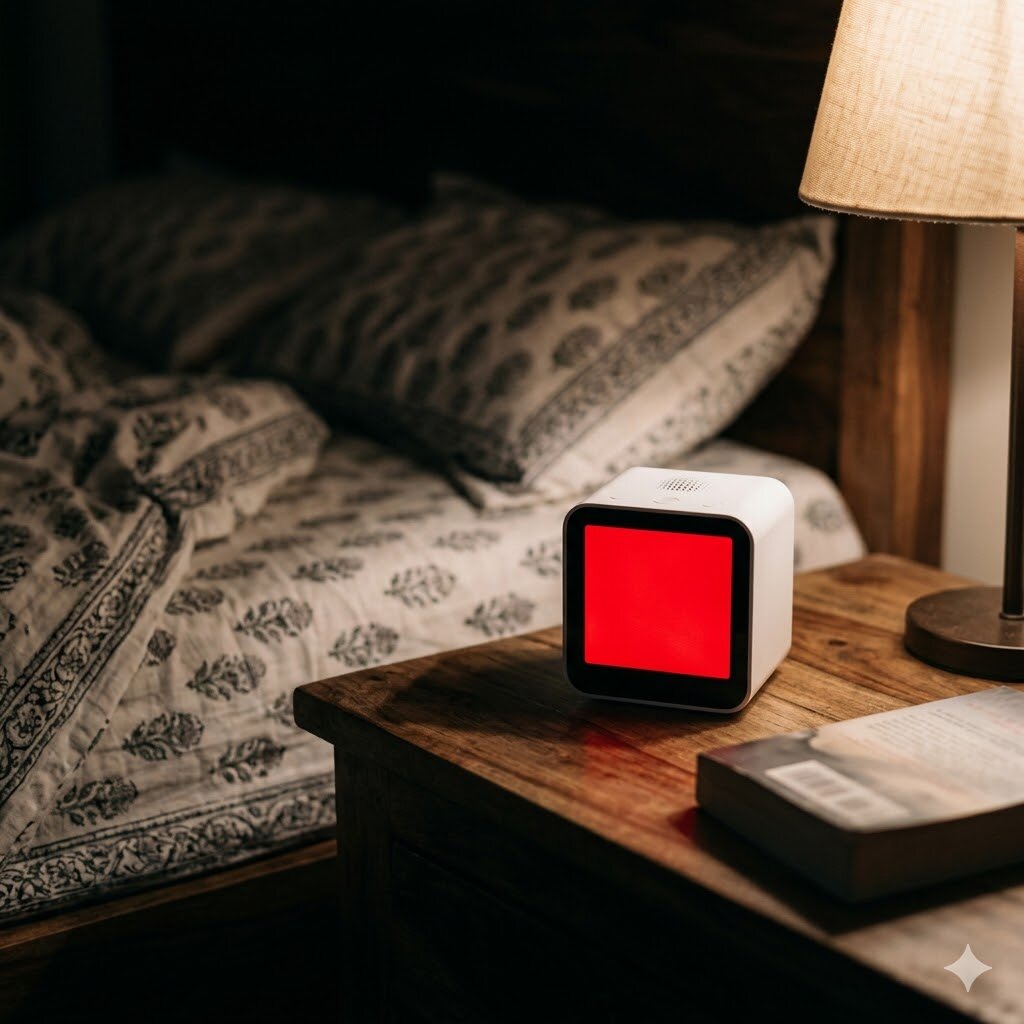
Indoor air quality monitor in an Indian bedroom showing elevated overnight CO₂

Bedroom CO₂ at Night: Why It Climbs Past 1,400 ppm — and What It Does to Your Sleep

Close two adults inside a typical Indian bedroom with the door shut and the AC running, and CO₂ levels climb past 1,400 ppm before midnight. By 3 AM the same room often sits above 1,800 ppm. Sustained CO₂ at those levels measurably reduces slow-wave sleep, recovery, and next-day decision-making. The uncomfortable part: an air purifier cannot help, because purifiers do not remove CO₂.

Key numbers

How fast CO₂ actually rises in a closed bedroom

A resting adult exhales roughly 17 litres of CO₂ per hour. Two adults asleep in a 30 m³ bedroom add ~34 litres per hour to a fixed-volume box. Pure mixing math says the room moves from 420 ppm to 1,000 ppm in under an hour, to 1,500 ppm by the second hour, and continues climbing all night unless air is exchanged with the outside.

Air conditioning does not help. A split AC is a heat pump — it cools and recirculates the air already in the room. It does not pull in fresh outdoor air. The same CO₂ molecules cycle through the evaporator coil and back into the room.

Why modern Indian homes trap more CO₂ than older ones

Houses built in the 1980s and 1990s in Delhi NCR had loose-fitting wooden windows, ventilator grilles above doors, and a generally leaky envelope. Air infiltration happened whether anyone wanted it or not.

Today’s homes are sealed by design. Aluminium and uPVC casement windows, gasketed sliding doors, double-glazed units, and full-height tiling have pushed natural air-change rates from ~1.0 per hour down to ~0.2 per hour. The house holds heat better. It also holds CO₂, cooking fumes, candle smoke and VOCs better.

The same envelope improvement that lowered electricity bills made indoor air staler.

What 1,400+ ppm does to your sleep

Two strands of evidence matter here:

1. Sleep quality. Strøm-Tejsen and colleagues at the Technical University of Denmark ran two field experiments in student dormitories: when bedroom CO₂ was lowered from ~2,400–2,600 ppm to ~660–835 ppm, actigraphy-measured sleep quality improved significantly, as did next-morning logical-thinking test scores and self-reported sleepiness (Indoor Air, 2016). A 2025 ASHRAE-funded follow-up (Project 1837-RP) confirmed the effect and recommended that bedroom ventilation standards be tightened.

2. Next-day cognition. The Harvard CogFx study (Allen et al., Environmental Health Perspectives, 2016) controlled CO₂ exposure in office workers across green, conventional, and high-ventilation conditions. Cognitive scores on the Strategic Management Simulation tool were 61% higher in the green condition and 101% higher in the “green-plus” (low CO₂, high outdoor air) condition compared to conventional offices. Crisis response and strategy were the most affected domains.

You wake up unrested even though you spent eight hours horizontal. The next morning’s first three hours of work are noticeably worse.

The recovery comparison

People who track sleep recovery with wearables (Whoop, Oura, Garmin, Apple Watch) commonly report that one night in a CO₂-saturated bedroom drops their recovery score by roughly the same margin as going to bed after two pegs of whisky.

That is anecdotal community data, not a clinical trial. But the direction of the effect matches the published cognition studies. If you have a recovery score on your wrist, the experiment is free to run: measure one night with the bedroom door open and a window cracked, then one night with both shut. Most people see a 10–20 point difference.

Why an air purifier doesn’t help

An air purifier pulls room air through a HEPA filter (for PM2.5) and sometimes an activated carbon stage (for VOCs and odours). Neither filter touches CO₂.

CO₂ is a small, stable, non-polar gas. It does not get trapped by HEPA fibres or adsorbed by standard activated carbon at room temperature. The only consumer-scale way to lower indoor CO₂ is to dilute it with outdoor air, which a purifier — sealed inside the room — cannot do.

If your phone says PM2.5 inside is under 15 µg/m³ and you still wake up groggy, the suspect is CO₂.

What actually lowers bedroom CO₂

Three options, in order of how well they work in Delhi NCR:

  1. Mechanical fresh-air ventilation. A positive-pressure fresh air system pulls outdoor air through an H13 HEPA filter and pushes it into the home at a steady ~500 m³/h. CO₂ in a sealed bedroom typically stabilises at 600–800 ppm overnight, well under the WHO line. Learn how positive pressure works.
  2. Cracking a window. Free, but only works on the ~30 nights a year when outdoor PM2.5 in NCR is under 35 µg/m³. The rest of the year you trade CO₂ for PM2.5.
  3. Sleeping with the bedroom door open. Helps if the rest of the home has fresh air supply. Doesn’t help if the whole house is sealed.

For Delhi NCR specifically, option 2 fails ~10 months of the year — the same reason aqi0 exists as a category.

How to know if your bedroom is the problem

You don’t need an industrial sensor. A consumer CO₂ monitor (Aranet4, Qingping, or a cheaper Chinese NDIR unit on Amazon for ₹3,000–5,000) will give you a reading every minute. Place it on the bedside table, close the door at 11 PM, and look at the graph in the morning.

aqi0 measures this on every site survey we run.

FAQ

Does opening a window solve it? Sometimes. It works on low-AQI nights and in a city with clean outdoor air. In Delhi NCR an open window in winter trades 1,800 ppm of CO₂ for 250 µg/m³ of PM2.5. You sleep better and breathe worse.

Does an air purifier reduce CO₂? No. HEPA filters and activated carbon do not capture CO₂. Only ventilation (fresh outdoor air mixing in) lowers it.

Why didn’t I notice this in my parents’ house? Old homes leak air through gaps. New homes don’t. The sealing improvement is what surfaced the CO₂ problem.

Is 1,400 ppm dangerous? Not acutely. Submarine crews work at 5,000–8,000 ppm. But sustained exposure during sleep measurably reduces sleep quality and next-day cognition.

Where does aqi0 keep my bedroom CO₂? Field data across 60+ installations: typically 550–800 ppm overnight, depending on room volume and occupant count.