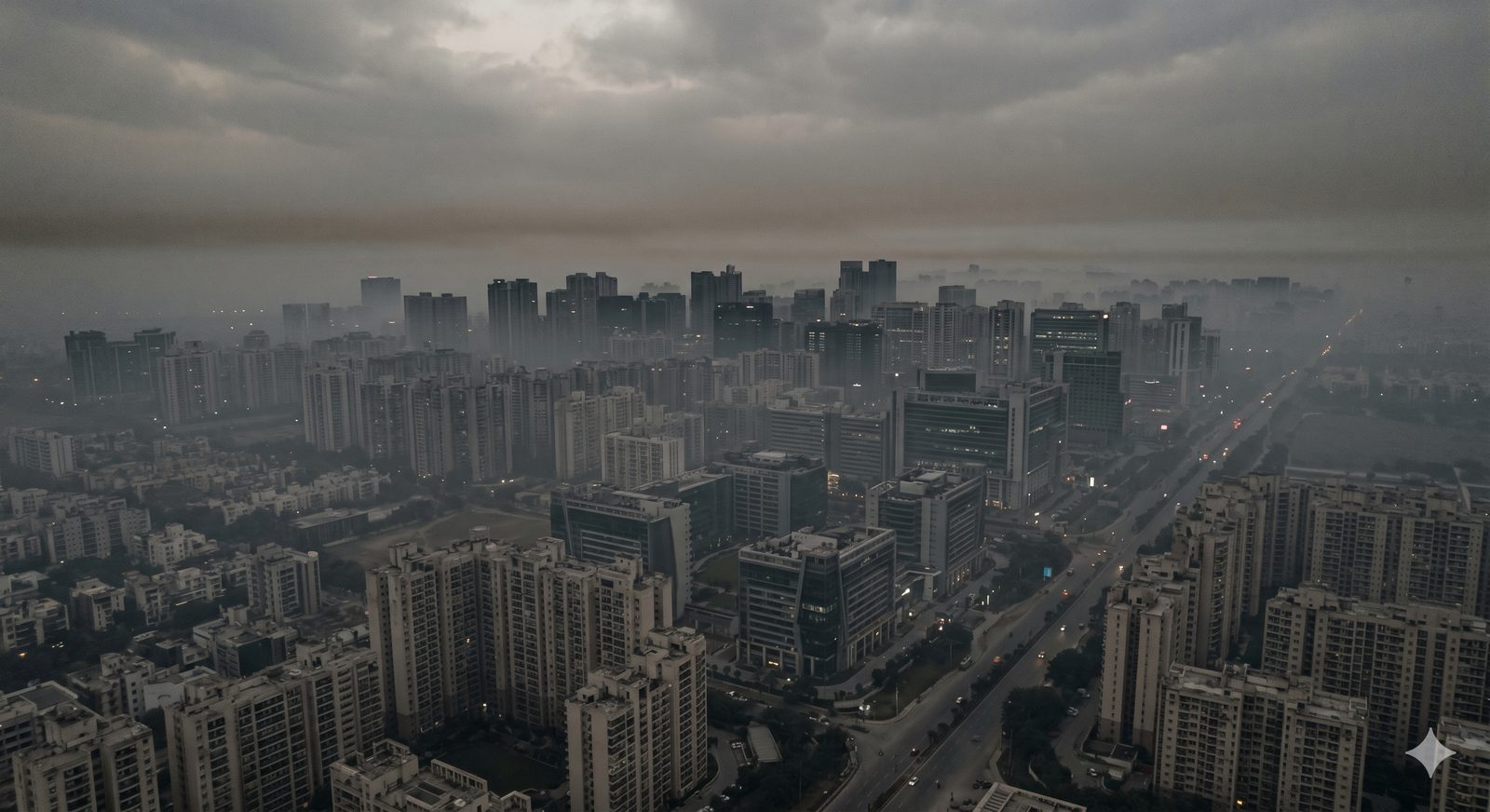
Delhi NCR AQI Year-Round: Why “Moderate” Air Is Still Hurting You
Most NCR residents have re-calibrated their idea of safe air. After November 2024 sat at AQI 400+ for weeks, an AQI 80-100 in May feels like relief. Doors open, runs in the park, “the air is clean today.” It isn’t. Here’s the year-round picture, the breath-count math, and why a fresh air system is annual insurance — not a winter-only Diwali emergency.
Watch the 8-minute version: the same year-round AQI argument as below, narrated.
Skip ahead: - The annual AQI cycle in NCR — month by month - Why monsoon doesn’t fix PM2.5 the way you think it does - The cumulative dose: what 100 µg/m³ actually puts in your lungs every year - The 12-hour indoor argument - What WHO says vs what India’s CPCB says vs what your body experiences - The mental shift: continuous protection, not crisis response
The annual AQI cycle in Delhi NCR — month by month
NCR air quality follows a brutally predictable cycle. Treat this table as approximate — averages vary year to year — but the shape is consistent across every year of CPCB data.
| Period | Months | Typical 24-hour PM2.5 | Typical AQI band | What’s driving it |
|---|---|---|---|---|
| Severe winter | Late Oct – early Feb | 150-300+ µg/m³ | Very Poor → Severe (300-500) | Stubble burning + winter inversions trap pollution at ground level. Diwali week spikes higher. |
| Late winter | Feb | 80-150 µg/m³ | Poor (200-300) | Inversions ease but the airshed is still saturated. |
| Spring | Mar – Apr | 60-100 µg/m³ | Moderate-Poor (150-200) | Construction dust, vehicle emissions, pre-monsoon dry winds. |
| Pre-monsoon | May – Jun | 50-80 µg/m³ | Moderate (100-150) | High temperatures aid dispersion, but PM2.5 baseline persists. |
| Monsoon | Jul – Sep | 30-60 µg/m³ | Satisfactory-Moderate (75-150) | Wet deposition + better mixing height. Lowest readings of the year. |
| Post-monsoon transition | Early Oct | 60-120 µg/m³ | Moderate-Poor (150-250) | Crop residue burning starts. Cycle resets. |
The honest summary: Delhi NCR’s best months — peak monsoon — still average 30-60 µg/m³ PM2.5. The WHO 24-hour guideline is 15 µg/m³. Even at the cleanest point of the year, NCR air is roughly 2-4× above what the WHO calls safe.
The trap is psychological. After living through 350 µg/m³ in November, 80 µg/m³ in May feels like clean air. It feels like a different planet. But your lungs don’t grade on a curve relative to last winter — they grade on absolute exposure.
Why monsoon doesn’t fix PM2.5 the way you think it does
The common assumption: “Monsoon rains wash the pollution away.” Half-true, badly understood.
What the rain actually does: - ✓ Removes PM10 (coarse dust) efficiently — particles 2.5–10 µm are big enough to be captured by raindrops - ✓ Reduces street-level visible smog (which is mostly PM10) - ✗ Does not efficiently remove PM2.5 — fine particles (under 2.5 µm) are too small for raindrops to scavenge well. Most fall through the rain or remain suspended. - ✗ Some PM2.5 components actually grow in humid conditions (hygroscopic growth — sulphates and nitrates absorb moisture and become larger), partially offsetting any wet-deposition benefit.
What does help in monsoon: - Higher mixing height (warm air rising disperses pollutants vertically) - Stronger winds (horizontal dispersion) - Lower local emissions (less heating, less stubble burning, less construction in heavy rain)
The net effect is real — monsoon PM2.5 is roughly half of winter levels. But it’s still 2-4× the WHO guideline, and your indoor air, if you open windows in monsoon, immediately tracks outdoor air.
There’s no month in NCR where you can stop thinking about PM2.5.
The cumulative dose: what 100 µg/m³ actually puts in your lungs every year
This is the calculation most Indian air-quality conversations skip — and it’s the number that actually matters.
Step 1: How much air do you breathe?
A sedentary adult takes about 12-16 breaths per minute, with a tidal volume of ~500 mL per breath. That works out to:
- ~17,000 breaths per day
- ~6.2 million breaths per year
- ~6,000–8,000 litres of air per day (≈ 6-8 m³, depending on activity level)
A child or adolescent breathes more per kilogram of body weight than an adult. A 6-year-old inhales roughly 2× the air per kg of an adult — same outdoor concentration, twice the lung dose. (We covered this in detail in Air pollution and children’s health.)
Step 2: Multiply by PM2.5 concentration
| Average annual PM2.5 | Daily PM2.5 inhaled (8 m³ × concentration) | Yearly PM2.5 inhaled |
|---|---|---|
| 5 µg/m³ (WHO ideal annual) | 0.04 mg | 15 mg |
| 15 µg/m³ (WHO 24-hour guideline) | 0.12 mg | 44 mg |
| 40 µg/m³ (CPCB annual standard) | 0.32 mg | 117 mg |
| 60 µg/m³ (typical Delhi monsoon) | 0.48 mg | 175 mg |
| 100 µg/m³ (“moderate” — your spring/summer NCR average) | 0.80 mg | 292 mg |
| 150 µg/m³ (typical NCR autumn) | 1.20 mg | 438 mg |
| 250 µg/m³ (winter average) | 2.00 mg | 730 mg |
The scale is small in absolute terms — milligrams, not grams. But these are fine particles depositing deep in your alveoli, where about 30-50% of inhaled PM2.5 is retained (the rest is exhaled or trapped in mucus). At Delhi NCR’s annual average of ~100 µg/m³, you’re depositing roughly 100-150 mg of fine particulate matter into your lungs and bloodstream every single year.
For a 40-year-old who has lived in Delhi NCR all their life, that’s 3-6 grams of PM2.5 deposited cumulatively. This is not a hypothetical number — it’s the arithmetic of breathing in Delhi.
The WHO ideal annual exposure (5 µg/m³): 15 mg/year. Roughly 20× less. That’s the gap.
The 12-hour indoor argument
Here’s the lever. Most Indian working adults spend:
- 8-10 hours indoors at home (sleep + meals + downtime)
- 8-10 hours indoors at work or school
- 2-4 hours commuting / outdoor
Children spend even more time indoors — closer to 18-22 hours per day under normal routines.
If you control air quality during the 8-10 hours you’re at home (especially overnight when bedrooms are sealed), you cut roughly 40-50% of your daily PM2.5 dose, every day, every season — including the months when outdoor AQI looks “moderate” and you’re tempted to stop caring.
Run the same math for a closed Indian bedroom in summer: - Outdoor AQI 100 → outdoor PM2.5 ~80 µg/m³ - Closed bedroom indoor PM2.5 typically tracks at 60-90% of outdoor with a 1-2 hour lag → 50-70 µg/m³ indoors - 9 hours sleep × 0.5 m³/hour breathing rate × 60 µg/m³ = 270 µg PM2.5 inhaled overnight, every night, in “moderate” months
A whole-home positive-pressure fresh air system holds indoor PM2.5 below 10 µg/m³ continuously — that’s 0.06× the moderate-season number. Same 9 hours of sleep, the inhaled dose drops from 270 µg to ~45 µg. Across a year of “moderate” nights, that’s the difference between ~100 mg of overnight PM2.5 and ~16 mg.
This is why aqi0 customers run their systems 24/7 year-round — not just October to February. The annual integral of avoided exposure is what protects health.
What WHO says vs what India’s CPCB says vs what your body experiences
There are three thresholds you’ll see referenced:
| Source | Annual PM2.5 limit | 24-hour PM2.5 limit | What it represents |
|---|---|---|---|
| WHO (2021 guidelines) | 5 µg/m³ | 15 µg/m³ | Health-based — the level below which population health risk is minimal |
| WHO Interim Target 1 | 35 µg/m³ | 75 µg/m³ | A halfway point for highly polluted regions transitioning to compliance |
| India’s CPCB (NAAQS, 2009) | 40 µg/m³ | 60 µg/m³ | What India considers “compliant” for clean-air monitoring |
| Delhi NCR reality | ~100 µg/m³ | 30-300+ µg/m³ depending on season | What you’re actually breathing |
The CPCB standard is 8× the WHO guideline for annual exposure. Even compliance with CPCB still implies measurable cardiovascular and respiratory risk.
The CPCB AQI band you see on your weather app is based on the CPCB standard, not the WHO one. So when your phone says “AQI 95 — Satisfactory” in May, that translates to roughly 75 µg/m³ PM2.5 — five times the WHO 24-hour guideline and fifteen times the WHO annual ideal.
We covered the standards in detail in PM2.5 safe levels in India. The short version: the threshold most Indians intuitively use (“AQI under 100 = fine”) is anchored to a national standard that’s already lenient by global health-evidence standards.
The mental shift: continuous protection, not crisis response
Most NCR families think about indoor air the way they think about umbrellas — pull it out when the weather is obviously bad. The data argues for thinking about it the way you think about drinking water. You don’t drink filtered water only during cholera outbreaks. You filter water all year because the cumulative exposure to pathogens over decades is what matters, not the worst day.
PM2.5 works the same way. The cumulative deposition in your lungs and bloodstream is what eventually shows up as:
- Reduced lung function in adolescence and adulthood (peer-reviewed, multiple cohort studies)
- 5-10% higher cardiovascular mortality per 10 µg/m³ chronic PM2.5 exposure
- Stunted lung growth in children chronically exposed during ages 0-8 (does not recover even after moving to cleaner air)
- 1-2 IQ point reduction per 10 µg/m³ chronic exposure during developmental years (PNAS, 2018)
- Elevated risk of stroke, dementia, and certain cancers
None of this happens because of one bad winter. It happens because the air is bad for 9-10 months of the year, every year, and the dose accumulates.
Fresh air system as winter-only: misses 6 months of dose Fresh air system year-round: cuts cumulative annual dose by ~50%
That’s the real value proposition. The crisis-mode purchase you might make in November is worth roughly half of what the year-round purchase is worth.
The price tag, in years of life
The Air Quality Life Index (AQLI), maintained by the Energy Policy Institute at the University of Chicago, translates ambient PM2.5 exposure into life expectancy. The methodology calibrates exposure-response from natural-experiment cohorts in highly polluted regions and projects forward at the population level — the same statistical machinery used to quantify the smoking–lung-cancer link.
The headline numbers for India, from the most recent published update (AQLI 2024, covering 2022 data), are stark:
- 3.5 years — average life expectancy lost in India to PM2.5, versus a world meeting the WHO annual guideline of 5 µg/m³
- 11.9 years — average life expectancy lost in Delhi specifically, the highest of any major city in the world
- 8+ years — typical loss across most of the Indo-Gangetic Plain (Uttar Pradesh, Bihar, Haryana, Punjab)
Two things make these numbers unusual. First, they aren’t a “lifetime cancer risk” or “increased odds” framing — they’re a direct year-count built from the same kind of population-cohort data that established cigarettes shorten life. Second, the cause is a single measurable pollutant: airborne fine particulate matter under 2.5 microns. Reduce the pollutant, reduce the loss.
The intervention boundary matters. AQLI assumes whole-environment exposure reduction. The half of your daily PM2.5 exposure that happens inside your own home — typically 10-14 hours including sleep — is the half you can actually control with a fresh air system. Solving that half cleanly is not the same as recovering all 11.9 years, but it is by far the largest single lever an individual Delhi resident has on this number, and it is the only lever you can pull without waiting for policy.
Source: AQLI 2024, Energy Policy Institute at the University of Chicago — aqli.epic.uchicago.edu. Country and city-level estimates are browsable on EPIC’s interactive map.
What aqi0 does
aqi0 builds positive-pressure fresh air systems for Indian homes. Indoor PM2.5 stays below 10 µg/m³ with fresh filters — that’s below the WHO 24-hour guideline of 15 µg/m³, every hour of every day, including monsoon when outdoor air is at its “best” 50-60 µg/m³ and including November when outdoor is at 350.
CO₂ flushes continuously below 1,000 ppm — closed bedrooms overnight stay below the WHO comfort threshold even with kids sleeping. (See CO₂ in the bedroom for why this matters.)
One unit covers up to 2,000 sq ft (typical 2-4 BHK Indian home). Operates 24/7 at ~30W (about ₹170/month at ₹8/unit).
| Item | All-in (incl. 18% GST) |
|---|---|
| Fresh Air System (installed) | ₹70,000 + GST (₹82,600 all-in) |
| Annual AMC | ₹12,500 + GST (₹14,750/year all-in) |
Bundle perk: the aqi0 AQI monitor (₹6,000) is included free when AMC is signed on the same invoice as the system.
Same pricing across NCR. Installation, ducting, electrical, and louver are included. .
Installed across multiple homes in Gurugram and South Delhi NCR.
Related reading
- PM2.5 safe levels in India — WHO vs CPCB explained
- How to reduce PM2.5 at home in India
- Air pollution and children’s health in India
- Are air purifiers enough for Delhi pollution?
- Fresh Air System vs Air Purifier — full breakdown
Get a quote
Call +91 96676 72740 or WhatsApp wa.me/919667672740 for a free site survey. Most installations complete in one site visit.
Last updated: 2026-04-28