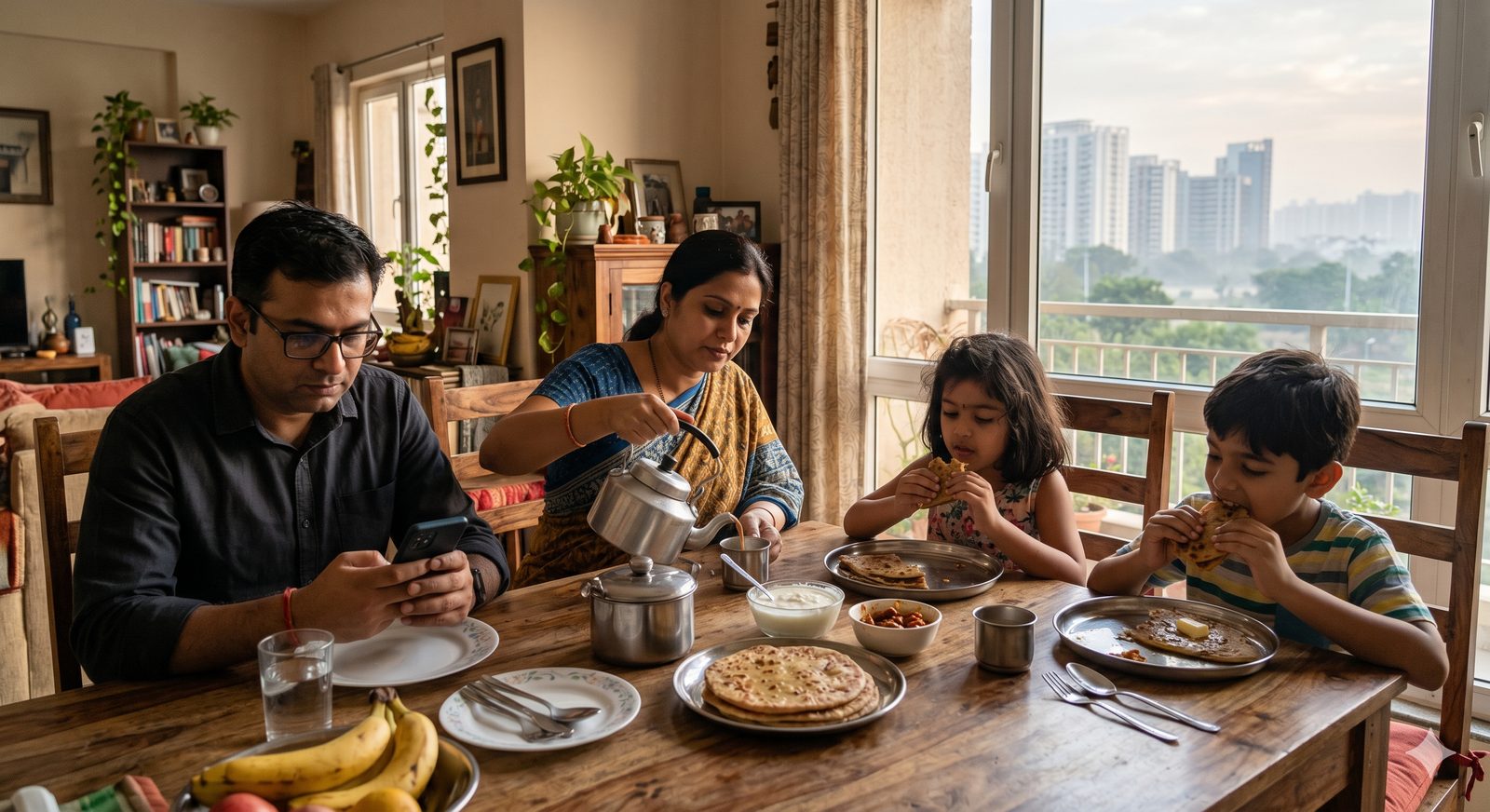
Indian family at breakfast in a Gurugram apartment, with the city skyline visible through a balcony in the morning haze — the daily life that Delhi's air is quietly shortening

Delhi Takes 11.9 Years Off Your Life. Here’s the Part You Can Actually Fix.

The Air Quality Life Index puts Delhi at 11.9 years of life lost to PM2.5 — more than any major city on earth. This isn’t a vibes statistic or an “increased risk” framing. It’s a direct year-count, built from the same population-cohort science that proved cigarettes shorten life. Below: where the number comes from, why it lands harder than most parents realise, why a room air purifier can’t address most of it, and the single largest lever an individual household has.

Watch · 8-min version the same argument as below, narrated — what the AQLI number actually means, why purifiers can't fix most of it, and the one lever you have at home.

Skip ahead: - What 11.9 years actually means - Why most NCR residents don’t act on this - The compounding stakes — kids, sleep, cognition - Why purifiers aren’t the answer for most of this - The lever you actually have: your home is 10-14 hours a day - What a whole-home fresh air system does


What 11.9 years actually means

The Air Quality Life Index (AQLI), maintained by the Energy Policy Institute at the University of Chicago (EPIC), translates ambient PM2.5 exposure into life expectancy. The methodology calibrates exposure-response from natural-experiment cohorts in highly polluted regions and projects forward at the population level — the same statistical machinery that quantified the smoking–lung-cancer link.

The headline numbers from the most recent AQLI update (2024, covering 2022 data):

Two things make these numbers unusual.

First, they aren’t a “lifetime cancer risk” or “increased odds” framing. They are a direct year-count, built from the same kind of population-cohort data that established cigarettes shorten life expectancy. If you live in Delhi, the number says: your life is, on average, almost 12 years shorter than it would be if the air met WHO guidelines.

Second, the cause is a single measurable pollutant: airborne fine particulate matter under 2.5 microns. Reduce the pollutant, reduce the loss. The relationship isn’t a hypothesis — it’s the basis of the AQLI’s published city-level estimates.


Why most NCR residents don’t act on this

The dominant mental model in Delhi NCR is that air pollution is a winter problem — October through February — and the rest of the year is fine. After living through November at AQI 400+, an AQI 80 in May feels like a different city.

The data disagrees. PM2.5 stays above the WHO 24-hour safe limit (15 µg/m³) for 9-10 months of the year in NCR. Even the monsoon — the cleanest stretch — averages 30-60 µg/m³, which is roughly 2-4× the WHO guideline.

The 11.9 years figure is not a “winter penalty.” It is a year-round, cumulative exposure number. Switching off a purifier in March doesn’t pause the clock — it just stops the one room you were protecting.

The full year-round picture is covered in Delhi NCR AQI Year-Round: Why “Moderate” Air Is Still Hurting You.


The compounding stakes — kids, sleep, cognition

The 11.9 years figure is a population average. The cost shows up earlier and more concretely in three specific places that NCR parents and working professionals already feel:

Indian children’s lungs are 10-15% smaller than they should be

By the time an Indian child reaches their teens, their measured lung capacity is consistently 10-15% below what would be expected for their height and age in a low-pollution environment. The damage is largely permanent — by adolescence, the lung’s alveolar development is essentially complete, and what’s lost cannot be regenerated.

This is not “they’ll get used to it.” The body does not adapt by growing more capacity. It adapts by living with less.

Full breakdown: Why Indian Lungs Are 10-15% Smaller and What Air Pollution Does to Children in India.

Closed bedrooms hit 2,000+ ppm CO₂ overnight

The WHO guideline for indoor CO₂ is under 1,000 ppm. A typical Indian bedroom, sealed for AC use, with two sleeping adults, climbs from ~700 ppm at lights-off to 1,800-2,500 ppm by morning. That is the groggy wake-up. The 11am slump. The sleep that doesn’t seem to restore.

This is not a vibes problem. The cognitive performance drop at 2,000 ppm CO₂ vs 1,000 ppm is measurable — published controlled studies put it at meaningful double-digit percentage hits on decision-making and complex task performance.

Full breakdown: The 1,000 ppm CO₂ Cliff: What the Science Actually Says.

The cumulative annual dose is large

At Delhi NCR’s typical annual average PM2.5 (~90 µg/m³, sometimes higher), an adult inhales roughly 292 milligrams of fine particulate matter per year. The WHO-allowable annual dose at the 5 µg/m³ guideline is closer to 16 mg. NCR residents take in nearly 18× the WHO-allowable dose, year after year. The 11.9 years is what 18× looks like compounded over a lifetime.


Why purifiers aren’t the answer for most of this

The default Indian household response to bad air is one room air purifier per bedroom. This is not nothing — a HEPA purifier in a sealed room will lower PM2.5 meaningfully. But it does not address the 11.9-years problem for three reasons.

1. Purifiers cannot reduce CO₂. They recirculate the existing air through a filter. The CO₂ you exhale stays in the room. A purifier + a closed bedroom = the same trapped CO₂, just with cleaner particles. The 2,000 ppm overnight problem is unsolved.

2. One purifier per room with every door shut isn’t how Indian families live. Indian homes are typically used as a single connected space — kids move between rooms, doors open and close, the kitchen vents through the living room. The “sealed room” assumption that makes a purifier work is rarely held.

3. Purifiers don’t bring fresh air in. They cannot reduce the cumulative dose because the home’s air supply is still whatever leaks through gaps from outside. In a season where outdoor PM2.5 averages 90 µg/m³, the inside catches up to the outside the moment a door opens.

Detailed comparison: Fresh Air System vs Purifier: What’s the Difference and Why Your Air Purifier Can’t Handle Delhi Winters.


The lever you actually have: your home is 10-14 hours a day

Roughly half of an NCR resident’s daily PM2.5 exposure happens inside their own home, counting sleep, meals, work-from-home hours, and family time. For school-age children and elderly family members, the share is higher — often 14-16 hours indoors per day.

This is the half you can control. Without waiting for policy. Without moving cities. Without giving up on Delhi.

Solving the home half cleanly does not recover all 11.9 years — outdoor exposure, commute exposure, and workplace exposure remain. But it is by far the largest single lever an individual household has on the AQLI number, because:

The intervention that does this is a whole-home fresh air system, not a room purifier.


What a whole-home fresh air system does

A whole-home fresh air system (technically a positive-pressure ventilation unit) does three things continuously:

  1. Pulls outdoor air in through a hospital-grade H13 HEPA filter, which captures over 99.95% of particles under 0.3 microns — including PM2.5.
  2. Pressurises the home so the inside is slightly above outdoor pressure. Polluted outdoor air cannot leak in through door gaps, window seals, or balconies — the air flow is always outward.
  3. Pushes stale indoor air out through those same natural gaps, continuously flushing CO₂, cooking pollutants, VOCs, and humidity.

The result, measured at real installs across Gurugram and South Delhi:

You do not have to remember to switch it on. You do not have to close doors. You do not have to put one in every room. It runs in the background, continuously, year-round.

This is the intervention that maps onto the 11.9 years problem at the scale it actually exists.

Full product mechanics: What is a Fresh Air System? and How aqi0 Works.


Sources


Get a quote

Call +91 96676 72740 or WhatsApp wa.me/919667672740 for a free site survey. Most installations complete in one site visit.

Whole-home fresh air system, installed: ₹70,000 + GST. Annual AMC: ₹12,500 + GST. Bundle AMC on the same invoice as the system → aqi0 AQI monitor included (worth ₹6,000).