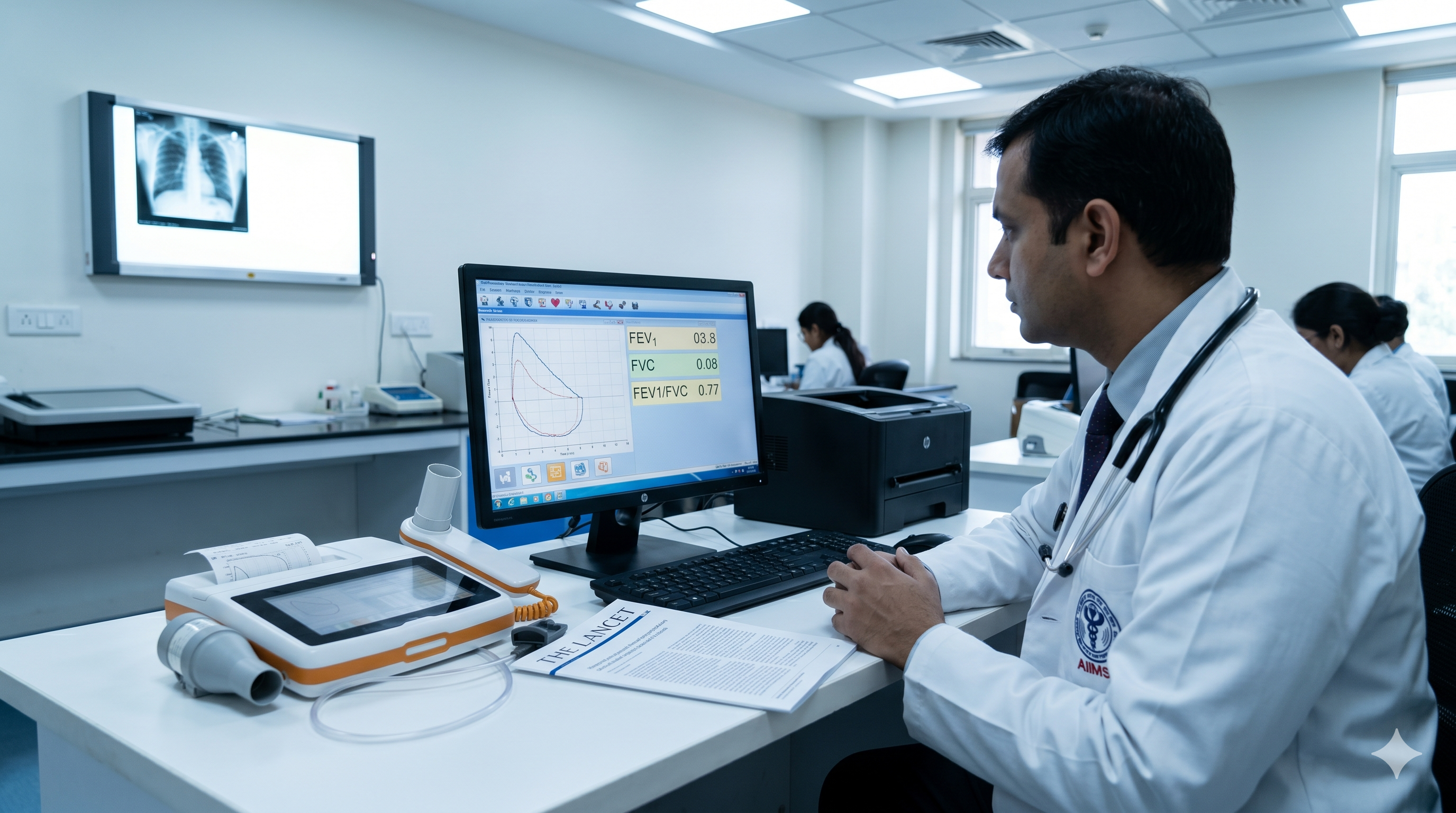
Air Pollution and Exposure Reduction: A Guide to the Evidence
Research on pollution reduction helps explain why cleaner air matters. Different study designs answer different questions; a change in a short-term biomarker is not the same as proof of a long-term clinical benefit from a particular household product.
This is a selected reading guide, not a systematic review or a claim that every cited study directly tested “tolerance”.
1. Public-health guidelines
The WHO 2021 global air-quality guidelines synthesise evidence to inform exposure reduction. They set pollutant-specific guideline levels with averaging periods.
They are not a certification for an air purifier, an individual diagnosis, or a CO₂ threshold for bedroom cognition. Read the PM2.5 interpretation guide before applying a value to a room measurement.
2. Children’s lung-function development
Gauderman and colleagues, NEJM 2015, examined improvements in ambient air quality alongside lung-function growth in Southern California children. Better air quality was associated with improved growth over the study periods.
This observational evidence is relevant to population air-quality improvement. It is not a trial of aqi0, and it does not predict the gain for a particular Indian child after a home installation.
3. A short-term filtration trial
Morishita and colleagues, JAMA Internal Medicine 2018, studied portable air filtration, personal particle exposure and blood pressure among older residents of a senior facility.
The trial offers evidence about its intervention and measured outcomes in that setting. It does not establish that a purifier replaces a blood-pressure medicine, that every user responds equally, or that the finding transfers unchanged to another product or duration.
Natural experiments: what happens when ambient pollution drops temporarily
When ambient PM2.5 or related pollutants drop because of a policy intervention or an event-driven traffic restriction, the populations exposed do not become “weaker” or “more vulnerable” during the clean-air window. They become measurably healthier — and the gains reverse when pollution returns. This is the single most direct test of the “tolerance” hypothesis available, and it has been run in four cities.
-
Atlanta 1996 Olympics — Friedman MS et al. JAMA 2001;285(7):897–905. PMID 11180733. During the 17-day Olympics, peak daily ozone fell 27.9%. Acute asthma care events in children dropped 41.6% in Medicaid claims, 44.1% in HMO records, 11.1% in pediatric ER visits, and 19.1% in state hospital discharges. The effect appeared and disappeared in lockstep with the traffic restrictions.
-
Beijing 2008 Olympics, cardiovascular biomarkers — Rich DQ et al. JAMA 2012;307(19):2068–2078. PMID 22665106. In 125 healthy young adults followed before, during, and after the Olympics, fibrinogen, von Willebrand factor, sCD62P and sCD40L improved during the clean-air window and reverted to pre-Olympic levels when pollution returned. Heart rate also tracked the air quality.
-
Beijing 2008 Olympics, pulmonary inflammation — Huang W et al. Am J Respir Crit Care Med 2012;186(11):1150–1159. PMID 22936356. In the same cohort, fractional exhaled nitric oxide, exhaled-breath nitrate/nitrite/8-isoprostane and urinary 8-OHdG fell by 4.5%–72.5% during the clean period; on return to dirty air, the same markers rose by 48%–360%.
-
Dublin 1990 coal ban — Clancy L et al. Lancet 2002;360(9341):1210–1214. PMID 12401247. After the ban, black smoke fell ~70% (a 35.6 µg/m³ drop). Over 72 months, adjusted non-trauma deaths fell 5.7%, respiratory deaths 15.5%, and cardiovascular deaths 10.3% — an estimated 359 fewer deaths per year.
-
Utah Valley steel mill closure — Pope CA III. Am J Public Health 1989;79(5):623–628. PMID 2495741. During the 13-month strike that closed the Geneva Steel mill (1986–87), children’s hospital admissions for bronchitis and asthma were 2–3× lower than in the operating winters. Admissions rose again when the mill reopened.
-
US county-level PM2.5 reductions — Pope CA III, Ezzati M, Dockery DW. N Engl J Med 2009;360(4):376–386. PMID 19164188. Across 211 US counties, each 10 µg/m³ reduction in PM2.5 between the 1980s and 2000s was associated with 0.61 ± 0.20 years of life-expectancy gain — explaining up to 15% of overall life-expectancy improvement during that window.
The pattern is consistent. The body does not “miss” the dirty air or become more vulnerable during the clean window. It recovers, and the recovery is real and measurable.
HEPA filter randomised controlled trials: what happens when indoor PM2.5 drops
When the intervention is reversed — instead of waiting for ambient air to clean up, install a HEPA filter inside a home — the effect appears on shorter timescales and has been measured in randomised crossover trials in at least four countries.
-
Allen RW et al. Am J Respir Crit Care Med 2011;183(9):1222–1230. PMID 21257787. A 7-day HEPA crossover trial in 45 healthy adults in a British Columbia woodsmoke-impacted community. Indoor PM2.5 dropped 60%; reactive hyperemia (endothelial function) improved 9.4% and C-reactive protein dropped 32.6%.
-
Bräuner EV et al. Am J Respir Crit Care Med 2008;177(4):419–425. PMID 17932377. A 48-hour HEPA trial in 21 elderly Danish couples (mean age 65–80). Indoor PM2.5 dropped 62% (12.6 to 4.6 µg/m³); microvascular function score improved 8.1% even at this low baseline.
-
Chen R et al. J Am Coll Cardiol 2015;65(21):2279–2287. PMID 26022815. A 48-hour double-blind HEPA crossover in 35 Shanghai college students at baseline PM2.5 of 96 µg/m³ — the closest available analogue to Delhi NCR annual average. Filtration cut PM2.5 57%. Effects: IL-1β −68.1%, MCP-1 −17.5%, myeloperoxidase −32.8%, sCD40L −64.9%, systolic BP −2.7%, diastolic BP −4.8%, exhaled NO −17.0%.
-
Karottki DG et al. Environ Health 2013;12:116. PMID 24373585. 48 nonsmoking Copenhagen adults (51–81 years). Indoor PM2.5 fell from ~8 to ~4 µg/m³ over 14 days. Microvascular function improved; monocyte CD11b/CD62L expression decreased.
-
Cui X et al. Environ Int 2018;114:27–36. PMID 29475121. A double-blind randomised crossover of 70 healthy Chinese adults using HEPA for a single overnight. PM2.5 dropped 72.4% (to 10 µg/m³). Airway impedance fell 7.1%, airway resistance 7.4%, von Willebrand Factor 26.9%. A single night of cleaner air measurably improved airway mechanics and reduced thrombosis risk.
-
Morishita M et al. JAMA Intern Med 2018;178(10):1350–1357. PMID 30208394. A 3-day HEPA trial in 40 nonsmoking older adults in a Detroit senior facility. Personal PM2.5 fell 53%; systolic blood pressure dropped 3–4 mmHg — a magnitude comparable to a single antihypertensive medication.
Independent randomised trials across four countries, different populations, different baselines, different outcomes — all of them showing the same direction. When indoor PM2.5 drops, inflammation drops, vascular function improves, blood pressure falls, and airway mechanics improve. The systematic review of crossover HEPA RCTs (Walzer D et al. Indoor Air 2020) confirmed a mean 56% PM2.5 reduction and ~2.5 mmHg systolic BP drop across studies. None of these are “training penalties”. All of them are clinical improvements.
Children’s lung development: the most decisive evidence
If the “the body needs exposure to develop properly” hypothesis were true at any age, it would be most visible in children — whose lungs are actively building alveoli and capacity through age 18. The hypothesis is decisively refuted by three studies in particular.
-
Gauderman WJ et al. N Engl J Med 2004;351(11):1057–1067. PMID 15356303. USC Children’s Health Study. 1,759 children tracked from age 10 to 18 across 12 Southern California communities. The proportion of 18-year-olds with clinically low FEV1 (<80% predicted) was 4.9× higher in the most polluted vs least polluted communities (7.9% vs 1.6%). Effects were strongest for PM2.5 and NO₂.
-
Gauderman WJ et al. N Engl J Med 2015;372(10):905–913. PMID 25738666. Three USC cohorts (1994–98, 1997–2001, 2007–11; n=2,120) followed as PM2.5 fell in Southern California. Each 12.6 µg/m³ drop in PM2.5 produced a 65.5 ml gain in 4-year FEV1 growth and a 126.9 ml gain in FVC growth. The share of 15-year-olds with clinically low FEV1 fell from 7.9% to 6.3% to 3.6% across the three successive cleaner-air cohorts. If pollution exposure built developmental tolerance, this trend would invert; it does not.
-
Avol EL et al. Am J Respir Crit Care Med 2001;164(11):2067–2072. Same USC cohort followed when families relocated. Children who moved to lower-pollution areas showed accelerated lung-function growth; children who moved to higher-pollution areas showed slowed growth. The same lungs, in the same bodies, responded to current exposure — not to a “trained” developmental history.
The children’s-cohort literature is the single most direct test of the developmental-exposure hypothesis, and it produces the opposite of what that hypothesis would predict.
Dose-response: no safe threshold
If a small “training dose” of PM2.5 were protective, the dose-response curve would be J-shaped (low PM2.5 = lower mortality than zero PM2.5). The dose-response curve is not J-shaped. It is essentially linear, with the steepest health gains in the lowest concentration range.
-
Dockery DW et al. N Engl J Med 1993;329(24):1753–1759. PMID 8179653. Harvard Six Cities study. 8,111 adults followed 14–16 years; mortality rose linearly with PM2.5 across cities ranging from 11 to 30 µg/m³. Rate ratio for most vs least polluted: 1.26 (95% CI 1.08–1.47).
-
Pope CA III et al. JAMA 2002;287(9):1132–1141. PMID 11879110. American Cancer Society CPS-II cohort (~500,000). Each 10 µg/m³ long-term PM2.5 increase associated with 4% higher all-cause, 6% higher cardiopulmonary, and 8% higher lung-cancer mortality.
-
Burnett RT et al. Environ Health Perspect 2014;122(4):397–403. PMID 24518036. The Integrated Exposure-Response function underlying the Global Burden of Disease. Risk increases continuously from 0 µg/m³ upward, with the steepest slope in the 0–35 µg/m³ range — meaning each µg/m³ avoided at low concentrations buys more health than each µg/m³ avoided at high concentrations.
-
WHO Global Air Quality Guidelines. WHO, 2021. Annual PM2.5 guideline tightened from 10 → 5 µg/m³; 24-hour from 25 → 15 µg/m³. The guideline states explicitly: “there is no level of exposure below which no health effects occur.”
The Indian context
-
Pandey A, Brauer M, Cropper ML et al. Lancet Planet Health 2021;5(1):e25–e38. PMID 33357500. GBD 2019 India analysis: 1.67 million deaths in India in 2019 attributable to air pollution (17.8% of all deaths); 0.98 million from ambient PM2.5 alone.
-
Krishna B et al. Lancet Planet Health 2024;8(7):e500–e509. Daily mortality and PM2.5 in ten Indian cities (2008–2019). 7.2% of daily deaths — approximately 33,000/year across just these ten cities — were attributable to PM2.5 above WHO guidelines. The list includes Mumbai, Bengaluru and Chennai — cities frequently considered “less polluted” — meaning the health burden is not confined to the Indo-Gangetic Plain.
-
Singh V et al. PMC11116984, 2024. Comparative study of 354 never-smoker youth aged 15–29 in Delhi NCR vs Pauri Garhwal. FEV1 was 17% lower in Delhi never-smokers than in matched rural peers. 22.6% had a restrictive pattern; 5.1% obstructive. The chronic Delhi exposure does not produce trained tolerance; it produces measurable lung-function loss.
-
Salvi S, Ghorpade D et al. Eur Respir J 2020;56(3):1902129. PMID 32366494. Normal spirometry reference values for Western Indian adults (n=1,258). Indian adults have systematically smaller lung volumes than European or American reference populations. Locally derived equations are required to avoid overdiagnosis of restrictive disease.
-
Bourgeois B et al. Environ Int 2023;181:108248. PMID 37857188. Mouse model of sub-chronic PM2.5 exposure. PM2.5-induced lung inflammation persisted for 12 weeks after exposure stopped. The Nrf2 antioxidant defence was activated but failed to restore redox homeostasis. The biological signature of PM2.5 injury outlasts the exposure — meaning intermittent dirty air keeps the inflammation primed, while sustained cleaner air actually lets it resolve.
-
Morrow PE. Fundam Appl Toxicol 1988;10(3):369–384. The foundational mechanistic study on lung particle overload. Above ~60 µm³ particle burden per alveolar macrophage, clearance kinetics slow; above ~600 µm³, clearance virtually ceases. The clearance machinery does not “train up” under load — it saturates.
The strongest contrary argument, treated honestly
The PM2.5-hormesis hypothesis (Cox LA. Dose-Response 2012;10(2):209–218) argues that the PM2.5 mortality dose-response may be J-shaped — i.e., very low PM2.5 might be slightly protective relative to zero. The paper exists and has been cited in industry-friendly commentary. Why it has not displaced the linear-no-threshold consensus:
- Has not been replicated. No independent research group has reproduced a J-shaped PM2.5 mortality curve at the individual cohort level.
- Contradicted by individual-level prospective cohort data. Harvard Six Cities reanalyses, the Medicare cohort, and the ACS-CPS II cohort all show essentially linear dose-responses with no protective minimum.
- Contradicted by controlled-exposure laboratory studies. Liu et al. Particle and Fibre Toxicology 2020 showed vascular and pulmonary harm in healthy adults at PM2.5 of 38 µg/m³ — within the alleged “protective” range.
- Contradicted by the WHO 2021 systematic review of over 500 papers, which concluded no detectable threshold exists.
- Contradicted by every Olympic and pollution-ban natural experiment — if hormesis were correct at the population level, mortality should rise when ambient PM2.5 falls below the alleged protective dose. The opposite happens every time the intervention has been studied.
Cox’s J-curve is consistent with one statistical model fit to one ecologic dataset. The mainstream peer-reviewed position is unambiguous in the opposite direction.
Summary citation list (numbered, with PMIDs where available)
- Friedman MS et al. JAMA 2001;285(7):897–905. PMID 11180733. [Atlanta 1996 Olympics, asthma]
- Rich DQ et al. JAMA 2012;307(19):2068–2078. PMID 22665106. [Beijing 2008, CV biomarkers]
- Huang W et al. Am J Respir Crit Care Med 2012;186(11):1150–1159. PMID 22936356. [Beijing 2008, pulmonary inflammation]
- Clancy L et al. Lancet 2002;360(9341):1210–1214. PMID 12401247. [Dublin coal ban]
- Pope CA III. Am J Public Health 1989;79(5):623–628. PMID 2495741. [Utah Valley steel mill]
- Pope CA III et al. N Engl J Med 2009;360(4):376–386. PMID 19164188. [US county-level PM2.5 and life expectancy]
- Allen RW et al. Am J Respir Crit Care Med 2011;183(9):1222–1230. PMID 21257787. [BC woodsmoke HEPA RCT]
- Bräuner EV et al. Am J Respir Crit Care Med 2008;177(4):419–425. PMID 17932377. [Danish elderly HEPA RCT]
- Chen R et al. J Am Coll Cardiol 2015;65(21):2279–2287. PMID 26022815. [Shanghai HEPA RCT]
- Karottki DG et al. Environ Health 2013;12:116. PMID 24373585. [Copenhagen elderly HEPA]
- Cui X et al. Environ Int 2018;114:27–36. PMID 29475121. [Single-overnight HEPA crossover]
- Morishita M et al. JAMA Intern Med 2018;178(10):1350–1357. PMID 30208394. [Detroit senior facility HEPA]
- Gauderman WJ et al. N Engl J Med 2004;351(11):1057–1067. PMID 15356303. [USC CHS lung development]
- Gauderman WJ et al. N Engl J Med 2015;372(10):905–913. PMID 25738666. [USC CHS lung development with cleanup]
- Avol EL et al. Am J Respir Crit Care Med 2001;164(11):2067–2072. [USC relocation study]
- Dockery DW et al. N Engl J Med 1993;329(24):1753–1759. PMID 8179653. [Harvard Six Cities]
- Pope CA III et al. JAMA 2002;287(9):1132–1141. PMID 11879110. [ACS CPS-II mortality]
- Burnett RT et al. Environ Health Perspect 2014;122(4):397–403. PMID 24518036. [IER dose-response]
- WHO Global Air Quality Guidelines 2021. World Health Organization, 2021. [WHO position]
- Pandey A et al. Lancet Planet Health 2021;5(1):e25–e38. PMID 33357500. [India GBD 2019]
- Krishna B et al. Lancet Planet Health 2024;8(7):e500–e509. [Ten Indian cities daily mortality]
- Singh V et al. PMC11116984, 2024. [Delhi vs Pauri Garhwal lung function]
- Salvi S et al. Eur Respir J 2020;56(3):1902129. PMID 32366494. [Western Indian spirometry reference]
- Bourgeois B et al. Environ Int 2023;181:108248. PMID 37857188. [Persistent PM2.5 lung inflammation, mouse model]
- Morrow PE. Fundam Appl Toxicol 1988;10(3):369–384. [Lung overload mechanism]
Questions to ask of any new claim
| Question | Why it matters |
|---|---|
| Who was studied? | Age, health and setting affect applicability |
| What exposure changed? | Outdoor pollution and a room intervention differ |
| What was measured? | Concentration, biomarker, symptoms and clinical events differ |
| How long was follow-up? | A brief trial cannot answer every long-term question |
| What uncertainty was reported? | A point estimate alone can overstate precision |
| Was this product tested? | General filtration evidence is not brand-specific validation |
Applying the evidence to a home
A sensible equipment decision starts with the environmental problem, a measurement plan and documented capabilities. Keep clinical questions with the care team. Do not extrapolate a trial percentage into a household promise of disease prevention or recovered life-years.
See common adaptation questions and room filtration versus fresh-air supply for practical context.