Whole-home air purifier in Gurugram and Delhi NCR
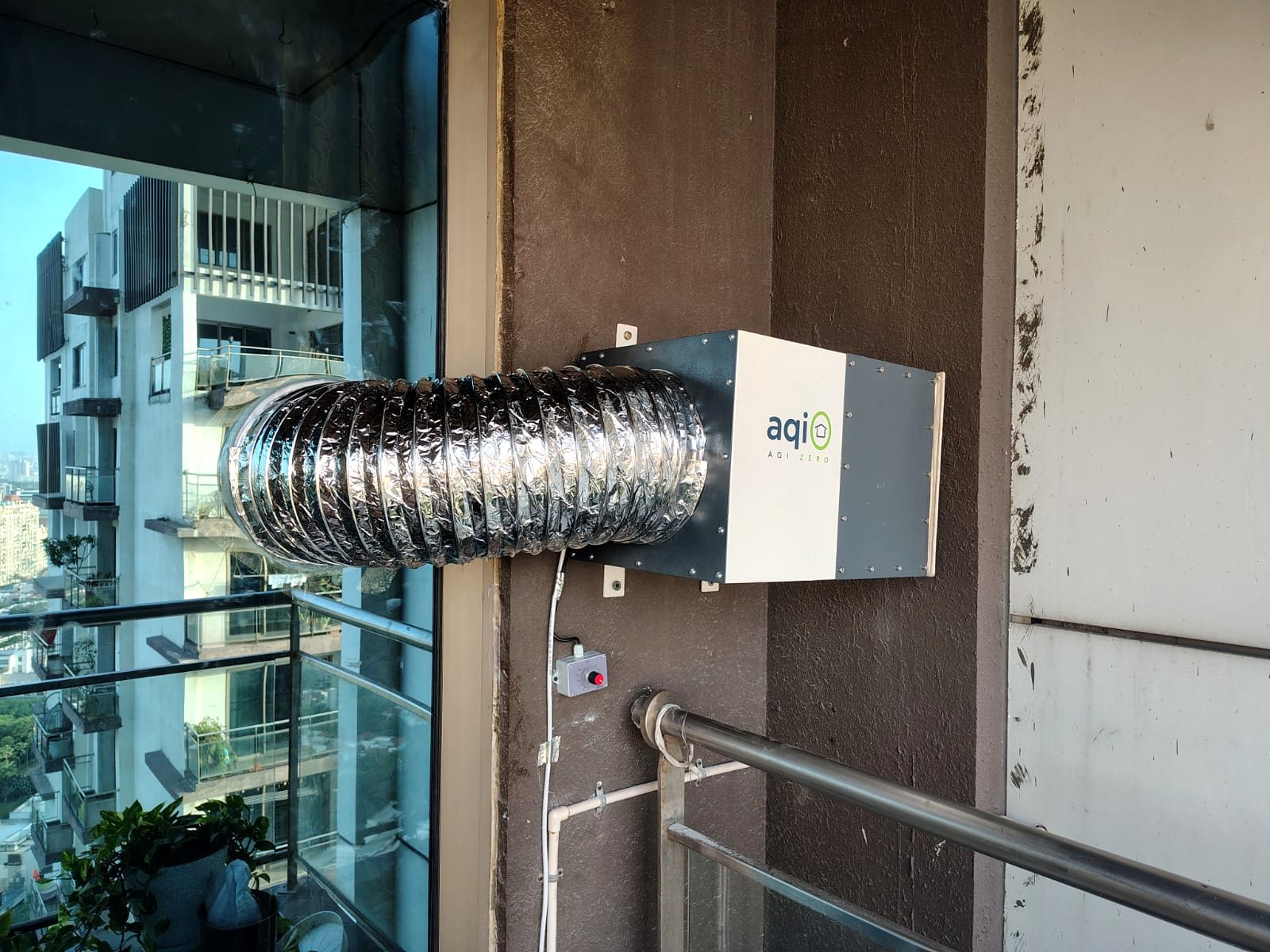
aqi0 filters outdoor air through H13 HEPA and supplies it to your home. One outdoor unit, an indoor diffuser and a layout assessed around the rooms you use. Technically, it is a positive-pressure fresh air system with its own intake and supply path.
₹82,600, fully installed. Annual care plan ₹14,750; optional AQI/PM2.5 monitor ₹4,000, sold separately.
Installation planning in Gurugram and Delhi NCR.
Start with what you already do for water
Indian households have been treating their drinking water for generations — boiled water, the ceramic candle filter at your grandmother’s house, an Aquaguard on the wall, a Pureit by the sink, an RO under the counter, an inline filter snapped onto the tap. Whatever the method, nobody in the family drinks straight from the tap. And nobody worries that having clean water at home will leave them unable to handle tap water elsewhere. The principle is simple: if something harms the body, less of it is better. You filter the input you control.
Air is the same input, two tiers behind. You drink about 2 litres of water a day. You breathe about 11,000 litres of air a day — and unlike water, you cannot choose to drink elsewhere.
The category called “air purifier” was built around the wrong unit for India: a single small room, sealed off from the rest of the house, recirculating air that is already inside. That works where homes are built tight and outdoor air is mostly clean, and indoor pollution comes from cooking or pets. None of those conditions describe an Indian home in October, or August, or April.
aqi0 is the same idea applied to the input you have not been filtering — one unit that draws outdoor air through H13 HEPA, holds the whole home slightly above outdoor pressure, and displaces stale indoor air through gaps and exhausts.
Fresh air for the whole home
Room purifiers filter air already indoors. aqi0 supplies filtered outdoor air, which serves a different purpose: replacing indoor air as well as filtering incoming particles. An ordinary HEPA room purifier does not supply outdoor air or remove CO₂.
The result depends on airflow reaching the occupied rooms and having suitable exit paths. We assess the floor plan, usual door positions, occupancy, nearby exhausts and maintenance access before installation. HVAC integration is not currently offered.
Will one unit cover your home?
One unit is specified for up to 2,000 sq ft carpet area. Above that or across more than one floor, we specify two units; we’ll confirm layout and sizing with you. Ceiling height, partitions and closed bedrooms matter alongside floor area.
The outdoor unit is approximately 14″ wide × 17″ high × 20″ deep. A standard installation needs a 10-inch opening, a nearby 6A power point and a suitable mounting position. Inside, the supply duct ends at a diffuser. The team explains the visible route and finish before work begins.
What is inside
| Component | aqi0 specification |
|---|---|
| Fan | EC fan, variable speed |
| Airflow | Approximately 500 m³/h effective; approximately 700 m³/h free-air rating |
| Filtration | Washable pre-filter and three H13 HEPA panels |
| Normal power draw | Approximately 30 W; varies with setting and conditions |
| Body | Outdoor-mounted sheet-metal enclosure; exposure and cover needs confirmed with you |
| Monitoring | Optional AQI/PM2.5 monitor; CO₂ needs a separate suitable instrument |
H13 classification refers to filtration at the most-penetrating particle size. It is not a guarantee of a particular room reading or removal of every gas. Read the filter-grade guide and technical note for details.
Compare the functions you need
| Question | Room particle purifier | aqi0 filtered fresh-air supply |
|---|---|---|
| What air is treated? | Air recirculated within its effective room coverage | Outdoor air supplied into the home |
| How is coverage assessed? | Clean-air delivery, room volume and use | Supply airflow, layout, room connections and exit paths |
| Does it address ventilation? | An ordinary recirculating unit does not add outdoor air | Adds outdoor air; occupancy and distribution still need assessment |
| What affects results? | Sizing, speed, leakage, indoor sources and filter condition | Sizing, speed, openings, indoor sources, distribution and filter condition |
An existing room purifier can remain useful. Neither approach eliminates the need to control cooking smoke or investigate other indoor sources. See the full comparison.
Performance you can check
The technical note sets out aqi0’s published PM2.5 and CO₂ commitment, operating conditions and remedy. Read those together rather than interpreting the brand name as a promise of a zero reading at all times.
At commissioning, record the room, time, monitor, equipment settings and conditions alongside readings. A measurement on installation day is not evidence of the same result every day of winter. Longer logs help assess performance during ordinary use.
Installation and running costs
| Item | Price |
|---|---|
| System, fully installed | ₹82,600 |
| Annual care plan | ₹14,750/year |
| aqi0 Dial — Wi-Fi remote control | ₹7,500 |
| Carbon filter — add-on, six-month life | ₹2,200 |
| Bundle — system, monitor and a care plan | ~~₹1,01,350~~ ₹99,999 |
| Bundle with two years of care | ~~₹1,16,100~~ ₹1,11,111 |
| Individual replacement H13 panel | ₹2,200 |
| Optional AQI/PM2.5 monitor | ₹4,000 |
Standard work includes the unit, bracket, duct, diffuser, wiring and agreed opening. Toughened glass requires a replacement pane from a specialist. Exposed positions may need an external cover; confirm this and any non-standard electrical work in the quote. See pricing, the installation scope, and what a whole-home air purifier costs in India for the full category price range.
At an assumed constant 30 W, 24-hour operation uses 21.6 kWh in 30 days, or ₹172.80 at ₹8/kWh. This is an illustration, not a fixed bill, and excludes any added cooling or heating load from bringing outdoor air indoors.
Care through the year
Clean the washable pre-filter every 7–10 days, following the care instructions. Let washed parts dry before refitting. Do not wash the H13 panels.
The care plan replaces one of the three panels on rotation, about every 45 days during October–February, with longer intervals based on pollution load through the rest of the year. It includes machine cleaning and fault visits. Current plan pricing and the published +75-day offer when purchased with the system are on the pricing page.
Questions before you book
Can bedroom doors stay closed?
We assess the air path into and out of each room. Door undercuts and other transfer paths matter; a fully sealed bedroom cannot be assumed to receive the same airflow as the living room.
Does it cool or dehumidify the home?
No. It brings outdoor air indoors, adding a temperature and moisture load that depends on the weather. Cooling, heating and moisture control need separate attention.
What about cooking and exhaust fans?
Use the kitchen chimney or exhaust to remove cooking emissions, with suitable replacement air. Do not disable necessary exhaust to preserve pressure. Read the cooking ventilation guide.
How long does installation take?
A single day, typically 4–6 hours.
What is the warranty?
The published technical note provides one year of no-questions fan replacement and three years for the speed controller/electronics, with no chassis warranty. Filters are consumables. Read the full terms before ordering.
Chat with us
Share your locality, carpet area, floor plan and a photo of the proposed external position. We assess the duct route, power point, room connections and access—no obligation.
Call +91 96676 72740 or WhatsApp aqi0.