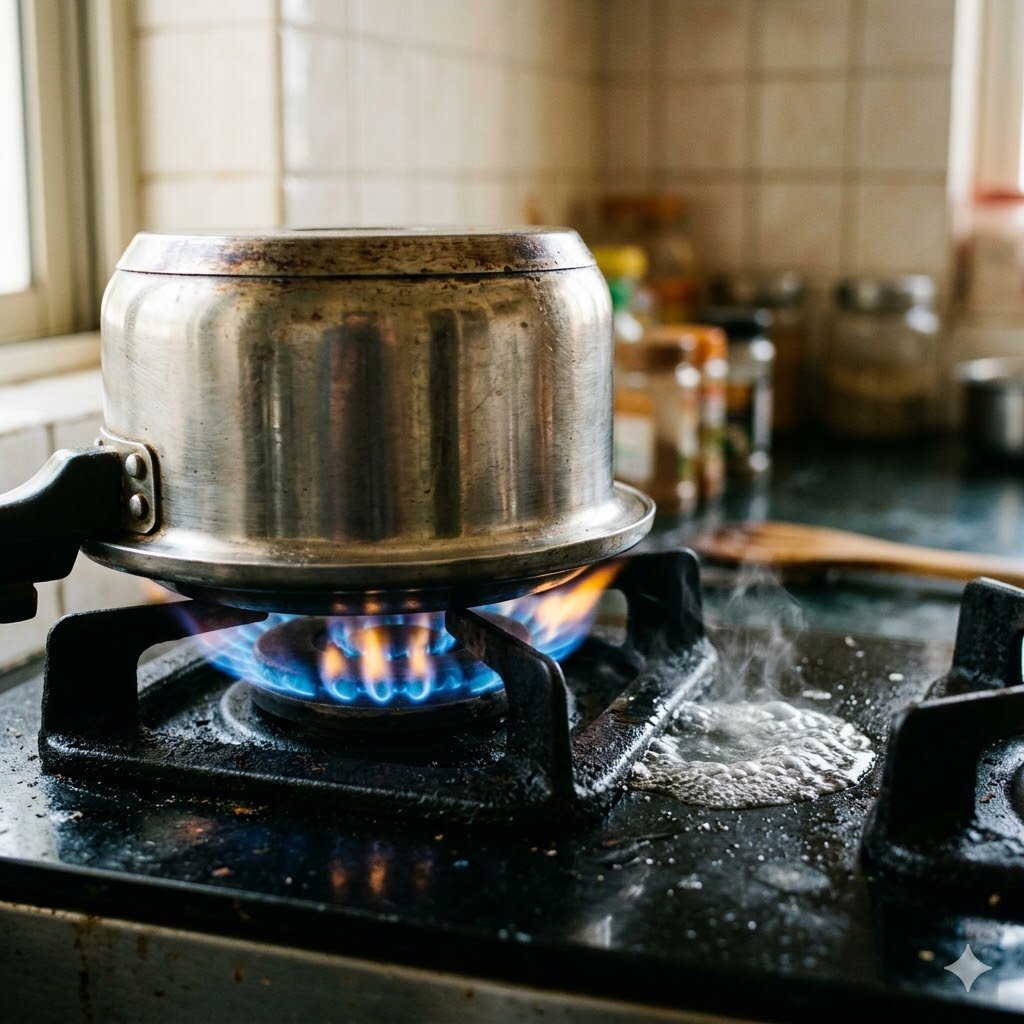
Indoor combustion in Indian homes — every flame is an indoor air problem

Every Indoor Flame Is an Indoor Air Problem: Tandoor, Sigri, Diya, Gas Burner

Combustion releases particulate matter, nitrogen oxides, carbon monoxide and volatile organic compounds. This is true of a 200-rupee gas burner running clean blue flame, a charcoal sigri keeping the family warm in December, a small clay diya during aarti, and the indoor tandoor at the dhaba downstairs. The emission rates vary enormously, but the principle does not. Every Indian household burns something most days. This page covers the full menu and what it does to indoor air.

Key numbers

The full Indian indoor-combustion menu

A non-exhaustive list of what gets burned indoors in Indian homes:

1. Gas burners (LPG, PNG). Cleanest combustion of the lot, but not zero. A blue-flame LPG burner produces NO₂ at 100–250 ppb at face height, plus CO at low levels. Yellow or orange flame (insufficient oxygen or wrong burner setting) increases CO and PM2.5 substantially.

2. Biomass cookstoves (chulha). Firewood, agricultural residue, dung cake. Used in 60% of rural Indian homes and a small fraction of urban poor households. PM2.5 in the kitchen during cooking commonly exceeds 1,000 µg/m³; over 25 years of daily exposure, this is one of the largest known indoor environmental health burdens in India. Women and children exposed disproportionately.

3. Kerosene stoves and lanterns. Used in some lower-income urban and rural homes still. Emits PM2.5, sulphur dioxide, and characteristic kerosene VOCs.

4. Charcoal / coal sigri (angeethi). Used for winter heating in some North Indian homes and small businesses. CO from a charcoal sigri in a closed room can kill — annual fatality incidents in Delhi NCR winter. Even at non-fatal levels, CO exposure is significant.

5. Tandoors and grills. Restaurant tandoors operate at very high temperatures with proper ventilation. Home tandoors (less common) produce significant indoor PM2.5 if used inside.

6. Indoor heaters (gas or kerosene). Catalytic kerosene heaters are still used in some homes. Emit NO₂, CO, formaldehyde and SO₂.

7. Diyas, lamps and ghee deepams. Small flame; small but real emission of PM2.5 and combustion products. Multiplied across festival evenings, contributes meaningfully.

8. Incense, agarbatti, dhoop, dhuni. Covered at length in candles, incense and agarbatti. PM2.5 above 1,500 µg/m³ during burning.

9. Mosquito coils. Equivalent to 75–135 cigarettes per coil for PM2.5 — see mosquito repellent and indoor air.

10. Candles. Paraffin and (less so) soy/beeswax. PM2.5, benzene, toluene.

11. Tobacco smoking indoors. A separate huge category. Cumulative PM2.5 and VOC contribution is well-known.

The pollutants and what they do

Every combustion source produces some subset of:

PM2.5 and ultrafine particles — penetrate deep into the lung and bloodstream. Documented cardiovascular, respiratory, dementia, fertility and cancer effects (see what PM2.5 does to your body).

NO₂ (nitrogen dioxide) — respiratory irritant. Linked to childhood asthma development and adult exacerbation. WHO 1-hour guideline: 200 µg/m³.

CO (carbon monoxide) — binds haemoglobin in place of oxygen. At high concentrations (charcoal sigri in closed room), acutely fatal. At low chronic concentrations, contributes to cardiovascular stress.

Formaldehyde — IARC Group 1 carcinogen. Released by smouldering biomass and incense.

Polycyclic aromatic hydrocarbons (PAHs) — benzo[a]pyrene and similar; carcinogenic. Released by all incomplete combustion.

SO₂ (sulphur dioxide) — respiratory irritant; from coal and some kerosene combustion.

Black carbon (soot) — strong absorber of solar radiation; contributes to climate forcing as well as health effects.

What the data shows about indoor combustion in India

Three large datasets:

1. National Family Health Survey (NFHS-5). Cooking fuel data: 60% of rural Indian households use biomass; 32% of urban households use biomass at least partially. The Pradhan Mantri Ujjwala Yojana (PMUY) has reduced this but coverage is incomplete.

2. Global Burden of Disease (GBD) Indian state-level estimates. Household air pollution (indoor cookfire smoke) is among the top five contributors to disease burden in many Indian states, particularly affecting women and children.

3. ICMR COPD prevalence studies. COPD prevalence in Indian women using biomass for cooking is 14–18% in women over 35 years old — far higher than would be expected from smoking alone (which is much rarer in Indian women).

The data is clear: indoor combustion is one of the largest environmental health burdens in India.

What you can change in a typical urban Indian home

For most aqi0 customers (urban middle-class, LPG/PNG kitchen, no biomass cookstove), the relevant indoor combustion sources are:

Daily, high-impact: - LPG/PNG burner during cooking — use kitchen exhaust aggressively, keep kitchen door closed - Mosquito coils overnight — switch to physical barriers (mesh, nets) plus topical repellent

Daily or near-daily: - Agarbatti / dhoop during puja — time-limit, single-stick, ventilate during and after - Candles for ambience — minimise paraffin candles in bedrooms; prefer LED alternatives

Seasonal: - Diwali / festival burning — outdoor or balcony where possible - Winter charcoal sigri — never use indoors with closed doors; CO fatalities are recurrent every winter - Winter coal/wood heating — switch to electric or gas heating with proper exhaust

Special cases: - Tobacco smoking — outdoors only, never indoors with children present - Dhuni / large religious offerings — outdoor or in a designated ventilated space

The exhaust-and-supply protocol

For any indoor combustion source you can’t eliminate:

1. Ventilate during use. Kitchen exhaust, bathroom exhaust, open window (when AQI allows).

2. Contain the source. Closed kitchen door for cooking, designated puja room with closing door for ritual burning.

3. Ventilate after use. Continue exhaust for 10–30 minutes after the source is extinguished.

4. Don’t add CO sources to closed rooms. Especially charcoal sigri, kerosene heaters and unflued gas heaters. CO is undetectable to humans and lethal.

How a positive-pressure fresh-air system fits in

A fresh-air system delivers continuous filtered outdoor air into the home. For indoor combustion management:

The system doesn’t eliminate combustion sources. It manages the air quality of the rest of the home so that combustion pollutants don’t accumulate beyond their immediate use zone.

FAQ

Is induction cooking really cleaner? Yes. Eliminates NO₂ and CO entirely; reduces PM2.5 from oil aerosols somewhat (because no flame-related airflow). For homes prioritising indoor air quality, induction is a meaningful upgrade.

What about LPG vs PNG? Same combustion products at similar mass per unit cooking. PNG (piped natural gas) is marginally cleaner per unit energy but the indoor emission difference is small.

Should I never burn anything indoors? “Never” is unrealistic and disrespectful to cultural and religious practice. “Minimise, contain, ventilate” is the achievable framework.

Can a chimney work in a non-kitchen room? Yes. Puja rooms benefit from a small ducted exhaust similar to a bathroom exhaust. Few homes have this; it’s a sensible upgrade for households with daily ritual burning.

Is charcoal sigri actually dangerous? Yes. Indian newspapers report multiple winter CO-poisoning fatalities every year from charcoal sigri used in closed rooms. Never use any charcoal or coal combustion source in a closed indoor space.