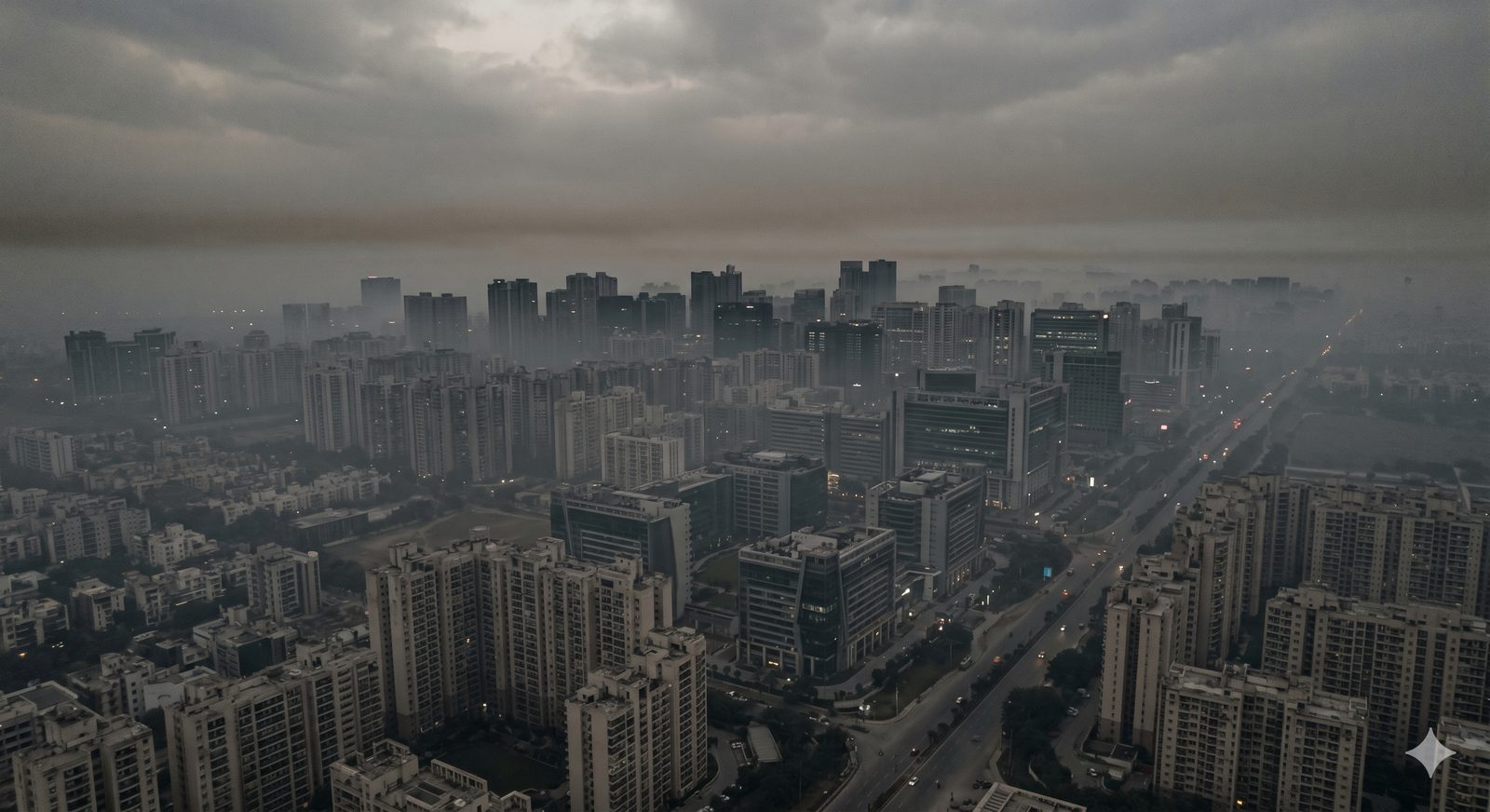
Gurugram skyline under winter smog — the outdoor concentration that defeats indoor purifiers

Why Your Air Purifier Can’t Handle Delhi Winters

If you own a premium air purifier in Delhi NCR and its air-quality indicator has stayed red or purple from October to February, the machine is not broken. The math is. A single recirculating filter cannot win a mass-balance fight against the volume of outdoor PM2.5 that leaks into an Indian home once outdoor AQI crosses 250. This is a category limitation, not a brand failure. Below: the equation, the independent Delhi field data, and why a fresh air system solves a problem a purifier cannot.

Watch · 8-min version the same argument as below, narrated — the mass-balance math that ends the premium-purifier debate.

The visceral problem

Every winter in Gurugram, South Delhi, and Noida, an identical scene plays out in tens of thousands of homes. Someone has spent ₹40,000-₹70,000 on a premium air purifier — Dyson, Sharp, Mi, Honeywell, Philips, Coway, or similar. The machine runs 24/7 through November, December, January. The air-quality indicator on the front never goes green. It oscillates between orange, red and purple for four months, depending on the day’s outdoor AQI.

The most common reaction is to assume something is wrong. The sensor needs cleaning. The filter is old. The purifier is wrongly sized for the room. Customer-support forums are full of these threads. The fix-it-yourself articles run into the thousands.

In almost every case, the machine is operating correctly. The indicator is reporting the true indoor PM2.5 — which is genuinely high. The problem is not the device. It’s mass balance.


How a purifier actually works (and why this matters)

An air purifier is a fan plus a filter in a box. It pulls air from the room it’s in, pushes that air through a HEPA filter, and blows it back out. Repeat continuously. The metric that describes how much clean air it produces per hour is CADR — Clean Air Delivery Rate, measured in m³/h. A bedroom-grade premium unit typically publishes CADR in the 150-300 m³/h range.

That number sounds large. The bedroom volume it has to clean is small — a typical Indian 12×12 ft bedroom is about 42 m³. So the purifier processes the entire room’s air several times per hour. On its own terms, the engineering is sound.

The problem is that the room is not a sealed box. Outdoor air leaks in continuously through window frames, door gaps, AC wall sleeves, electrical conduits, bathroom exhausts. The purifier is not just cleaning room air — it is cleaning room air plus a steady stream of new outdoor PM2.5 arriving through every gap, all day, every day.

The steady-state indoor PM2.5 (the level the room settles at after the purifier has been running for a while) follows a simple ratio:

C_indoor / C_outdoor = infiltration_rate / (infiltration_rate + CADR)

When CADR is large compared to infiltration, the ratio is small — the purifier wins. When CADR and infiltration are similar, the ratio is large — the purifier loses ground. The harder the outdoor air, the more it loses.


Indian homes leak outdoor PM2.5 three times faster than US homes

This is the data point most premium-purifier marketing skips.

Peer-reviewed field studies that placed monitors inside and outside Indian urban homes measured an average PM2.5 infiltration factor of 0.71 (± 0.19). In plain English: ~71% of outdoor PM2.5 ends up inside a typical Indian home even with windows shut. The equivalent figure for typical US homes is 0.26 — only 26% gets in.

The reason is construction. Indian apartments are built with single-pane windows, aluminium frames with gaps, AC sleeves cut through walls with foam packing, doors with daylight visible underneath, and electrical conduits without sealing. None of this is a failure of construction by Indian standards — these buildings perform perfectly well at their intended job. They are simply not airtight. And outdoor PM2.5 at 250-400 µg/m³ exploits every gap.

The implication is that the infiltration_rate term in the equation above is much larger than most purifier marketing assumes. A purifier engineered for a tightly-sealed European or American home has a fundamentally easier mass-balance problem than the same purifier in a Gurugram apartment.


What an independent Delhi field test actually measured

In 2020 an independent air-quality lab, Smart Air, ran a 9-day measurement of a premium purifier in a 500 sq ft office in central New Delhi. They used the Dyson Pure Cool TP04 — a unit with a published CADR of 164 m³/h, one of the most-marketed premium models in the Indian market.

The results, averaged across 9 days:

This is not a poor test of a bad purifier. It is a fair test of a competently-engineered premium unit against the reality of Delhi outdoor air leaking into a real building. The 49% reduction is what mass balance allows.

Dyson’s own 2020 in-house field study reached the same conclusion in different language. Their personal-exposure measurement during peak Delhi pollution season recorded indoor PM2.5 rising 459% vs the off-season baseline, and concluded that indoor levels stayed elevated regardless of which room or activity was monitored. Dyson — the brand most associated with premium indoor air in India — admitted in writing that during Delhi winter, indoor air stays bad. This was the most honest disclosure any premium brand has made.

The limitation is the category. Any room purifier — premium or budget, Dyson or Sharp or Mi — fights the same equation. The 49% number is roughly what the category delivers in a Delhi-winter home.


The scenario table

Apply a representative premium CADR (164 m³/h) to a typical 3 BHK in Gurugram across the realistic range of outdoor PM2.5:

Outdoor PM2.5 Bedroom with one purifier (door closed, 12×12 ft) Living room with one purifier (~100 m³, doors used) Other rooms (no purifier)
80 µg/m³ (AQI ~165, “moderate”) ~16 µg/m³ (yellow) ~38 µg/m³ (orange) ~57 µg/m³
250 µg/m³ (AQI ~300, common Nov-Jan) ~51 µg/m³ (red) ~119 µg/m³ (purple) ~178 µg/m³
400 µg/m³ (AQI ~500, severe smog days) ~82 µg/m³ (red) ~191 µg/m³ (purple) ~284 µg/m³

A few honest qualifications about this table:

The takeaway is the column headers. On a moderate day (outdoor 80), one bedroom purifier delivers near-safe air for one room. On a typical Delhi winter day (outdoor 250-400), the same purifier delivers air that is still well above the WHO limit, even in the room it sits in, and the rest of the home is functionally unprotected.


“What if I…” — the four follow-up questions

“What if I run two purifiers in the same room?”

It helps. Two premium units double the effective CADR — from ~164 m³/h to ~328 m³/h in a typical 42 m³ bedroom. The C_indoor / C_outdoor ratio drops from 0.21 to 0.12. At outdoor 250, indoor goes from ~51 µg/m³ to ~29 µg/m³ — better, still red, still above the WHO limit. At outdoor 400, indoor goes from ~82 to ~47. Two purifiers in a closed bedroom cannot get you to safe.

Two purifiers cost ₹80,000-₹1.4 lakh. Per room. With doors closed. For one room.

“What if I seal the windows and doors better?”

Reducing infiltration is real engineering. Better seals do lower the infiltration_rate term. But two problems follow.

First, residential sealing in India is rarely tight enough to change the mass balance meaningfully. Doors and windows in Indian apartments are not designed to seal like passive-house joinery. Aftermarket gasketing helps maybe 20%, not 70%.

Second — and decisively — a tightly-sealed room with people in it becomes a CO₂ problem. Two adults sleeping in a sealed bedroom with the door shut accumulate 1,200-2,500 ppm of CO₂ by morning (WHO guideline: under 1,000). Sustained exposure above 1,000 ppm reduces cognitive scores by 15-50% the next day. Sealing without ventilation trades PM2.5 for impaired sleep. The household has not gained.

Full CO₂ argument →

“What if I open windows briefly to ventilate the CO₂?”

Bad trade in Delhi NCR. Outdoor PM2.5 at 250 µg/m³ entering through an open window for 10 minutes deposits enough particulate to dominate the room for the next hour. The purifier then spends that hour clawing it back. You have ventilated CO₂ at the price of a particulate spike. Net effect on the family: worse air, not better.

“What if I buy a more expensive purifier?”

Premium pricing in this category buys design, smart sensors, app integration, and quieter operation. It does not buy a fundamentally different mass-balance equation. A ₹70,000 purifier and a ₹20,000 purifier with the same CADR sit at the same indoor PM2.5 steady state at the same outdoor concentration. Price scales the experience. It does not scale the physics.


How a fresh air system inverts the equation

A positive-pressure fresh air system handles the problem differently. Instead of recirculating room air through a filter, it draws ~700 m³/h of outdoor air through an H13 HEPA filter (99.95% efficient at 0.3 µm) and pushes the clean filtered air into the home. Two things change in the equation above:

  1. The home is pressurised at 10-25 Pa above outdoor. Air leaks outward through gaps, not inward. The infiltration_rate term collapses to zero. Unfiltered outdoor air can no longer get in.
  2. Every cubic metre entering the home has been through a clinical-grade HEPA filter. What enters is already clean. There is no recirculation problem because there is no dirty air being recirculated.

Mathematically, the equation stops being a battle. Steady-state indoor PM2.5 is determined by the filter efficiency, not by the outdoor concentration. The harder the outdoor air, the more value the system delivers — the opposite of how a recirculating purifier scales.

Field measurements across aqi0 installs in Gurugram, South Delhi, and Noida show indoor PM2.5 holding under 15 µg/m³ during outdoor episodes of 250-500 µg/m³. The system delivers the WHO guideline across the entire home, not one closed room.

The same architecture solves the CO₂ problem — continuous outdoor-air intake displaces accumulated CO₂, holding indoor levels under 1,000 ppm overnight. One install. Whole home. PM2.5 and CO₂ both controlled.

How positive-pressure ventilation works → · Product specs and pricing →


When a purifier IS the right tool

We are not anti-purifier. A purifier is a legitimate purchase when:

Outside those cases, a purifier in Delhi NCR is an interim tool that solves part of the problem in one room. The math does not let it do more.


The summary, in three lines

  1. Indian homes leak outdoor PM2.5 inside at ~71% of the outdoor concentration.
  2. Above outdoor PM2.5 ~250 µg/m³, no single room purifier — premium or otherwise — can hold indoor PM2.5 below the WHO 15 µg/m³ limit. Independent Delhi testing measured 49% average reduction in a real Delhi office.
  3. Positive-pressure fresh air systems solve the same problem by inverting the mass balance — air leaks out, not in, and every cubic metre entering is HEPA-filtered.

Book a free site survey

We measure your home’s current PM2.5 and CO₂, show you where a fresh air system would go, and give you a quote. No obligation.

+91 9667672740  •  WhatsApp