Good questions — about the aqi0 whole-home air purifier
Straight answers to what families ask us most. aqi0 is a whole-home air purifier — technically, a positive-pressure fresh air system. We assess the home before specifying the installation.
No questions match — try a different word, or ask us on WhatsApp ›
Or browse all sections: How it works · Installation · Filters & AMC · Cost · Comparisons · Specific homes · Warranty & support
How it works
What is a fresh air system?
aqi0 supplies H13 HEPA-filtered outdoor air through a standalone installation. Outdoor-air supply and particle filtration serve different functions. The assessment checks the air path through occupied rooms and the routes for air to leave.
How does positive-pressure ventilation work?
Supplying air can create a small pressure difference that encourages outward flow through available paths. The actual pressure and leakage depend on wind, openings and exhaust operation. It does not eliminate all unfiltered entry under every condition. See the positive-pressure guide.
Do windows really stay closed?
External windows and doors being shut is part of the published performance design condition. Normal door use can cause temporary changes. Keep necessary exhaust and safety ventilation functional; the installation must provide an appropriate airflow path.
How much air does it move?
The specification is approximately 500 m³/h effective airflow, compared with approximately 700 m³/h free-air rating. Actual airflow depends on settings, filters and the installation. An air-change calculation describes nominal flow divided by volume, not complete replacement of every pocket of air.
What does aqi0 use — EC fan or AC fan?
A variable-speed EC fan with approximately 30 W normal draw. The published rated life is 40,000 hours; rated life is not the warranty period or a prediction of the date a fan will fail.
What grade of HEPA does aqi0 use?
H13 HEPA on Japanese media. H13 classification is based on efficiency at the most-penetrating particle size; it is not a hard 0.3-micron cutoff. Read the HEPA classification guide.
How is this different from an ERV or HRV?
ERV/HRV systems recover energy through an exchanger and normally use both supply and extract paths. aqi0 is a standalone supply system without that recovery function. Suitability depends on climate, building and ventilation needs; see the system comparison.
How loud is the aqi0 fresh air system?
The fan sits outdoors. Perceived sound depends on speed, mounting, duct route and the room. We do not publish a measured dB curve. Discuss noise-sensitive bedrooms and the proposed operating setting during the assessment.
Installation
How long does installation take?
A single day, typically 4–6 hours.
What does installation include?
The unit, bracket, duct, diffuser, standard wiring, labour and agreed wall, ordinary-glass or ply opening. Toughened-glass replacement and an external cover where needed are separate considerations. Confirm any non-standard electrical work in the quote. See the technical note.
Can the system be installed in a rented apartment?
Subject to landlord and building permissions and a suitable installation position. Ask about the opening, external bracket, later removal and restoration responsibilities before approving work.
Where in my home does the unit go?
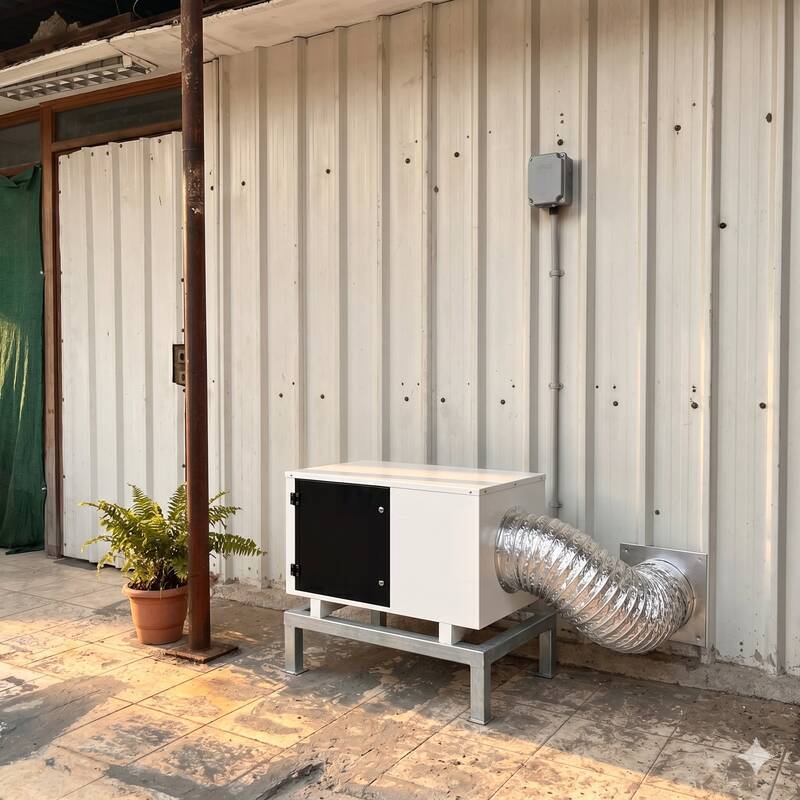
The unit sits outdoors with a supply duct entering the home. Choose the intake away from kitchen, bathroom, generator and parking exhausts. Placement depends on access, weather exposure, room connections and the agreed visible finish.
What about cooking smoke?
Use the chimney or appropriate exhaust with suitable replacement air. Do not assume positive pressure removes cooking emissions before occupants breathe them. Door position should follow the airflow plan, not a universal instruction to seal the kitchen.
What do you need to know about my home before installation?
We’ll confirm layout and sizing with you: the duct route, power point and room-to-room airflow, including closed-bedroom paths. There is no obligation.
My home has glass walls — can you still install?
The glass type and available opening need assessment. Toughened glass cannot be cut after tempering; a specialist replacement pane with the opening is required, or a suitable alternative route is agreed.
Does the install work on upper floors?
Floor height alone does not decide suitability or intake air quality. Safe exterior access, mounting, nearby exhausts and building approvals must be checked.
Filters & AMC
Does the system have multiple layers of filtration?
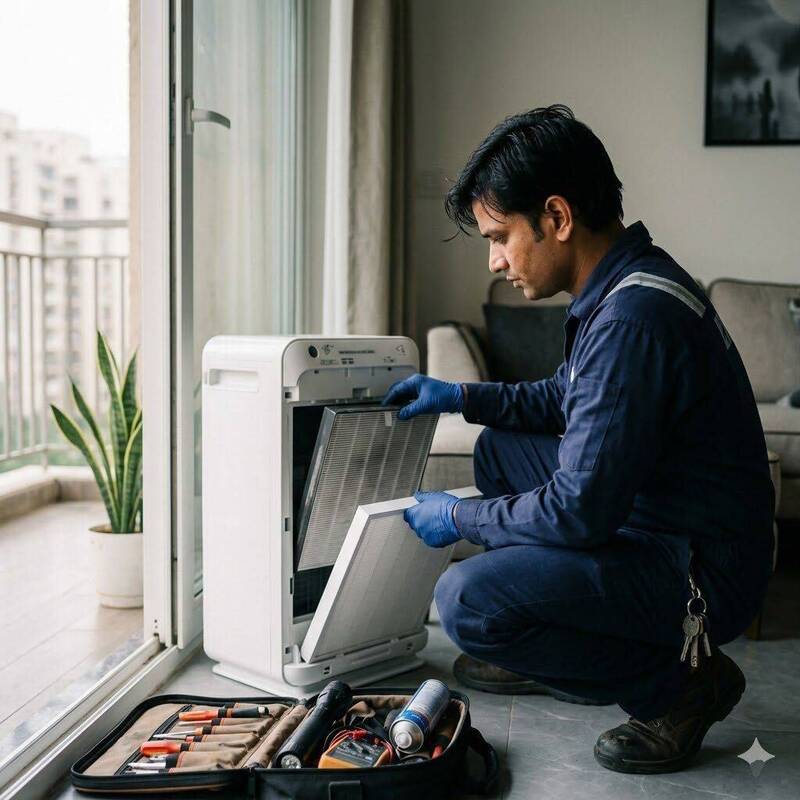
Yes: a washable pre-filter and three H13 HEPA panels. The pre-filter catches coarse debris. Clean it every 7–10 days according to the care instructions and allow washed parts to dry before refitting. Do not wash the H13 panels.
Does the system remove gases, VOCs and odours?
HEPA filtration addresses particles, not every gas. Outdoor-air supply can dilute indoor-generated gases when the supply air is suitable and airflow is sufficient. Persistent odours need source investigation. The standard specification should not be treated as a promise of VOC removal or dehumidification.
How often do filters need changing?
One of the three H13 panels is replaced on rotation, about every 45 days through October–February. Intervals during the rest of the year depend on pollution load and use. See the filter-care guide.
What’s in the AMC?
The published annual care plan is ₹14,750 and includes filter replacement, machine cleaning and fault visits. Each scheduled replacement changes one panel on rotation. The published offer adds 75 days when the plan is signed with the system; pricing gives the options.
What happens if I miss an AMC filter change?
Loaded filters can restrict airflow and affect performance. Arrange the due service and review the readings and airflow. Do not assume a fixed grace period or wait for a particular symptom.
Can I buy filters separately?
Yes. Individual replacement panels are ₹2,200. The care plan includes the scheduled panels; without it, replacement and any service needs are arranged separately.
When is the first filter change, and what does it cost?
The first replacement depends on pollution load and use. It is covered by an active care plan or chargeable otherwise. There is no first-filter-change-free offer.
What size are the aqi0 HEPA filters?
The specified panel dimensions are 362 × 276 × 50 mm. Each unit has three panels. Match the specified grade, sealing, airflow resistance and installation requirements as well as dimensions.
Can I use an off-the-shelf HEPA filter in my aqi0 system instead?
Physically, yes — and that is deliberate. 362 × 276 × 50 mm is a standard, widely available panel size, not a proprietary cartridge. You are not locked into buying filters only from us, and you are not exposed to a format only one supplier can make. Many systems in this category use an odd size that binds you to the maker for the life of the machine; we chose the opposite on purpose.
The honest caveat: matching the outside dimensions does not by itself establish the grade, the sealing or the airflow resistance. Check those, or confirm a replacement with us before fitting it — not because you need our permission, but because a poorly sealed panel undoes the filtration you paid for. Ours are ₹2,200 per panel if you would rather we supplied them.
Cost
How much does a fresh air system cost?
One aqi0 system is ₹82,600, fully installed. Annual care plan ₹14,750; optional AQI/PM2.5 monitor ₹4,000. Confirm your installation scope and any non-standard work before ordering.
What’s the electricity cost to run this 24/7?
At an assumed constant 30 W, a 30-day month uses 21.6 kWh. At ₹8/kWh that is ₹172.80. Actual draw, tariff and month length vary. This excludes any added cooling or heating load.
What’s the 5-year total cost of ownership?
Using unchanged current prices and five annual care plans gives ₹82,600 + ₹73,750 = ₹1,56,350 before electricity. At a constant 30 W and ₹8/kWh, five 365-day years add ₹10,512: an illustrative total of ₹1,66,862. This excludes optional equipment, site-specific work, cooling/heating load and repairs outside warranty; future prices may change.
Do you offer payment plans?
Ask the team for the payment options available for your order. Any instalment eligibility, charges and terms must be confirmed by the payment provider before you choose.
Are there site-specific costs?
Toughened-glass replacement, an external cover where required and non-standard electrical work need to be identified before ordering. The care plan and monitor are separate. Read pricing with the technical note.
Comparisons
Fresh air system vs air purifier — which is better?
A room purifier recirculates and filters indoor air; aqi0 supplies filtered outdoor air. Choose around the particle and ventilation problems, room layout and measurements. Neither removes the need for source control and maintenance. See the comparison.
How should I compare whole-home systems?
Ask for effective airflow through filters, coverage assumptions, filtration grade, installation scope, care costs, warranty and written performance conditions. Compare current written quotes for the same property rather than assuming every alternative costs more or requires an AMC.
Ours, so you have something to compare against: ₹82,600 fully installed, all taxes included, one system for a whole home up to 2,000 sq ft carpet; an EC fan at ~500 m³/h effective in service (~700 m³/h rated, free air); H13 HEPA on Japanese media in three 362 × 276 × 50 mm panels; the opening, ducting, diffuser, wiring and bracket included; an optional care plan at ₹14,750 a year; and ₹2,200 per panel if you change them yourself.
Other brands in the same whole-home category typically sit at ₹1.5–2 lakh installed. The full category price ladder sets out what drives the difference and what to put to a dearer quote.
Are all HEPA labels equivalent?
No. Check the classification and supporting test documentation, not just the marketing term. aqi0 specifies H13. A filter grade does not certify every room result or establish removal of gases.
Specific home situations
What size home does one unit cover?
Up to 2,000 sq ft carpet area. Above that or across multiple floors, we specify two units; we’ll confirm sizing and room connections with you. For busy commercial spaces, occupancy and use require a separate assessment.
Can bedroom doors stay closed?
The airflow route into and out of the room must remain suitable. Door undercuts and transfer paths matter; a full threshold seal may obstruct distribution. Tell us the usual door positions when we confirm the layout.
Does it work with AC running?
The equipment has a separate function. aqi0 supplies outdoor air; your cooling equipment handles temperature and some moisture. Outdoor-air supply adds load, so settings and thermal comfort need assessment. HVAC integration is not offered.
What about during monsoon?
Rain can remove PM2.5 as well as larger particles, but local readings still vary. Check indoor particles and humidity. A particle filter does not dehumidify the home or guarantee prevention of mould.
What if there’s a power cut?
The supply fan stops unless supported by suitable backup power. Check inverter capacity, compatibility and desired runtime; consumption depends on operating conditions. Review operation and readings when power returns.
Can I use it in a shop, studio, or workshop?
Commercial use needs an assessment of occupancy, sources and exhaust. Industrial dust, fumes or specialist healthcare requirements may need other engineering. A residential floor-area rating is not a commercial design standard.
Warranty & support
What’s the warranty?
The published terms provide one year of no-questions fan replacement and three years for the speed controller/electronics. The sheet-metal chassis has no warranty; filters are consumables. Read the technical note for the complete terms and performance remedy.
What’s the fan’s design life beyond warranty?
The published rated life is 40,000 hours—about 4.5 years at continuous operation. This is not a promise of actual service life or an extension of warranty.
How do I contact support?
Call or WhatsApp +91 96676 72740, or email [email protected]. Include the installation reference and a description of the issue.
Do you service outside NCR?
Contact the team with the location to confirm installation and ongoing service availability before ordering. This page does not promise coverage or an expansion date for other cities.
What if I move homes?
The team can arrange removal and reinstallation. You arrange restoration of the old opening; a civil charge applies for the new opening. Ask for the shifting scope and quote before booking, as set out in the technical note.
Chat with us
We assess the duct route, power point and airflow through your home. No obligation.