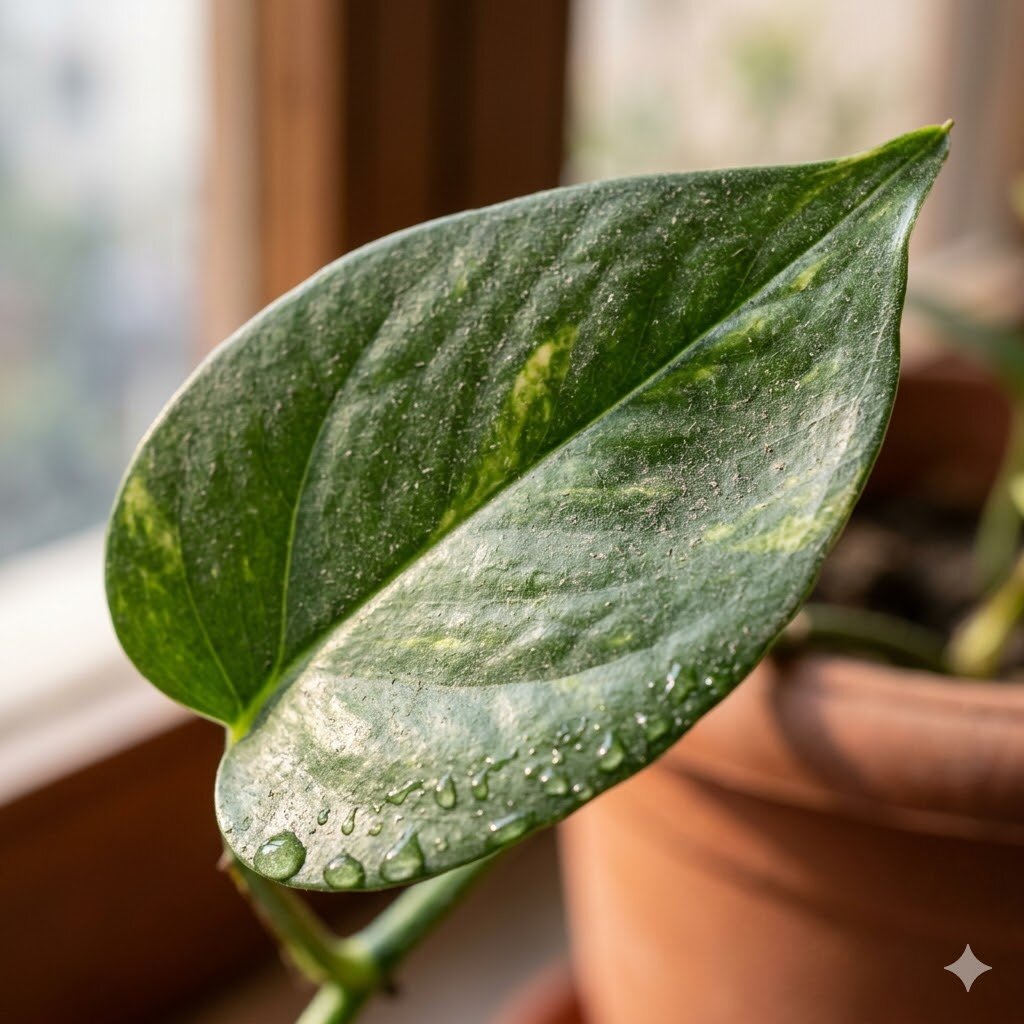
Money plant leaf with PM2.5 dust deposits — why plants don't clean indoor air

Why Money Plants Stop ‘Breathing’ in Delhi Winter (and What the NASA Study Really Said)

The internet’s most-cited indoor air-quality recommendation — “put houseplants in your home” — is built on a single 1989 NASA study that’s been misread for thirty-five years. The original work measured volatile-organic-compound (VOC) reduction in sealed lab chambers with one plant per 0.1 m³ of space — equivalent to about 600 plants for a typical living room. At realistic plant density, the air-quality benefit is essentially zero. There’s a separate, real, smaller story about why plants visibly struggle in Delhi winter — their stomata (leaf pores) clog with PM2.5, reducing photosynthesis. This page covers the misread science, the small real story, and what plants actually do for indoor air.

Key numbers

What the NASA Clean Air Study actually was

Published in 1989 by NASA and the Associated Landscape Contractors of America. Designed to investigate plant-based air purification for sealed environments such as future space stations — explicitly not for ordinary homes.

The methodology:

  1. A single plant placed in a small sealed chamber (typically 0.85 m³)
  2. Specific VOCs injected at known concentration (benzene, formaldehyde, trichloroethylene)
  3. VOC concentration measured over 24 hours
  4. Reduction attributed to the plant + its soil microbiome

The findings: yes, a single plant in a small sealed chamber does reduce specific VOCs over hours-to-days. The mechanism involves stomatal uptake, microbial activity in soil, and adsorption to plant surfaces.

Why this doesn’t translate to real homes

Three reasons:

1. Air exchange in real homes dwarfs plant uptake rates. A typical home exchanges air with the outside (through doors, windows, and HVAC) at rates of 0.2–1.5 air changes per hour. Outdoor air, even polluted urban air, generally contains lower VOC concentrations than indoor air. So normal building ventilation removes far more VOC per hour than plants can.

2. Plant uptake rates scale linearly with leaf area. The chamber study used one plant per 0.1 m³. A typical living room is 30+ m³. To match the chamber’s plant-to-air ratio, you’d need 300 plants in your living room — an actual jungle.

3. Some plants increase rather than decrease VOCs at night. Plants release some VOCs (terpenes, isoprenes) themselves, especially under heat or stress. Indoor plants under stress (which is most of them, given suboptimal light) may add VOC load rather than remove it.

A 2019 meta-analysis (Cummings & Waring) reanalysed multiple studies and concluded that, at residential plant densities, the effect on real indoor air is statistically indistinguishable from zero.

The stomata story (which IS real)

Plants breathe through tiny pores on their leaves called stomata. Each leaf has thousands; they open during the day to absorb CO₂ for photosynthesis and release water vapour and oxygen.

In high-PM2.5 environments like Delhi winter, three things happen to indoor plants:

1. PM2.5 deposits on leaf surfaces. The same particles that reach the deep lung also reach plant leaves. They accumulate as a visible black-grey film over weeks.

2. Stomata clog. PM2.5-sized particles physically block stomatal openings. Photosynthesis slows. CO₂ uptake drops.

3. Plant stress increases. Reduced photosynthesis + reduced gas exchange + heavy-metal toxicity from particulate metals = visible stress (yellowing, leaf drop, slow growth).

The “money plant that stopped growing in November” is real. The plant has accumulated PM2.5 on its leaves, its stomata are clogged, and it is metabolically struggling. Wiping the leaves with a damp cloth weekly is the gardener’s standard fix.

This story is real. It is also small. A struggling money plant is not measurably affecting your air quality — but it is itself harmed by the pollution.

What plants do measurably for indoor air

Three small but real effects:

1. Humidity. Plants transpire water vapour. A few large plants modestly raise indoor humidity in dry winter months. This is a real benefit (5–10% RH increase) but small in scale.

2. CO₂ during daylight. A single large plant in a well-lit room can absorb perhaps 1–10 g of CO₂ per day. A typical room with two adults generates 4–8 kg of CO₂ per day. Plant absorption is well under 1% of human production. Effectively zero impact on bedroom CO₂.

3. Psychological benefit. Plants make people feel better. There is robust evidence that exposure to plants reduces stress, improves mood, and may indirectly improve respiratory perception of indoor air. This is not the same as actually purifying air, but it has real welfare value.

The “instagram aesthetic” pattern

Indian middle-class homes increasingly feature aesthetic indoor plants — money plants, snake plants, ZZ plants, peace lilies, areca palms. The marketing leans heavily on “air-purifying” claims.

The aesthetic is fine. The plants are good for mood. The air-purifying claim is, in practical terms, false. Keeping plants is reasonable; keeping plants as your air-quality strategy is mistaken.

What this means for IAQ buyers

Three implications:

1. Don’t substitute plants for real interventions. If your indoor air quality plan starts and ends with “I have lots of plants,” the plan does not work. Fresh-air ventilation + filtration is the real intervention.

2. Wipe your plants’ leaves. Weekly damp-cloth wipe of leaves preserves the plants. They struggle less; they look better; they recover their CO₂ uptake (small but positive).

3. Don’t overcrowd. Too many plants in a sealed room increase indoor humidity to the point of mould risk and, if the plants are stressed, can add VOC load. Moderation works better.

What aqi0 says about plants

aqi0’s position: keep your plants for aesthetic and psychological reasons. They are good for you in ways that don’t show up in air-quality measurements. Don’t use them as a justification for skipping real ventilation.

A typical aqi0 customer’s home has both plants and a fresh-air system. The plants thrive better in the cleaner indoor air (their stomata don’t clog as fast). The customer thrives better too. They’re complementary, not substitutes.

FAQ

Are some plants better than others for air? The NASA study identified several “high-performing” plants — peace lily, snake plant, areca palm, English ivy, spider plant. The ranking is real within the chamber study. At residential plant density, none of them deliver measurable real-world benefit.

Should I keep plants in my bedroom? Fine. Some old folk wisdom warned against plants in bedrooms because they “exhale CO₂ at night.” The effect is minuscule (1% of human CO₂ output). Bedroom plants are not a health concern.

Are succulents and cacti good for air? No special air-quality benefit. Some succulents (notably crassulacean acid metabolism plants) take in CO₂ at night rather than day, but the absolute mass is still tiny.

Will my money plant clean the air in my Delhi apartment? No. It will survive (sometimes), it will look nice, and it will struggle every winter. The air will be cleaned by a fresh-air system, not by the plant.

Are vertical green walls / living walls different? Marginally. With hundreds of plants packed into a wall plus an irrigation system, you start to approach NASA-study plant density. Real-world performance data is limited and mixed. The aesthetic and humidity-comfort benefits are real; the air-quality benefit at typical scale remains modest.