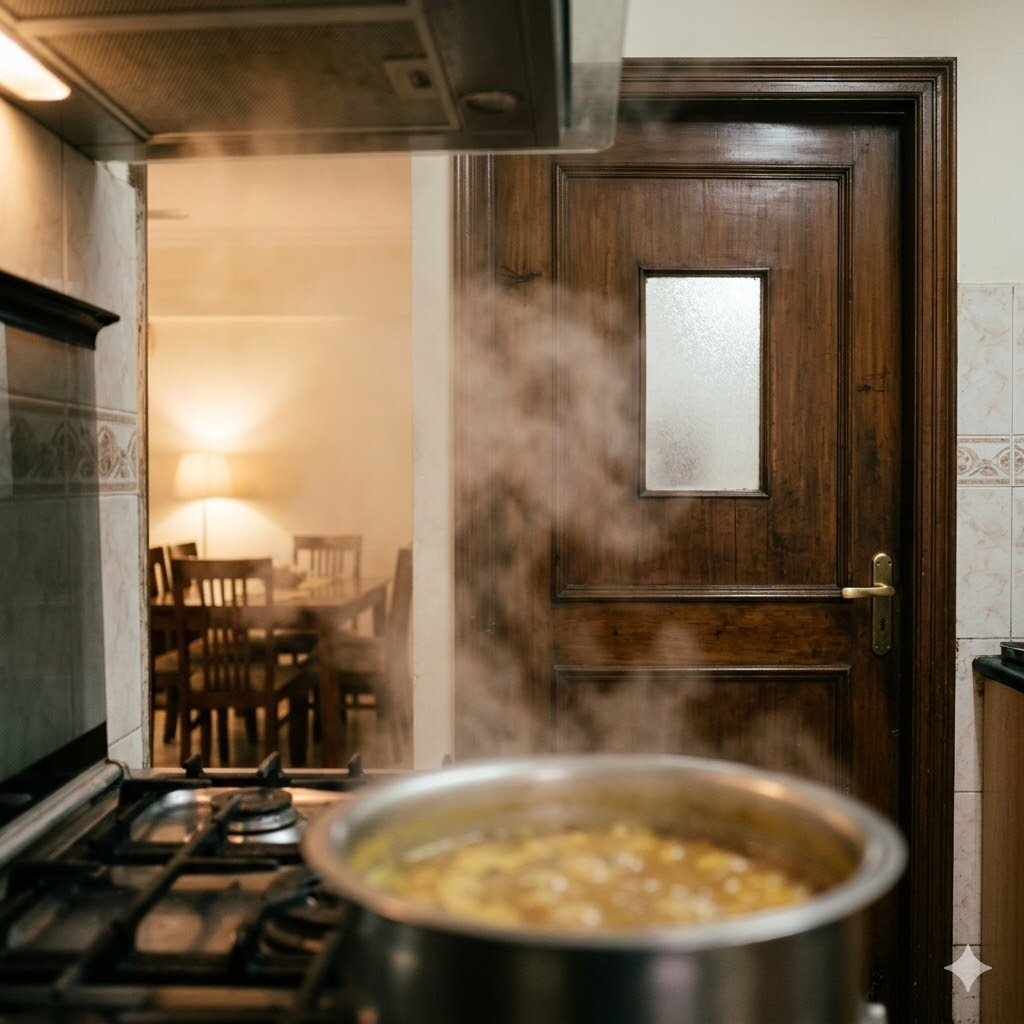
Should You Close the Kitchen Door While Cooking?
Closing a kitchen door can help limit the spread of cooking emissions, but only if the kitchen still has effective extraction and an adequate replacement-air path. Sealing the cook into a room with weak exhaust is not a solution.
Start with extraction at the cooktop
Use a hood that exhausts outdoors where the installation allows it, and maintain it as instructed. Cooking emissions arise from both the food and, with a fuel-burning hob, combustion. An electric hob removes the burner combustion source but does not eliminate particles from cooking.
EPA’s cooking guidance recommends using an externally vented hood while cooking, using rear burners where possible and keeping grease filters clean.
A door changes the airflow path
The exhaust needs air to replace what it removes. A closed door with a suitable transfer path may allow air to move into the kitchen while limiting free mixing with adjacent rooms. A fully sealed door may restrict the exhaust instead.
The result depends on fan flows, other open doors, wind and the building. Closing a door does not automatically establish a fixed pressure difference or guarantee that all pollutants leave through the hood.
Have the installer assess the normal cooking arrangement. Do not block required combustion-air openings or alter a fuel-burning appliance’s ventilation yourself.
A practical routine
- Turn on the outdoor-vented hood for cooking and use the recommended setting.
- Use the door position agreed for an effective replacement-air path.
- Keep children and unnecessary activity away from hot cooking surfaces; never add a curtain near the hob as a smoke barrier.
- Continue extraction after cooking as instructed and check how the room clears.
If the kitchen becomes excessively hot, smoke visibly escapes or the door position noticeably reduces extraction, investigate the ventilation. Do not accept poor conditions for the cook simply to protect the rest of the home.
Check the neighbouring rooms
A PM2.5 record in the living area can help identify repeated cooking-related peaks. Keep the sensor away from the hot plume and record cooking method, hood setting and door position. Comparisons are more useful when outdoor conditions are similar.
A PM2.5 sensor cannot rule out nitrogen dioxide or carbon monoxide. Appropriate appliance servicing and safety provisions remain necessary.
Where filtered fresh air fits
A standalone aqi0 system supplies filtered outdoor air, while the kitchen exhaust removes emissions at the source. Their interaction is assessed for the layout; supply does not replace extraction. Read chimney versus wall exhaust and the home PM2.5 action plan for the next checks.
FAQ
My kitchen has no door — what do I do?
Install one if you can. If not, a heavy curtain helps marginally. Keeping the exhaust running on high during and after cooking still extracts most of the smoke before it spreads. A fresh-air system that supplies clean air into the living room helps maintain the pressure gradient even without a kitchen barrier.
Doesn’t closing the door make the kitchen too hot?
Yes, modestly. The exhaust pulls some heat out with the smoke; the rest stays. An additional bathroom-style exhaust fan or a small ceiling fan inside the kitchen helps with comfort. Many Indian families accept the heat trade-off in exchange for keeping the rest of the home clean.
What if I’m steaming rice, not frying?
Low-emission cooking (steaming, boiling without fat, electric kettle, microwave) produces minimal aerosols. The protocol still helps slightly but isn’t critical.
Does this matter with PNG instead of LPG?
Slightly less NO₂, but the same oil-aerosol problem. The protocol applies equally.
Should I avoid being in the kitchen during cooking?
The cook is always in the highest-exposure zone by definition. A well-running chimney/exhaust + open ventilation route + N95 mask if cooking heavily are all incremental improvements. Closing the door at least keeps the rest of the family out of the spike zone.