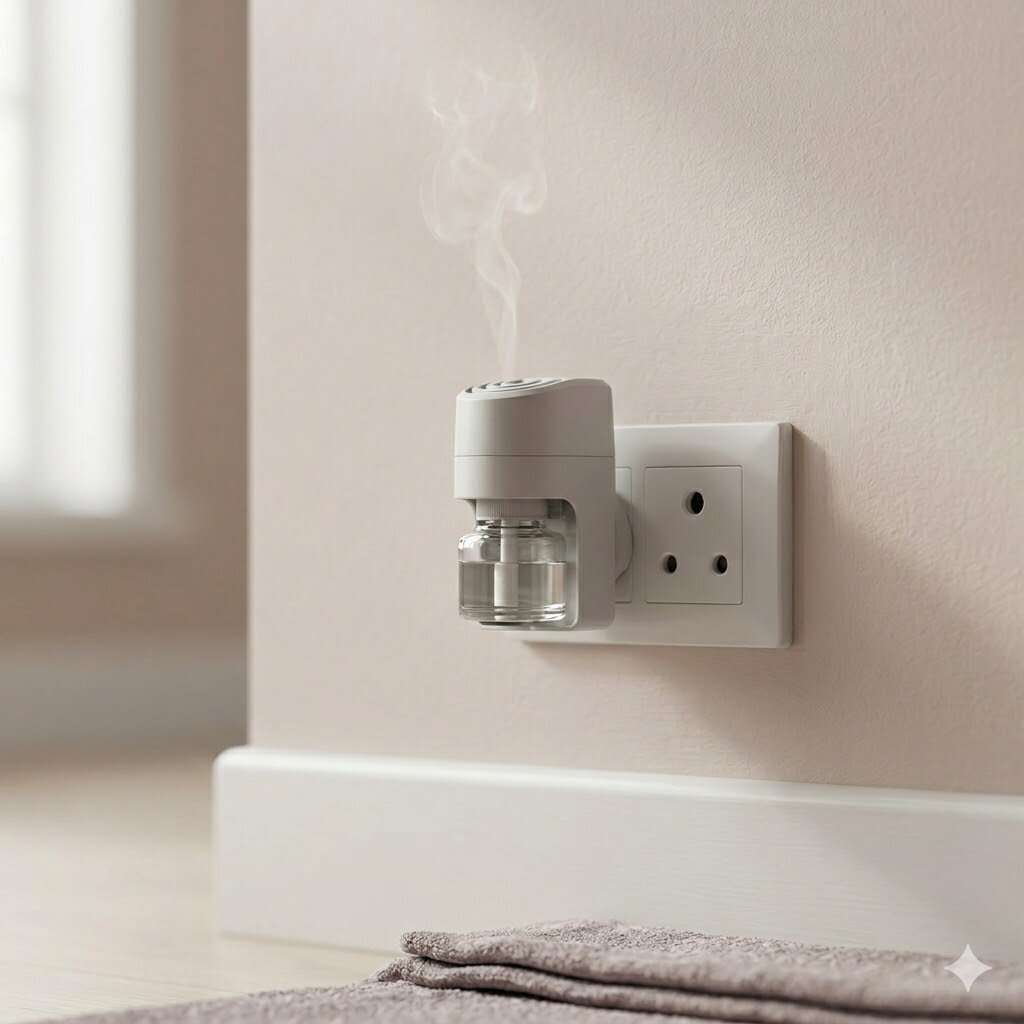
Plug-in air freshener — the continuous indoor VOC source most Indian homes never question

What’s Really in That Room Freshener: VOCs, Phthalates, and the Indoor-Air Cost of Smelling Fresh

A single press on an aerosol “Forest Pine” air freshener releases a chemical cocktail into a closed bathroom that, if you saw the ingredient list, you would not voluntarily inhale. Air fresheners — sprays, plug-ins, gels, reed diffusers — are one of the most under-discussed indoor air quality problems in Indian households. They emit VOCs continuously, contain phthalates linked to endocrine disruption, and react with indoor ozone to form secondary pollutants that include formaldehyde. This page covers what the testing has found, what the science shows, and what to do instead.

Key numbers

What’s actually in the bottle

Three categories of ingredients matter, none required to be disclosed on the label:

1. Fragrance compounds (primary VOCs). The “fragrance” or “perfume” entry on the ingredient list legally covers up to several hundred individual chemicals. Common ones: benzyl acetate, linalool, limonene, alpha-pinene, eugenol, citronellol. Most are mild irritants at typical exposure; some are sensitisers.

2. Phthalates (carriers and fixatives). Diethyl phthalate (DEP) is added to make fragrance “last longer” by slowing evaporation. Other phthalates (DBP, DEHP) appear in plastic bottles, plug-in cartridges, and gel air fresheners. Phthalates are well-documented endocrine disruptors linked to reproductive harm, asthma in children, and reduced sperm counts. The NRDC 2007 study of 14 air-freshener products found phthalates in 12 of them.

3. Propellants and solvents. In aerosols: butane, isobutane, propane (also potential carriers of trace benzene). In plug-ins: petroleum distillates and glycols.

4. Secondary pollutants formed in use. When fragrance VOCs (especially terpenes like limonene and pinene) mix with indoor ozone — which always exists at low levels — they react to form formaldehyde, acetaldehyde, ultrafine secondary organic aerosols, and other compounds. The freshener can be “all natural” and still produce these secondary pollutants because the reaction happens after release.

What the research actually found

Three studies that defined this field:

1. NRDC, 2007. Tested 14 common air-freshener products in the US for phthalates. Found phthalates in 12 of 14, including in products labelled “all-natural” and “unscented.” Levels ranged from trace to 7,300 ppm.

2. Steinemann (multiple, 2008 onward). Lab-tested dozens of fragranced consumer products including air fresheners. Found products emitting 1–8 hazardous chemicals each; 44% emitted at least one of 24 carcinogenic Hazardous Air Pollutants under the US Clean Air Act, including formaldehyde, acetaldehyde, methylene chloride, and 1,4-dioxane. None of these compounds appeared on product labels.

3. ColumbiaDoctors / pregnancy study (2013, ~2,000 women). Plug-in air freshener use during pregnancy was associated with a statistically significant increase in serious lung infections in infants.

Why “natural” doesn’t help

A common reaction: “I switched to essential oils, those are natural.”

Essential oils are concentrated plant-derived VOCs. Limonene (citrus), pinene (pine), eucalyptol, menthol and linalool are the primary scent molecules. Three problems:

1. They are still VOCs. Plant origin does not change the chemistry; the lung does not distinguish.

2. They react with indoor ozone. Terpenes are especially reactive — they combine with ozone in minutes to form formaldehyde, ultrafine particles, and secondary organic aerosols. A study of indoor air after using a pine-scented cleaner showed elevated formaldehyde for hours afterward.

3. Continuous use compounds the load. Reed diffusers and plug-ins emit continuously; spray products spike and decay.

The least-harmful fragrance product is no fragrance product.

The Indian context

Two specific Indian patterns worth flagging:

1. Bathroom aerosols used heavily and in small spaces. The combination of small bathroom volume, low ventilation, and frequent aerosol use produces some of the highest indoor VOC peaks measurable in normal home use. A single 2-second press in a 4 m³ bathroom can drive VOC concentrations into the thousands of µg/m³ briefly.

2. Plug-in diffusers in bedrooms. Marketed as “long-lasting freshness,” plug-in cartridges emit VOCs and phthalates continuously into bedrooms where occupants sleep 8+ hours. The cumulative exposure is much higher than aerosol “spike and decay” use.

3. Religious incense (agarbatti, dhoop, dhuni). Daily burning in puja rooms or bedrooms produces large PM2.5 and VOC loads. Cultural context matters; the chemistry is not changed by intent. Burning briefly with a window open or kitchen exhaust running reduces residual exposure substantially.

What actually replaces the smell-fresh function

If the original problem is real (cooking smells, pets, mustiness), the right answers do not involve adding chemicals to mask the smell:

1. Solve the source. Cooking smells linger because kitchen ventilation is poor — fix the exhaust (see kitchen chimney vs wall exhaust). Pet smells reduce with weekly bathing, frequent vacuuming, washable bedding. Musty smells indicate moisture or mould — find the leak.

2. Ventilate. Cracking a window for 10 minutes when AQI allows, or running a fresh-air system continuously, removes the underlying compounds rather than masking them.

3. Activated charcoal (real, not scented). Bamboo charcoal bags or bulk activated carbon adsorb odour compounds passively. Effective in small enclosed spaces (wardrobes, shoe cupboards, fridges). Place in the room you want freshened.

4. Alum (फिटकरी) in bathrooms. Bathroom odour is often hydrogen-sulphide-driven (drain biology). Alum has mild antibacterial action and helps reduce odour at source. Not a perfume; a deodorant.

5. Baking soda. Open boxes absorb a range of odour compounds; classic refrigerator and storage cupboard application.

What aqi0’s fresh-air system does for this

A positive-pressure fresh-air system delivers continuous outdoor air. For odour and VOC management:

For most homes, eliminating air fresheners + running a fresh-air system delivers a cleaner indoor environment than any combination of masking products.

FAQ

Are plug-in air fresheners worse than sprays? Different exposure profiles. Sprays produce brief high peaks; plug-ins produce continuous low-level exposure. The plug-in’s cumulative dose over weeks often exceeds the spray’s spike. Both contain phthalates in most cases.

What about scented candles? Combustion (paraffin or soy) adds PM2.5 and combustion VOCs on top of the fragrance VOCs. The same general guidance applies: less is better, ventilation matters.

Is “unscented” actually safe? Often not. “Unscented” products can still contain masking fragrances and phthalates to cover residual chemical smells. “Fragrance-free” is a stricter claim, but unregulated.

My family has used these for years. Should I be worried? The evidence supports reducing exposure without panic. Air fresheners are one of several modifiable indoor VOC sources. Eliminating them is low-cost and immediate.

Won’t my house smell bad without them? If the underlying ventilation and source problems are addressed, no. If they aren’t, you’re masking the symptom rather than fixing the cause.