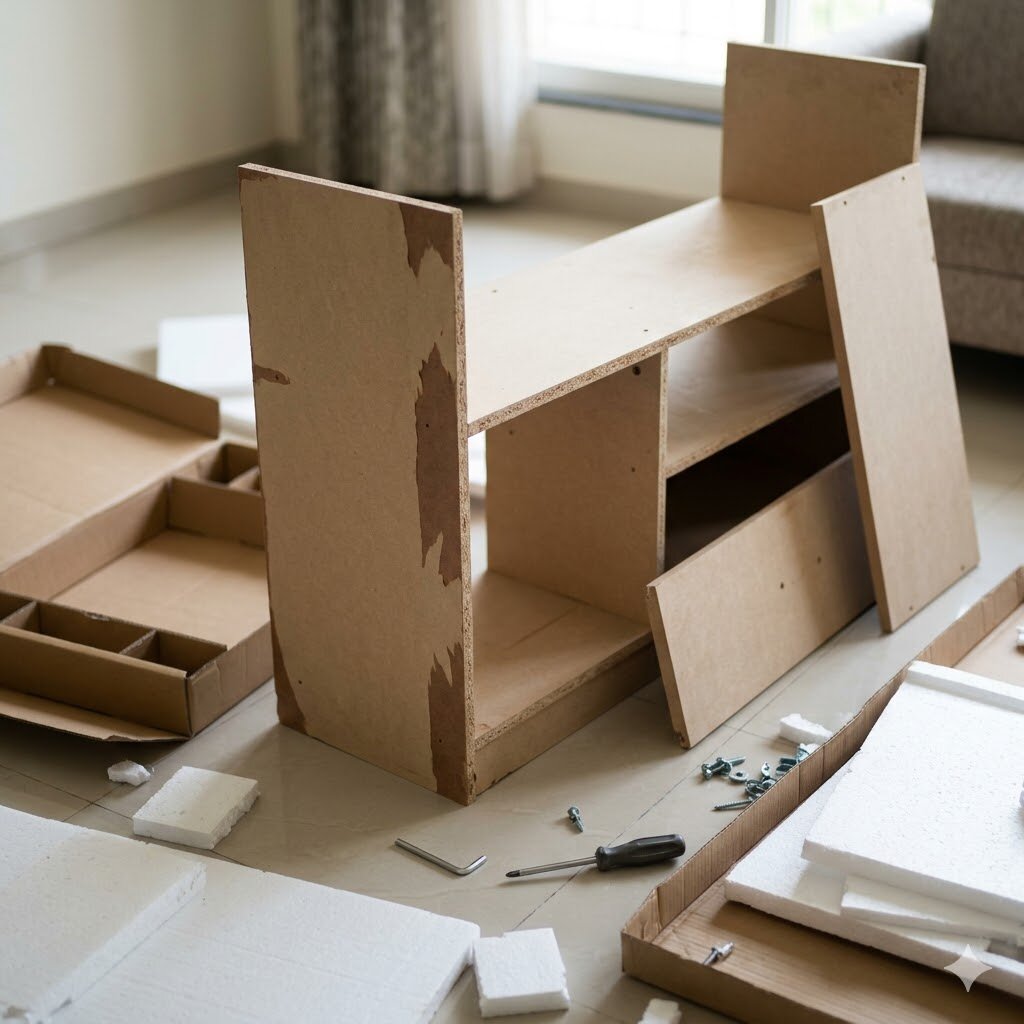
Formaldehyde in Furniture: What to Ask Before Buying
Some composite-wood products can emit formaldehyde. The useful buying question is what evidence applies to the exact panel and finished furniture, not whether every MDF item is dangerous or every solid-wood item is emission-free.
Ask for documentation that matches the product
Request the panel manufacturer, relevant emissions standard, test method, report date and product identification. If a seller cites E1, E0, CARB or another label, ask which scheme and product category it refers to. Numbers obtained by different methods should not be treated as directly interchangeable.
EPA’s consumer guidance on composite wood explains the scope of the US programme. It is useful context for a supplier’s US-compliance claim, not proof of every Indian product’s compliance or a substitute for applicable local requirements.
Check the complete furniture specification
Panels are only part of the purchase. Finishes, adhesives, edge treatments and other materials may also matter. Imported, branded, expensive or “natural” is not a test result.
Before ordering several large pieces for a bedroom, ask how installation and ventilation will be managed and what the seller recommends if an odour persists. Do not assume all emissions end after a fixed two-week airing period.
If the furniture is already installed
Record when the concern began, which room is affected and whether there were other recent changes such as painting or new flooring. Follow the manufacturer’s care and ventilation instructions. Avoid improvised heating or coating treatments that could damage materials or introduce new emissions.
EPA’s exposure-reduction guidance discusses ventilation and indoor conditions. If a specific formaldehyde concern remains, use a qualified assessment with a suitable measurement method. A generic TVOC score or smell alone does not establish the concentration.
Can aqi0 remove formaldehyde?
H13 HEPA is particle filtration, not a formaldehyde-removal medium. Outdoor-air supply can contribute to dilution when the incoming air is suitable, but the result depends on sources and airflow. An activated-carbon stage is available as an add-on at ₹2,200, but it sits at the intake and treats the air coming in — it does not scrub formaldehyde already released inside the room by new furniture. aqi0 does not promise a fixed 70–90% reduction or a universal safe move-in date.
See VOCs in homes and the technical note for the distinction between particle filtration and ventilation.
FAQ
Is IKEA furniture safe?
IKEA’s stated standard is E1 or stricter for fibreboard products sold globally; many SKUs meet E0. Their disclosure is more transparent than most Indian competitors. Specific products vary.
Is plywood safer than MDF?
Yes, substantially. Plywood typically uses phenol-formaldehyde resin which emits ~80% less formaldehyde than the urea-formaldehyde resin in MDF and particleboard.
Do plants reduce formaldehyde?
Not at residential scale. The 1989 NASA study often cited used sealed chambers with one plant per ~0.1 m³ — about 600 plants for a typical living room. Real homes see negligible benefit.
Should I remove existing furniture?
Rarely worth it. Older furniture (2+ years) has off-gassed most of its emission. Focus interventions on new purchases and ventilation.
My newborn’s nursery has a new MDF crib. What should I do?
Off-gas the crib in a well-ventilated balcony or unused room for 2–4 weeks before use. Run ventilation in the nursery continuously. Consider replacing MDF with solid-wood alternatives if budget allows.