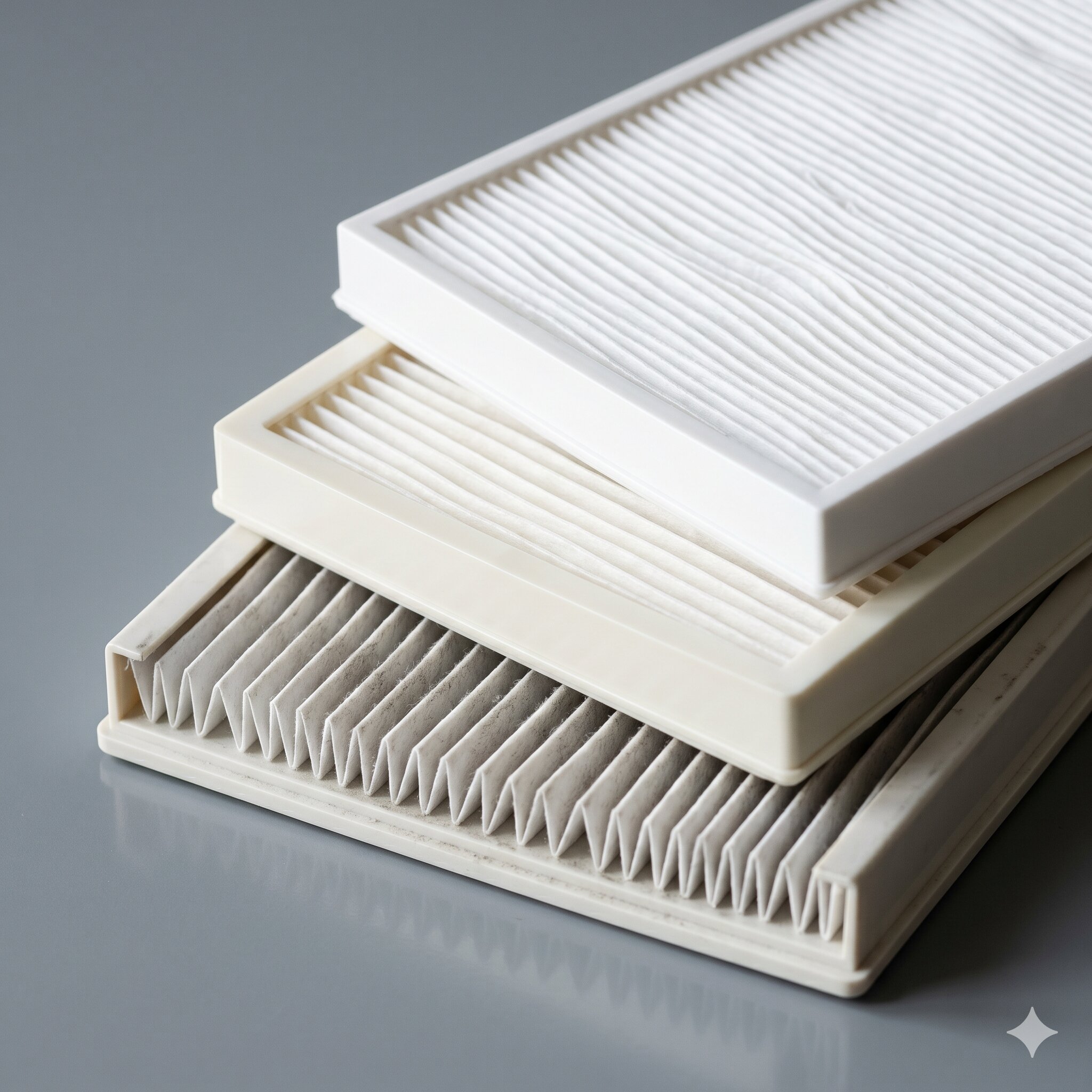
HEPA Filter Grades H11, H13, H14 in India: What the Numbers Mean and Which You Need
HEPA filters are graded by efficiency at capturing the most penetrating particle size (MPPS), typically around 0.1–0.3 µm. The European EN 1822 standard sorts them into classes from H10 (least efficient) through H14 (most efficient). H13 captures 99.95% of MPPS particles. H14 captures 99.995%. That extra “9” sounds small but represents a 10× reduction in what gets through. For most Indian residential applications, H13 is the right choice; H14 is over-specified and costs more in airflow penalty and energy. For specific applications (hospital operating theatres, semiconductor cleanrooms, surgical isolation), H14 is the standard. This page walks through what each grade actually does and which fits where.
Key numbers
- H10: ≥85% efficiency at MPPS (technically EPA-grade, not HEPA)
- H11: ≥95% efficiency
- H12: ≥99.5% efficiency (sometimes called “true HEPA” in some markets)
- H13: ≥99.95% efficiency
- H14: ≥99.995% efficiency
- MPPS: Most Penetrating Particle Size, typically 0.1–0.3 µm
- 20–40% — typical cost premium of H14 over H13 for the same size filter
What “efficiency” actually measures
EN 1822 testing measures particle capture at the most penetrating particle size — the size that the filter is least effective at catching. For most filter media, this falls in the 0.1–0.3 µm range. Particles smaller than this are caught by Brownian motion / diffusion; particles larger are caught by impaction and interception. The middle of the curve is the hardest to catch.
By rating filters at this worst-case point, EN 1822 gives you a real-world performance floor. The filter performs at least this well at MPPS, and better than this rating at every other particle size.
The grades in plain numbers
For every million particles of MPPS-size air hits the filter:
- H11 (≥95%): 50,000 particles pass through
- H12 (≥99.5%): 5,000 particles pass through
- H13 (≥99.95%): 500 particles pass through
- H14 (≥99.995%): 50 particles pass through
The difference between H13 and H14 is one order of magnitude (10×). The difference between H11 and H13 is two orders of magnitude (100×).
For PM2.5 (which spans 0.1–2.5 µm), efficiency at the MPPS is the rate-limiting performance. Above 1 µm, almost any HEPA grade captures 99.99%+ — including H11.
When H13 is the right answer
For most Indian residential applications, H13 hits the sweet spot:
Pros: - 99.95% PM2.5 capture is more than sufficient to hold indoor PM2.5 under 10 µg/m³ even when outdoor is 300+ - Pressure drop across H13 is modest — fan motors can push air through without excessive energy or noise - Filter life is good — 6–12 months typical residential use before replacement - Cost is reasonable — replacement filters in the ₹2,000–5,000 range
aqi0 uses H13 HEPA in standard fresh-air systems. Field measurements across 60+ installations consistently show indoor PM2.5 of 5–10 µg/m³ when outdoor is 200–400 µg/m³. The H13 specification is the engineering optimum.
When H14 is appropriate
H14 makes sense in three settings:
1. Hospital operating theatres and isolation wards. Surgical fields require near-zero airborne pathogen and particulate load. The extra 10× reduction matters when a single bacterial cell on a wound can cause complication.
2. Semiconductor cleanrooms. Chip fabrication requires Class 10 to Class 1 cleanroom standards where even a single 0.1 µm particle on a wafer is a yield-reducing defect.
3. Pharmaceutical manufacturing. Sterile drug production requires HEPA H14 at the point of fill to meet international standards.
For residential, the marginal benefit of H14 over H13 is rarely worth the cost and energy penalty.
When H11 is appropriate
H11 has a legitimate use case where its lower efficiency is compensated by other advantages:
1. Higher airflow at the same fan power. H11 has lower pressure drop than H13. With the same fan, you get more air movement. For applications where high air change rate matters more than per-pass efficiency (rapid PM2.5 reduction after a spike event), H11 + high airflow can outperform H13 + low airflow.
2. Lower energy use. For continuous 24/7 operation, the energy difference adds up.
3. Quieter operation. Less pressure drop = less fan noise.
The NHS in the UK has cited some cases where H11 is preferred over H13 for continuous use in COVID-era classroom ventilation. The trade-off is genuine.
For aqi0’s positive-pressure fresh-air application, H13 wins because the system runs continuously at low fan speed — energy and noise are already low, and the per-pass efficiency matters since most air gets one pass through the filter.
What H10 and below are (and aren’t)
EN 1822 grades below H10 are technically “EPA” (Efficient Particulate Air), not HEPA. These include E10, E11 and E12 in older labelling.
Many “HEPA-type” or “HEPA-style” consumer products use E11 or E12 media and are marketed as “HEPA” loosely. Their MPPS efficiency is 85–99.5% — not nothing, but not what HEPA actually means.
In India, the regulatory distinction is poorly enforced. A consumer purifier labelled “True HEPA” can mean anything from genuine H13 to E11. The way to tell:
- Look for “H13” or “H14” explicitly on the filter label or product spec
- Look for the EN 1822 standard reference
- Real HEPA filters from H13 upward are individually tested and serial-numbered — each filter has its own certificate
Pressure drop and lifespan
Higher HEPA grade = denser filter = higher pressure drop = filter resists airflow more.
- H11: ~100–150 Pa pressure drop at typical face velocity
- H13: ~200–300 Pa
- H14: ~300–450 Pa
For the same fan, this means H14 delivers maybe 60–70% of H13 airflow. Compensating requires a more powerful fan, which is louder and more energy-hungry.
Filter lifespan also differs:
- H11: Loads more slowly because more particles pass through; lasts longer at same airflow
- H13/H14: Loads faster; needs replacement more often
For aqi0’s residential systems running continuously, H13 filter replacement runs 6–12 months typical. Heavy-use (multi-occupant homes, high outdoor PM2.5 zones) tends to the shorter end.
How to verify your filter is what it claims
Three checks:
1. Look at the label. Real H13 and H14 filters have a serial number, manufacturer’s name, MPPS efficiency rating, and EN 1822 reference. Generic “HEPA filter replacement” with no specifics on the packaging is usually E10/E11 media.
2. Check for the individual test certificate. H13 and H14 filters are tested individually (or per-batch). A reputable manufacturer can provide the test report for your specific filter or batch.
3. Filter density visual check. A real H13/H14 filter is densely pleated, the media is opaque to light when held against a strong bulb. Sparse pleating or light passing through indicates either lower grade or counterfeit.
FAQ
Is “True HEPA” the same as H13? Sometimes. The term “True HEPA” is loosely used. The US definition typically refers to ≥99.97% at 0.3 µm — which is close to but not identical with EN 1822 H13. Read the specific spec.
Does HEPA capture viruses? Most viruses are 20–300 nm — smaller than the MPPS. Pure virus particles are captured at higher efficiency than the rated MPPS efficiency. In practice, viruses travel in respiratory droplets (1–10 µm) which HEPA captures at very high efficiency.
Does my AC have a HEPA filter? No. Standard split and window ACs have a dust filter (G3–G4 in the EN ISO 16890 grading) that captures large particles only. AC air still contains all the PM2.5 of the room air.
How often should I replace the HEPA filter? Depends on usage and pollution load. For aqi0 systems in NCR: typically 6–12 months. Some installations in very high-load areas need 4–6 months. Visible darkening + measurable airflow drop are the practical indicators.
Is H14 better for COVID protection? The marginal benefit over H13 for pathogen capture is small. Other factors (ventilation rate, mask use, vaccination) matter more. H13 is generally sufficient.