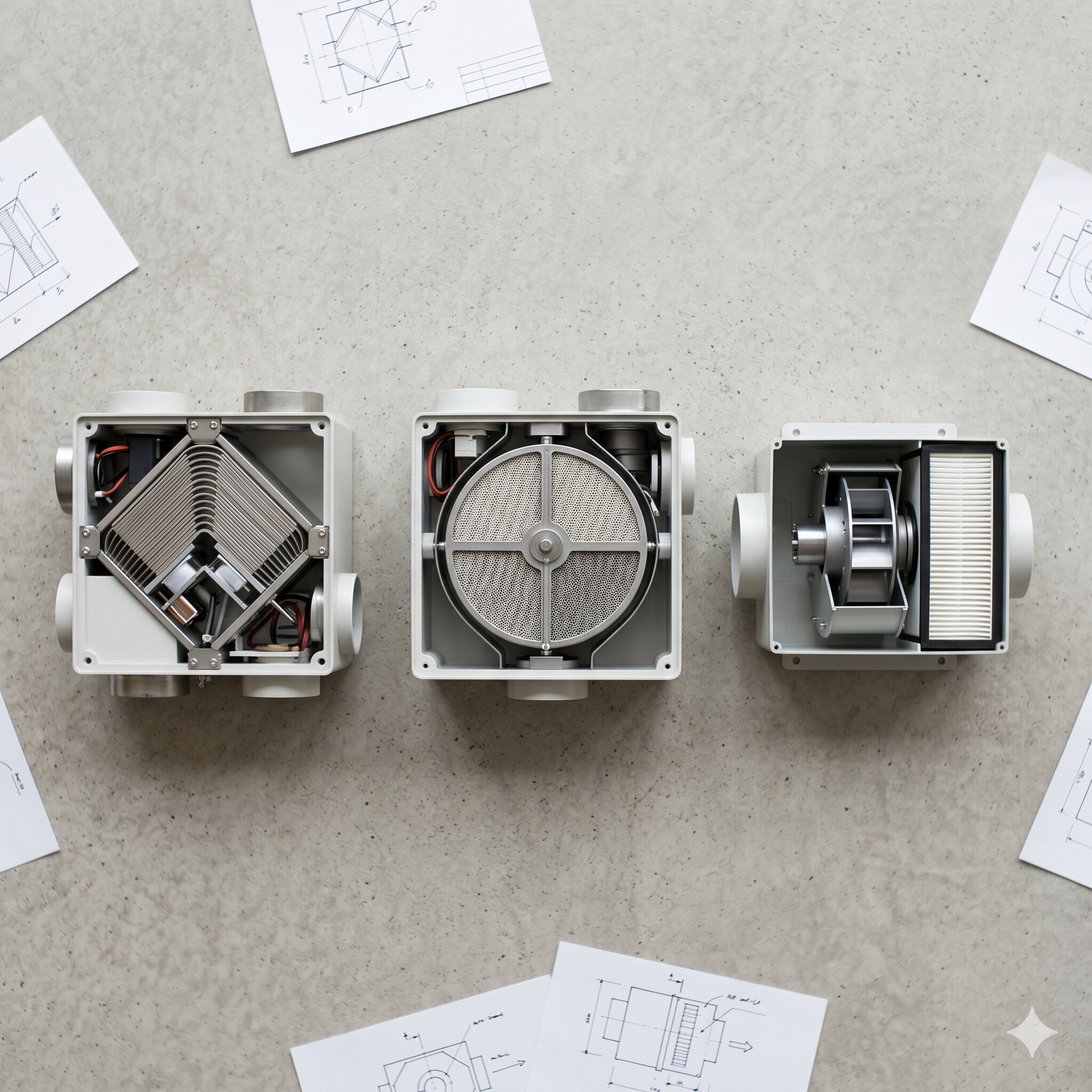
ERV vs HRV vs PPV: Which Ventilation System Fits an Indian Home?
Three categories of mechanical home ventilation dominate global markets: HRV (Heat Recovery Ventilation, popular in cold climates), ERV (Energy Recovery Ventilation, popular in humid climates), and PPV (Positive Pressure Ventilation, popular in high-outdoor-pollution markets). Each was designed for a different climate problem and each makes different trade-offs. For Indian conditions — high outdoor PM2.5, hot summers, monsoon humidity, dusty winters — PPV with H13 HEPA filtration is the right fit for most homes. The other two were designed for problems Indian homes mostly don’t have. This page covers the engineering of each and why the choice matters.
Quick comparison table
| Property | HRV | ERV | PPV |
|---|---|---|---|
| Designed for | Cold-climate energy efficiency | Humid-climate energy efficiency | Polluted outdoor air |
| Direction of air flow | Two-way (supply + exhaust) | Two-way (supply + exhaust) | One-way (supply) |
| Heat exchange | Yes (sensible) | Yes (sensible + latent) | No |
| Filtration | Secondary | Secondary | Primary (H13 HEPA) |
| Pressure | Neutral | Neutral | Positive (+10–25 Pa) |
| Outdoor pollution blocking | Limited | Limited | Excellent |
| Duct complexity | High (supply + exhaust) | High | Low (supply only) |
| Power consumption (typical) | 80–150 W | 80–150 W | 30–50 W |
| Capital cost (Indian home) | High (₹2–5 lakh) | High (₹2–5 lakh) | Moderate (₹75k–1 lakh) |
| Best fit | Norway, Canada | Singapore, Florida | Delhi, Beijing, Mumbai |
How HRV works (and why it’s a fit for cold climates)
A Heat Recovery Ventilator runs two ducts in parallel:
- Supply duct: outdoor cold air drawn in
- Exhaust duct: indoor warm stale air pushed out
The two streams pass through a heat exchanger (typically aluminium plate or rotating wheel) where heat transfers from the warm exhaust stream to the cold supply stream. The cold incoming air arrives pre-warmed; the warm outgoing air leaves pre-cooled.
Net effect: continuous fresh air exchange at minimal heating-energy penalty.
Why it works in cold climates: in a Toronto winter at -20°C outside and +21°C inside, naively dumping cold outdoor air into the home would crash the indoor temperature. The heat exchanger preserves 70–90% of the heat. HRV makes ventilation thermally affordable.
Why it’s a poor fit for India: the underlying problem HRV solves (heat loss to cold incoming air) doesn’t dominate Indian energy bills. The dominant Indian energy problem is cooling load, not heating. HRV’s heat-exchanger benefit is largely irrelevant. Its complexity, cost and dual-duct installation are.
How ERV works (and why it’s a fit for humid climates)
An Energy Recovery Ventilator is HRV’s cousin with one additional feature: the heat exchanger transfers both heat AND humidity between the supply and exhaust streams.
In a Florida summer at 32°C and 80% humidity outside, the indoor AC works hard to dehumidify. Dumping outdoor air directly into the home loads the AC with extra dehumidification work. The ERV pre-conditions incoming air by transferring some of the outdoor humidity to the outgoing (already drier) air, reducing AC load.
Why it works in humid air-conditioned climates: the underlying problem (latent cooling load from humid outdoor air) dominates summer energy bills in places like Singapore, Houston, Florida.
Why it’s a partial fit for India: monsoon humidity is real and ERV could in principle help. Three caveats:
- The dominant Indian ventilation problem is PM2.5, not humidity. ERV’s main feature doesn’t address it.
- ERV adds capital cost and complexity over PPV without solving the PM2.5 problem better.
- The latent-recovery benefit is mostly relevant during 4–6 monsoon weeks per year; the other 10 months of dusty, polluted, hot Indian air make ERV’s benefits marginal.
ERV is technically defensible but commercially uncompetitive for Indian residential use vs. PPV + AC.
How PPV works (and why it’s the right fit for India)
Positive Pressure Ventilation runs a single supply duct:
- Outdoor air is drawn through a wall-mounted intake (core-cut opening, 250 mm)
- Air passes through a washable pre-filter
- Air passes through an H13 HEPA filter (99.95% particle capture)
- Air is pushed into the home at ~500 m³/h
- The home is held at +10–25 Pa positive pressure
- Stale air exits passively through kitchen exhaust, bathroom exhaust, and door/window gaps
There is no parallel exhaust duct. There is no heat exchanger. There is no humidity exchange. The system does one thing: deliver filtered fresh air to the home, continuously, while preventing outdoor pollution infiltration.
Why it works in Delhi NCR:
- PM2.5 is the dominant problem. HEPA filtration solves it directly.
- Outdoor air is dirty, not extreme-temperature. Indian temperatures don’t make ventilation thermally expensive the way Canadian cold does.
- Positive pressure stops infiltration. Dirty outdoor air can’t sneak in through wall cracks because the inside is at higher pressure.
- Single-duct simplicity means lower installation cost and easier retrofit into existing homes.
- Low power consumption (~30W) means continuous operation costs under ₹170/month at ₹8/kWh.
PPV addresses the actual Indian indoor-air problem (PM2.5, CO₂, VOCs in sealed homes) at the cost level Indian middle-class budgets accept.
When HRV or ERV might still be worth considering in India
Three edge cases:
1. Premium passive-house construction in Himalayan or high-altitude locations. A Shimla, Manali or Dharamshala home where winter heating is significant could benefit from HRV’s heat recovery. Outdoor air is usually clean enough that PM2.5 filtration is secondary.
2. Coastal high-humidity premium homes. A Goa, Mangalore or Kochi luxury home running AC year-round could benefit from ERV’s latent recovery. PM2.5 in coastal cities is lower than NCR; humidity is the bigger problem.
3. Commercial buildings with strict energy codes. Some institutional buildings (international schools, hospitals, premium offices) have energy codes that require heat/energy recovery. HRV or ERV are appropriate here.
For 95% of Indian residential customers, PPV with H13 HEPA is the right answer.
The hybrid option
A PPV system with an optional heat-recovery add-on exists in some markets — combining PPV’s one-way design with a smaller, simpler heat exchanger on the incoming stream. This is rare in India because the marginal benefit doesn’t justify the added cost.
aqi0’s standard system is pure PPV. The October-2026 heater add-on warms the incoming air during the Delhi winter cold snap (December–January) when sub-10°C supply air would be uncomfortable, but operates as resistance heating, not heat recovery.
What about negative-pressure (exhaust-only) ventilation?
A common low-cost option in some markets: an exhaust fan in the kitchen or bathroom pulls air out continuously, creating slight negative pressure that “pulls in” fresh outdoor air through cracks.
For Indian conditions, this is the worst option. Negative pressure pulls in unfiltered outdoor air through every gap — exactly the pollution you’re trying to keep out. In Delhi, this is precisely backwards.
The only acceptable negative-pressure ventilation in India is short-duration use (kitchen exhaust during cooking, bathroom exhaust during showering) where the pollution exit takes priority over the infiltration cost.
Why the Indian market underdeveloped this category
Until ~2018, mechanical ventilation in Indian residential design was nearly absent. The construction industry treated ventilation as commercial-grade infrastructure (hospitals, offices). Several factors shifted this:
- Delhi’s air-quality crisis (post-2014)
- Imported brands (IQAir, Blueair, Dyson) creating consumer awareness
- Indian startups (aqi0 and competitors) building accessible-price PPV systems
- Builders bundling PPV in premium projects (₹1 lakh per apartment, as a feature)
The category is now growing. Most homeowners surveying NCR options in 2026 encounter PPV-style systems first, with HRV/ERV available only through specialty importers at premium prices.
FAQ
Is aqi0’s system an HRV or ERV? Neither. It’s PPV — single-direction supply with H13 HEPA filtration. The right design for Delhi conditions.
Could I add heat recovery later? Yes, technically. The PPV intake can be retrofitted with a heat exchanger. The cost rarely justifies the benefit in NCR. For Himachal or Uttarakhand homes, more reasonable.
Does PPV waste cooling energy in summer? Slightly. Bringing in 500 m³/h of 35°C outdoor air when indoor is 25°C adds a small cooling load. In a properly sized 1.5-ton split AC home, the impact is ~5–8% extra cooling. The trade-off (clean air vs. tiny energy cost) is well worth it.
Does PPV use more energy than HRV/ERV? No, less. PPV runs a single fan at low speed (~30W). HRV/ERV run two fans plus motor for the heat exchanger wheel (80–150W). PPV is the lower-energy option once you factor in the actual climate.
Can I run AC and PPV at the same time? Yes, that’s the standard configuration. AC handles temperature; PPV handles air quality. They are complementary, not in conflict.