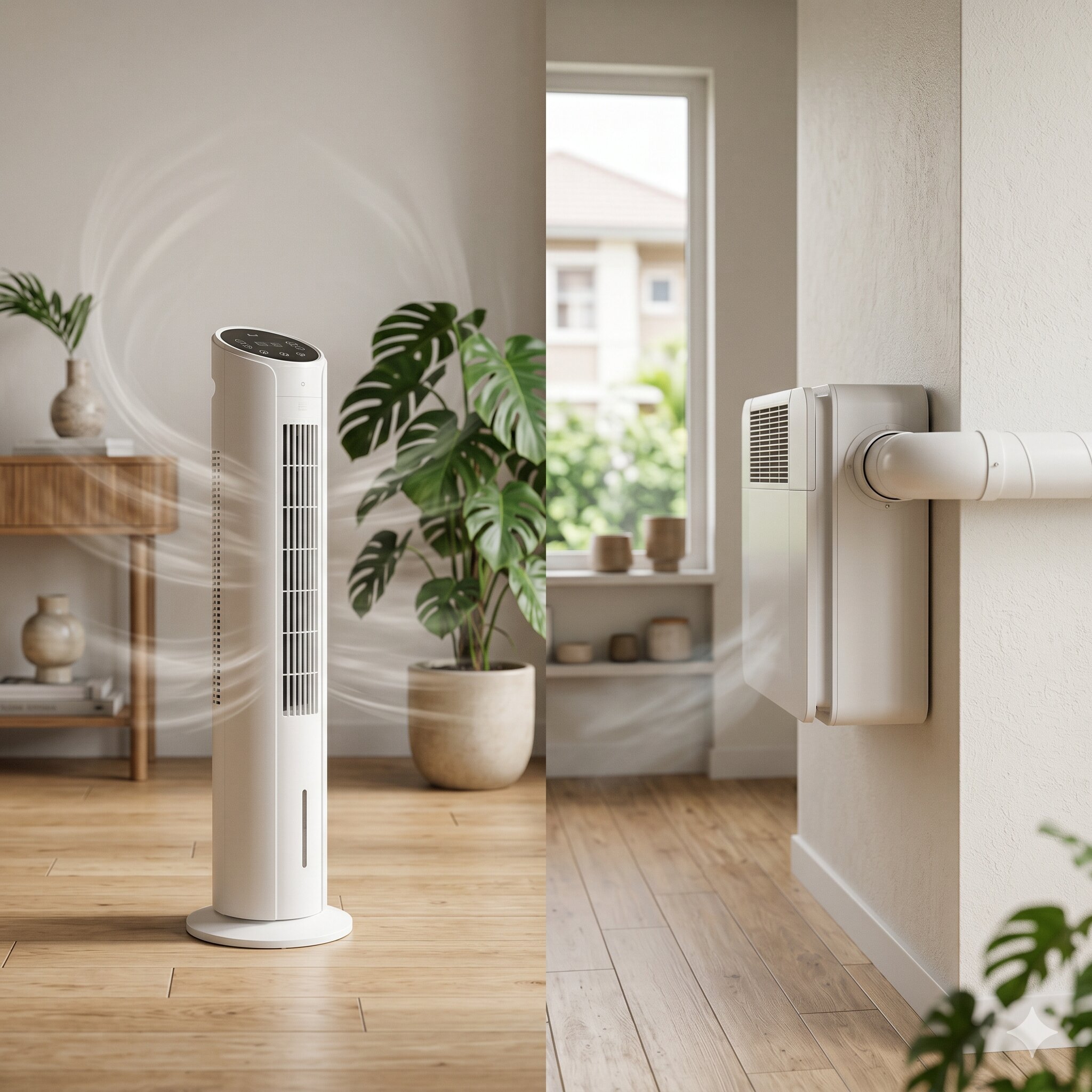
Fresh Air System vs Air Purifier: The Long Answer With CO₂ Math
The question gets asked at every aqi0 sales call: “I already have a Dyson / Mi / Honeywell / Philips air purifier — why do I need this?” The short answer is that purifiers and fresh-air systems solve different problems. A purifier removes particulate matter from air already inside the room. A fresh-air system brings in new filtered air from outside. The PM2.5 problem can be partly solved by either; the CO₂ problem can only be solved by ventilation. For Indian homes — which run sealed for AC, with closed bedrooms at night and closed offices during the day — CO₂ is half the indoor-air problem. This is the long-form comparison.
Key numbers
- PM2.5 removal: both solutions work
- CO₂ removal: only ventilation works (purifiers cannot)
- VOC management: ventilation dilutes; purifier carbon adsorbs (if carbon stage is real)
- Coverage area: purifier = one room; fresh-air system = whole home
- Continuous operation cost: purifier ₹100–200/month; aqi0 system ₹170/month at ₹8/kWh
What an air purifier does
A consumer air purifier is a closed-loop recirculation system inside one room:
- Room air enters the unit through an inlet
- Air passes through a pre-filter (dust, lint)
- Air passes through a HEPA filter (PM2.5)
- Air optionally passes through a thin carbon “filter” (limited VOC)
- Filtered air exits back into the same room
- Loop continues
The unit reduces PM2.5 concentration in the room over time. With sufficient airflow (CADR rating × time), the room reaches a steady-state PM2.5 that depends on the balance between filter removal and infiltration of new PM2.5 from outside.
What it does well: reduces PM2.5 in the immediate room. Effective when properly sized and run.
What it doesn’t do: - Remove CO₂ — the air keeps cycling through the same molecules - Bring in fresh air — nothing enters from outside - Cover other rooms — one purifier protects one room - Address the source — particles keep entering through doors, gaps and ventilation - Manage indoor humidity at scale - Provide pressure-balance protection
What a fresh-air system does
A positive-pressure fresh-air system is a one-way flow path from outside to inside:
- Outdoor air is drawn through a wall-mounted intake (10” / 250 mm core-cut opening)
- Air passes through a washable pre-filter (large particles, leaves, lint)
- Air passes through an H13 HEPA filter (PM2.5 at 99.95%)
- Filtered air is pushed into the home at ~500 m³/h
- The home is held at +10–25 Pa relative to outside
- Stale air exits passively through kitchen exhaust, bathroom exhaust, and minor gaps
The system handles air for the whole home continuously.
What it does: - Maintains low indoor PM2.5 throughout the home (typically 5–10 µg/m³) - Continuously dilutes indoor CO₂ (typically 550–800 ppm overnight) - Continuously dilutes indoor VOCs - Prevents outdoor pollutant infiltration via pressure differential - Provides quiet, continuous background air movement
What it doesn’t do: - Cool or heat the home (the AC and a heater do that) - Remove indoor pollutants at high spike (kitchen exhaust handles cooking) - Provide HEPA-equivalent filtration to outdoor air during walks outside
The CO₂ math that decides the comparison
Two adults in a sealed 30 m³ bedroom (12 × 12 × 9 ft), 8-hour overnight:
Air purifier scenario: - PM2.5 starts at 100, drops to 15 µg/m³ within 30 minutes (purifier working) - CO₂ starts at 500 ppm - Each adult exhales 17 L of CO₂ per hour - CO₂ rises linearly: 1,200 ppm at midnight, 1,800 ppm at 3 AM, 2,000+ ppm by 6 AM - Purifier has zero effect on CO₂
Fresh-air system scenario: - PM2.5 starts at 8, stays at 5–10 µg/m³ all night - CO₂ starts at 500 ppm - System brings in 500 m³/h of outdoor air; bedroom volume turns over every 4 minutes - CO₂ stays at 600–800 ppm all night
The PM2.5 difference is small in the bedroom (both solutions work). The CO₂ difference is dramatic. The cognitive and sleep-quality cost of 1,800 ppm CO₂ is documented (see bedroom CO₂ overnight and the 1,000 ppm cliff).
When a purifier is enough
Three scenarios where a purifier alone is reasonable:
1. Single-occupant studio apartment. One person in a small space. CO₂ accumulation is slower. PM2.5 is the dominant problem.
2. Office or workplace where you can’t install fresh-air supply. A personal purifier on the desk addresses your local breathing zone. Imperfect but better than nothing.
3. Travel and temporary accommodation. Hotel rooms, Airbnb, short-stay locations. A portable purifier is the only option.
For these, a quality purifier (genuine H13 HEPA, sized for the room) is a real upgrade over no protection.
When a fresh-air system is the right answer
Five scenarios:
1. Multi-occupant homes. Two adults sleeping in a bedroom = continuous CO₂ accumulation. Family with kids = the same problem multiplied across rooms.
2. Asthma, allergies, or respiratory conditions in the household. Whole-home consistency beats room-by-room patchwork. Walking into a different room shouldn’t mean walking into worse air.
3. Newborns and young children. Most of the day is spent in nursery + living room + parents’ bedroom. All three need clean air; protecting one is insufficient.
4. Year-round operation in a polluted city (Delhi NCR, Mumbai, Kolkata, Lucknow). The exposure window is 365 days × 24 hours. Continuous whole-home operation handles this; room-by-room purifiers don’t.
5. Sealed modern apartments. The same envelope that traps PM2.5 and CO₂ also traps cooking smoke, VOCs and humidity. Continuous ventilation addresses all of these at once.
Cost comparison over five years
A typical 2BHK Delhi NCR home with three rooms (living, master bedroom, kid’s bedroom).
Purifier route: - Three high-quality purifiers (e.g. Dyson HP09 ₹54,000 × 3 = ₹162,000) - Filter replacements every 12 months: ₹4,500 × 3 × 5 = ₹67,500 - Electricity (30W × 24h × 365 × 5 × 3 units, @ ₹8/kWh): ~₹31,500 - 5-year total: ~₹261,000 - Coverage: 3 rooms; CO₂ unaddressed; bathroom and kitchen excluded
Fresh-air system route: - aqi0 system + installation: ₹70,000 + GST (₹82,600 all-in) - Annual AMC: ₹14,750/year all-in × 5 = ₹73,750 (covers all filter changes + cleaning; aqi0 AQI monitor included free when signed on same invoice as system) - Electricity (30W × 24h × 365 × 5, @ ₹8/kWh): ~₹10,500 - 5-year total: ~₹166,000 (~₹178,000 with first-year AMC bundle) - Coverage: whole home; CO₂ addressed; kitchen and bathroom integrated via exhausts
The fresh-air system is approximately 35–40% cheaper over 5 years and covers more of the actual indoor air quality problem.
The honest case for keeping a purifier alongside
For most aqi0 customers, the fresh-air system is the foundation. A single purifier as a supplement makes sense in two cases:
1. The room where someone with severe asthma sleeps. Belt-and-braces protection during sleep when respiratory rate is low and exposure most consequential.
2. During specific events — fresh paint, new mattress unboxing, smoking guests, peak Diwali night. A portable purifier handles localised spikes that whole-home dilution can’t address as fast.
Both cases are supplementary. The base layer is ventilation, not purification.
What about the “but my purifier already handles PM2.5”
Yes. And it leaves untouched:
- CO₂ in the bedroom you sleep in
- PM2.5 in every other room of the house
- VOCs from sources downstream of where the purifier sits
- Indoor air quality during the 50% of your home time spent in rooms without a purifier
- Air quality in the kitchen and bathrooms (almost never has a purifier)
- Pressure protection against unfiltered outdoor air infiltration
These are not the purifier’s job. They are real problems left unsolved.
FAQ
Can I just buy a fresh-air system without a purifier? Yes. Most aqi0 customers do exactly this. The fresh-air system covers ~95% of the indoor air quality problem at lower cost than equivalent purifier coverage.
Do I keep my old purifier or sell it? Keep it for the bedroom or supplementary use. Don’t bother with separate purifiers in every room — the fresh-air system handles those.
What about purifier brands marketed as “fresh air” — Dyson Pure Hot+Cool, etc.? These are still purifiers (closed-loop recirculation). The “Pure” branding refers to PM2.5 filtration. They do not bring in outdoor air. Read the spec sheet — if there’s no outdoor wall opening, it’s not a fresh-air system.
Can I retrofit a purifier into a fresh-air system? Not really. The fundamental design — a wall-mounted intake bringing outdoor air through a filter into the home — requires a structural opening (core cut or glass cut). A portable plug-in device cannot do this.
Why isn’t this how all Indian homes are built? Construction practice in India still treats mechanical ventilation as commercial-grade infrastructure rather than residential. Indian building codes reference ventilation standards but do not enforce them at design or commissioning. This is changing slowly.