Seal the gaps you can see: a case study from three Delhi NCR homes
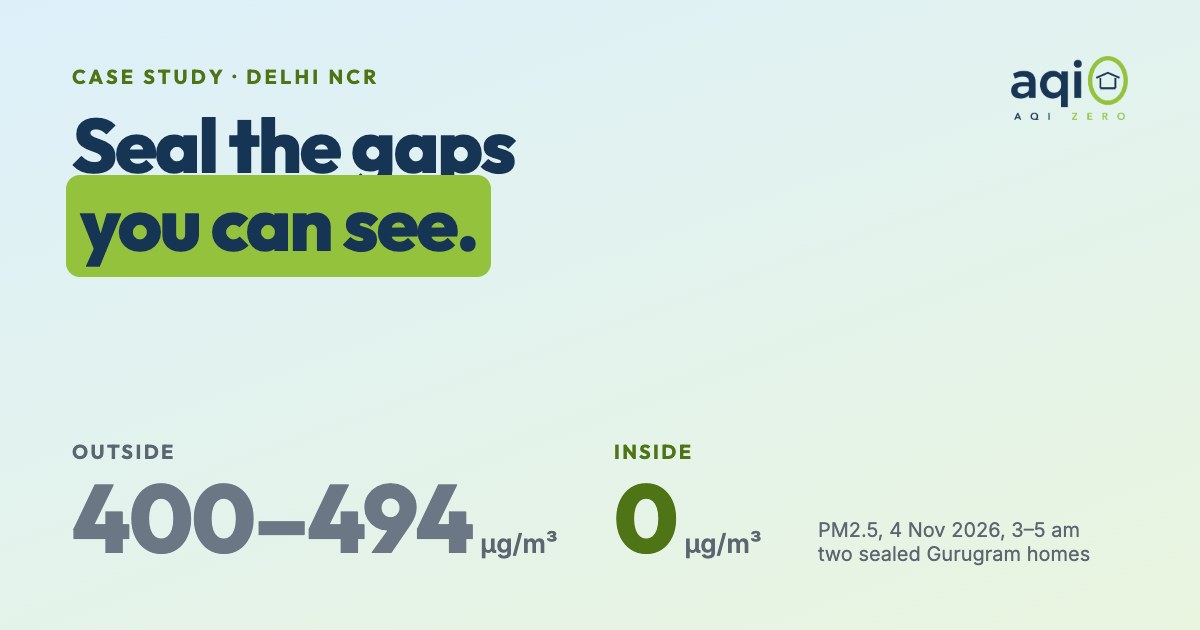
Three homes with aqi0, one lesson. On 4 Nov between 3 and 5 am, the nearest outdoor sensor read 400–494 µg/m³ PM2.5; inside two sealed Gurugram homes, three monitors read 0. Where the visible gaps were closed, night-time PM2.5 indoors fell to near zero, even with Severe air outside. Where a gap stayed open, the inside followed the outside, until it was closed.
Water has one pipe. Air has every gap.
Water reaches your home through one pipe. Filter it there and every tap runs clean. Air doesn’t wait for a pipe: it is everywhere, and every gap in a home is a way in.
aqi0 is a whole-home air purifier — technically, a positive-pressure fresh air system. It pushes filtered outdoor air in, so the home sits at a slight positive pressure and indoor air flows out through the gaps, instead of outside air flowing in.
That works when the outflow is spread over many small gaps you can’t see. One big gap — a door bottom, a cracked pane, a bathroom door left ajar — becomes the easy way. The pressure escapes there, and wind and exhausts pull outside air back in.
Seen gaps and unseen gaps
Seen gaps: close these
- Under doors to the outside: main, balcony, back, utility
- Old windows that don't shut tight
- Cracked glass, or a small hole in a pane
- AC pipe holes and old fixing holes in walls
- Bathroom doors left ajar; gaps around exhaust fans
- The gap under the kitchen door
Unseen gaps: leave these to us
Every home has hairline gaps in frames, joints and fittings. You can't see them and you don't need to chase them.
This is where the indoor air leaves. With the outflow spread across many of them, the pressure holds instead of escaping through one big opening.
Three homes, night by night
The same system in each home. What changed the nights was sealing. Each bar is one night’s median indoor PM2.5 between 11 pm and 6 am; the grey area is the outdoor level on the same nights. All values are µg/m³.
Home A SealedGurugram apartment · two monitors
- First nights 0–2 µg/m³. From 5 Oct, 20–50: up to three-quarters of the outdoor level. Air from the diffuser read 0, so the filters were fine; the leak was in the house.
- Turning the fan up helped for a while. Door-bottom seals alone made no difference.
- Bathroom doors that sat slightly ajar were tightened (12 Oct), and the door gaps and AC holes sealed (by 18 Oct).
- From 15 Oct to 5 Nov, every night under 15; 20 of 22 nights at 0–3. Same machine; the planned replacement wasn’t needed.
“The first night we’ve seen it be 0 through and through.” — the family, 13 Oct
Home B SealedGurugram floor · one monitor in the lounge
- 13–28 Oct: most nights 16–38.
- Pre-filter cleaned, doors and windows checked shut: no lasting change.
- 30 Oct: the visible gaps, including under the kitchen door, were covered at once, then sealed properly that weekend.
- 2–5 Nov: 0–4 inside, with 123–327 outside.
“Sealing. Really helped.” — the family, 5 Nov
Home C TapedCentral Delhi house, older building · one monitor
- Flagged at installation: doors to the outside needed sealing.
- Until 5 Nov: good nights 0–9, others 21–43; on 4–5 Nov, 108–113 inside with 219–290 outside.
- 6 Nov evening: an unused door to the outside balcony was taped shut. Inside fell from about 120 to under 15 in 40 minutes, and to 0 in 75, with about 255 outside.
- That night: 0–1 (readings to 2:40 am).
When outside air is 400+, a few minutes with a door open is enough
Air mixes fast. Home A, night of 3 Nov, with Gurugram’s CPCB AQI at 307: at 10:22 pm a single event, most likely a door opening, took the bedroom from 7 to 54 µg/m³ in six minutes.
The system brought it back, but it took about 1½ hours to reach 20 and 2¼ hours to reach 5. Later that night, with outdoor PM2.5 above 400, the same bedroom read 0.
Rough arithmetic: five minutes with a door open can swap 40–100 m³ of outside air, up to a fifth of a 2,000 sq ft home. At 400 µg/m³ outside, that lifts the whole home by about 30–80 µg/m³, and far more near the door.
Your 10-minute sealing check
- Doors to the outside: fit a brush or rubber strip at the bottom.
- Windows: shut and latched; foam tape on old frames.
- Glass: seal cracks and small holes.
- Walls: fill AC pipe holes and old fixing holes.
- Bathrooms: keep the doors shut; close gaps around exhaust fans.
- Kitchen: a strip under the door; chimney on while cooking, with the door ideally closed.
- Pre-filter: wash it every 7–10 days. A clogged pre-filter means less clean air in, and less pressure.
Reading your monitor at night
| Overnight reading | What it means |
|---|---|
| Under 15 µg/m³ | The home is sealed. This is what we aim for. |
| 20 or more, all night | A seen gap is still open somewhere. |
| A sudden jump | A door or window opened. It clears, but slowly, so keep openings short on bad nights. |
With the home sealed as designed and filters current, PM2.5 stays under 10 µg/m³ with fresh filters and under 15 µg/m³ across the filter cycle.
How we measured
- Inside: aqi0 monitors, one PM2.5 reading a minute. “Night” is the median from 11 pm to 6 am IST.
- Outside: hourly PM2.5 from government monitoring stations (CPCB network): the median of 4 stations in Gurugram and 8 in central Delhi. Where the stations were offline (3–4 Nov), the nearest public outdoor sensor. Gaps in the grey area are nights with no station data.
- Homes are not named. Data 2 Oct – 6 Nov 2026.
Download this case study as a 2-page PDF
Related: Inside vs outside: a month of PM2.5 readings from Delhi NCR homes · Why the kitchen door should be closed while cooking · How the aqi0 system works