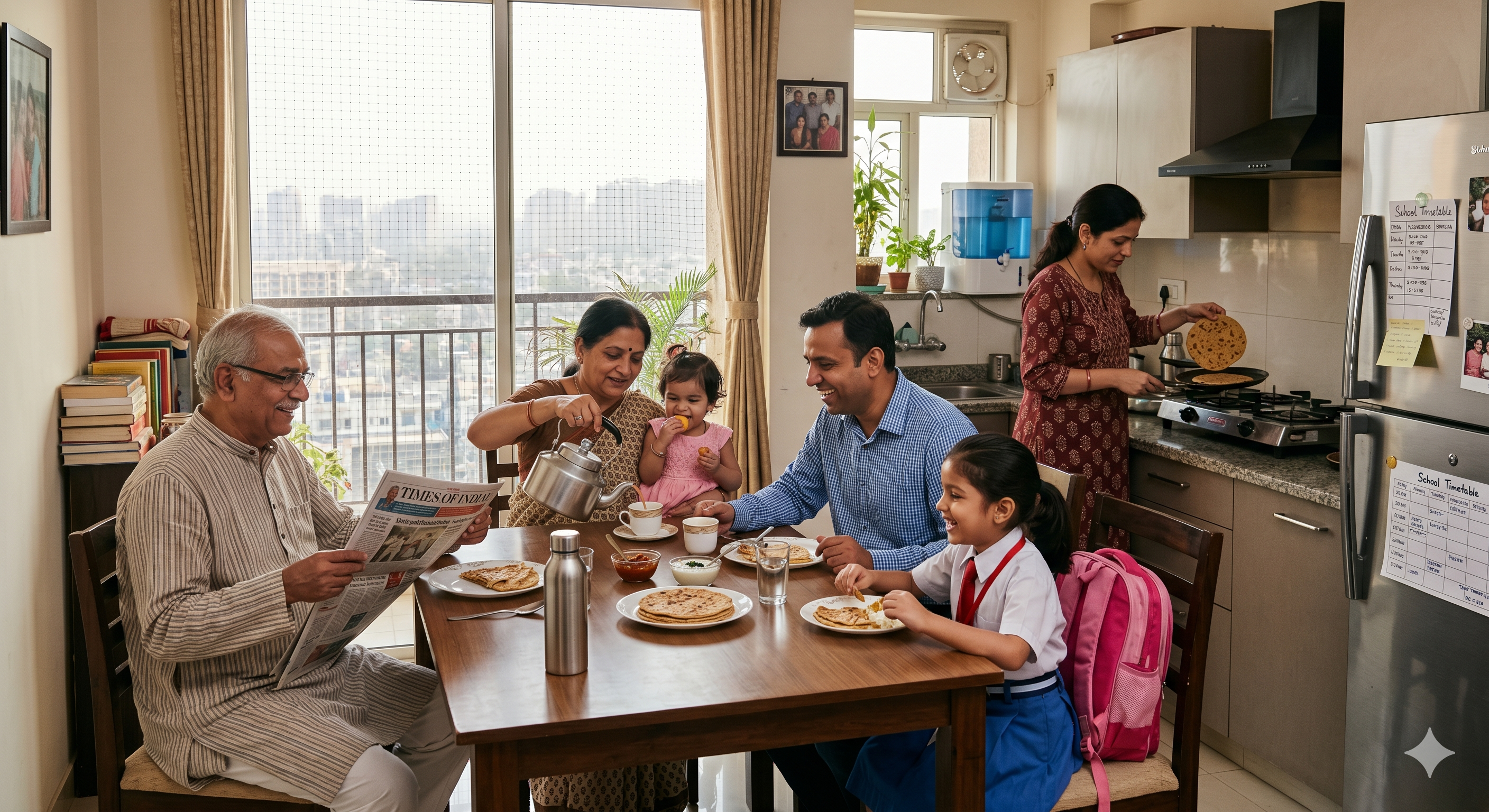
A three-generation Delhi family at breakfast in a clean modular kitchen, with the household water filter visible by the sink — the everyday upgrade that already exists for water

Can the Body Adapt to Air Pollution?

Your kitchen treats its drinking water. Maybe it’s the two-bucket candle filter you remember from your grandmother’s house. Maybe it’s the steel vessel of boiled water cooling on the counter every morning. Maybe it’s an Aquaguard on the wall, a Pureit by the sink, an RO under the counter, or a cheap inline filter snapped onto the tap. The form doesn’t matter — nearly half of Indian households practise some form of water treatment, and in urban kitchens the share is much higher. No one in your family drinks water straight from the tap; not your child, not your parents, not the household help, not the dog. Nobody worries any of them are “losing tolerance” to tap water by doing so — because everyone understands water doesn’t work that way. The body doesn’t get trained by drinking contaminated water; it gets damaged by it. The air your family is breathing is the same question, with the same biology, and the same answer. This blog is about why.

Watch · 8-min version the same argument as below, narrated — the five questions every Delhi NCR family asks, the household water-filtration analogy, the dose math, and the recovery evidence from twenty-five peer-reviewed studies.

Five questions every Delhi NCR family asks before they spend on a whole-home air purifier — and almost no one says out loud:

“I’ve lived in Delhi NCR my entire adult life. Whatever defences my body has built against this air over the years, won’t I lose them if I run a clean-air system at home for fourteen hours a day? After a year of clean indoor air, will I feel weaker stepping out than I do today — slower to shrug off a smoggy day at the office, more thrown off by a long drive across NCR?”

“My toddler has had a wheeze every winter since she was eighteen months old. The paediatrician keeps calling it ‘environmental’. If I switch on clean air at home now and her lungs stop reacting through the day, won’t her body forget how to cope when she steps out of the house — and won’t every visit to a grandparent’s flat, every cousin’s birthday party, every school day hit her harder than it does now?”

“My parents have been breathing this air for forty years. They’ve lived through every Delhi winter since the seventies, every Diwali, every stubble-burn season. Aren’t they already adjusted at this point? Won’t clean air at home actually unsettle them — set them back, make them feel worse outside instead of better, make the morning walk in the colony a struggle in a way it isn’t now?”

“Shouldn’t my kids be getting some exposure so their lungs develop properly? Their grandparents grew up in environments with kerosene stoves and street dust and seemed to come out of it fine. Isn’t that how the body learns to handle what’s around it — and aren’t we depriving our children of that natural toughening if we keep their home air clinically clean for the first ten years of their lives?”

“If I can’t fix the air outside anyway, what’s the point of clean air inside? The school bus, the walk to the park, the office commute, the weekend at a friend’s place — those hours are unfixable. Won’t every step outside the door undo whatever the system is doing inside the house, and isn’t this just an expensive way to feel briefly safe?”

These are the five questions we hear most often from families seriously thinking about it but who haven’t pulled the trigger. Every one of them rests on the same instinct — that your body trains on dirty air the way it trains on push-ups, or builds tolerance to it the way it builds immunity to a virus. It doesn’t. Air pollution is not a stressor your body strengthens against; it is a damage your body absorbs. There is no tolerance to lose, no toughness to forget, no developmental benefit your children miss out on if their home air is clean. The opposite is true on every count. The answer to all five questions is the same — no, your body does not work that way for the air we breathe in Delhi NCR. What follows is why, in plain language, with the research saved for the closer.

Before any of this, the one fact that makes everything else work

Without a purifier of any kind, what’s outside is what’s inside. Air moves through a Delhi home faster than most people realise — through every door-open, every window seal, every gap around a fan duct, every kitchen exhaust that pulls inside air out and lets outside air in to replace it. Within minutes of the outside number rising, the inside number catches up. If outside is 100 µg/m³ of PM2.5, inside is roughly 100. If outside is 500 on a winter morning after stubble burning, inside is 500. The only time indoor is higher than outdoor is when you cook — a kitchen tadka spike pushes a kitchen reading past 500 in ninety seconds. The only time indoor is lower without intervention is when outside has already dropped.

A common bedroom-purifier — the floor-standing tower with a HEPA filter — does a real job in a single closed room when the outside number is moderate. In a 150-square-foot bedroom with the door shut and windows sealed, it can pull a reading of 80 µg/m³ down to 20 or 30 inside an hour. But it stops working in two situations. The first is space: the moment you open the door or walk into the next room, the air mixes again — and one purifier per room across an Indian 3-BHK is four units running continuously. The second is the winter problem: when outside is 250 to 400 µg/m³, polluted air leaks back in faster than the filter can catch up. In a 300-plus square foot room, the floor of what a single recirculating purifier can hold is around 80 µg/m³. That floor is the high side of unhealthy. CO₂ is the separate disqualifier — no filter removes it, so a closed bedroom sealed with a purifier still reaches 1,200 to 2,500 ppm CO₂ by morning, well above the WHO 1,000 ppm guideline, regardless of how clean the particles are.

A whole-home positive-pressure system reverses the physics. It pulls outdoor air through medical-grade H13 HEPA filtration and pressurises the inside — clean air comes in, polluted air gets pushed out through the same gaps it used to leak in through. The indoor reading stays under 15 µg/m³ in every room, every season, door open or closed. That’s the one technical thing in this story; the rest is biology.

“Won’t I lose my toughness if I keep my house at clean-air levels?”

Toughness, in the sense most people mean it, is something the body trains for. Your muscles grow under load. Your heart adapts to running. Your immune system remembers viruses it has met before. Each of these works because there is a specific input the body knows how to respond to — weight, oxygen demand, a viral protein. Particulate matter has no such input. PM2.5 is a mix of soot, sulfate, nitrate, metals, organic compounds — chemically heterogeneous, with no single feature the body can identify and adapt to. The cells in your airways don’t see PM2.5 and learn to handle it better next time. They see PM2.5 and mount the same inflammation, the same oxidative stress, the same macrophage response they mounted yesterday and the day before. Worse — when chronic exposure pushes the alveolar particle burden past a certain point, the clearance machinery actually slows down rather than speeding up.

The water comparison is the cleanest way to see it. Your household has been treating its drinking water for as long as anyone can remember — boiled, candle-filtered, Aquaguard, RO, Pureit, the form changes by household and decade. Nobody in the family has gotten “softer” against tap water as a result of any of them. If you were given untreated tap water tomorrow, you would not handle it better because you had been drinking it; you would handle it worse, because contamination doesn’t train the gut. The same logic applies to air. What you experience as “toughness against Delhi air” is mostly habituation to symptoms — the morning chest tightness that you stopped noticing, the cough you stopped commenting on. The underlying biology is still being damaged at exactly the same rate. Running a clean-air system at home doesn’t take away a real defence; it removes a low-grade chronic injury that you had simply learned to ignore.

“My parents have been breathing this air for forty years — aren’t they already adjusted?”

This is one of the most difficult questions to answer honestly, because the assumption inside it is so understandable. The reality is that your parents are not adjusted. They are accumulated. Forty years of Delhi air has not built them up; it has loaded their alveolar macrophages, their cardiovascular system, and their cognitive reserve with the price of every one of those years. The breathlessness on stairs they laugh off, the slowing they call “age”, the chest infections that come twice a year instead of once — these are not signs of adaptation. They are early symptoms of accumulation. The peer-reviewed literature on older adults breathing chronically polluted air is consistent across every continent: cardiovascular risk, dementia risk, respiratory hospitalisation risk all rise with cumulative exposure, in a near-linear way.

Your parents have lived through every generation of household water treatment — the boiled-water vessel of their childhood, the ceramic candle filter you remember from their kitchen, possibly an Aquaguard later, possibly an RO now. No one in the family ever suggested any of those upgrades was going to “set them back” or weaken them against unfiltered water. Each one was understood as a quiet upgrade to the household, long overdue. The same upgrade exists for the air they breathe at home, and the same logic applies — what clean air does for them is not take away a defence; it stops adding to a hidden cost. Reducing daily exposure during indoor hours, which is the longest stretch they spend anywhere, slows the rate of further accumulation immediately. In short trials in which elderly adults switched on a home HEPA filter for as little as 48 to 72 hours, their blood pressure dropped 3 to 4 mmHg — a magnitude comparable to a single antihypertensive medication. They didn’t get “weaker” when they stepped outside the next day. They were measurably better-prepared for it.

“Shouldn’t my kids be getting some exposure so their lungs develop properly?”

The instinct to protect children by exposing them to small amounts of a hazard comes from somewhere real — small doses of a pathogen really do train the immune system, small amounts of physical stress really do strengthen growing bones. The instinct does not apply here. Notice that nobody applies it to water. Your children have been drinking treated water since infancy — boiled, candle-filtered, RO, whatever your household uses. Their immune systems developed perfectly well. Their gut bacteria settled in. They did not need any controlled exposure to contaminated water to “learn” how to be healthy. The water story is the air story. The science on children and air pollution is among the cleanest in environmental medicine, and it points in exactly the opposite direction.

Children’s lungs are not done at birth. Alveoli continue multiplying through age two; lung capacity rises until the late teens. Through that entire window, the input that determines how big and how strong the adult lung will be is the air the child has breathed. Decades of cohort research from California, where ambient pollution dropped substantially between the 1990s and 2010s, showed something striking: the proportion of fifteen-year-olds with clinically low lung function fell from nearly eight percent to under four percent as the air cleaned up. Children who moved from polluted communities to cleaner ones had their lung-function growth speed up. The same lungs, in the same bodies, responding to the air that was now around them.

The Indian picture is starker. Healthy never-smoker youth in Delhi NCR have spirometry results roughly seventeen percent below peers their age who grew up in rural Pauri Garhwal. There is no detectable “Delhi-tough” benefit from chronic Delhi exposure. The chronic exposure simply lowers the ceiling on what their adult lungs will be. Clean air at home, for fourteen of every twenty-four hours during the development window, is the single most protective input a parent can give. There is no exposure quota the body needs to fill.

“My toddler has had a wheeze every winter — won’t clean air at home leave her shocked when she steps out?”

No. The body is not “shocked” by polluted air after a stretch of clean air the way muscles are shocked by exercise after a layoff. What actually happens, in the bodies of children who get periodic breaks from polluted exposure, is that inflammation in the airways drops, mucus production normalises, and the airway is in a better position to handle the next encounter. The Beijing 2008 Olympics created a natural experiment that demonstrated this in adults — healthy young people whose biomarkers of airway inflammation fell by 5 to 70 percent during the sixteen-day cleaner-air window. When the pollution returned, those biomarkers rose again. The clean period had not made them more vulnerable; it had recovered them, and the recovery left them measurably better off going back into the dirty air.

For a child with a recurring wheeze, the practical version of this is straightforward. Fourteen hours of indoor air at under 15 µg/m³ a day is fourteen hours her airways spend not being inflamed. The cough at night either fades or stops. The “environmental” diagnosis the paediatrician keeps coming back to has, for fourteen hours of every twenty-four, no environment to react to. The trips to the grandparent’s house and the birthday party become what they should be — short outdoor exposures her airways have the reserve to handle, not the eighteenth straight hour of an ongoing low-grade injury.

“If outside is bad anyway, what’s the point of clean air inside?”

Ask the same question of water. You drink treated water at home — boiled, candle-filtered, RO, whatever your household runs. When you eat out, you drink restaurant water — sometimes filtered, sometimes not, often impossible to tell. When you visit a friend, you drink whatever’s offered. When you fly, you drink airline water. Those exposures are real. Nobody argues that they “undo” the treated water you drink at home, and nobody walks away from their household filter because the world outside isn’t clean. The cumulative dose still matters, and the part you control still matters most. Because total exposure is the integral of (concentration × time). The question that matters is not “is outside bad?” — it always is, year-round, with seasonal peaks but no clean months. The question that matters is during the hours when you have control, what is your family actually breathing?

Without a system, your home matches outside. With a system, your home holds at around 10 µg/m³. So during the fourteen indoor hours of a normal Indian day, a non-customer breathes air that’s eight times more polluted than what an aqi0 customer’s family is breathing. In plain language: your family is breathing roughly ten times cleaner indoor air, for the hours they spend at home, when you have a whole-home system. And the hours when they’re outside — the walk to school, the office commute, the visit to relatives — are the same with or without the system. The system does not weaken the outdoor hours; it strengthens the indoor ones, and the indoor ones are the bulk of the day, and the bulk of the day is most of what your body responds to.

The math holds in every season. In a Delhi summer with outdoor PM2.5 of around 80, your home tracks 80 without a system and holds 10 with one. In a Delhi winter with outdoor PM2.5 of 250, your home tracks 250 without a system and still holds 10 with one. The aqi0 number is the same in summer and winter. It is the same in Delhi proper and in Gurugram, in Noida and in Faridabad, in Lucknow and (in November-to-February) in Kolkata. The places where the air problem now affects 9 to 10 months of the year, not just the stubble-burn weeks, are exactly the places where the indoor lever is doing the most work.

Less is better. Period.

Step back from PM2.5 for a moment and look at the rest of the things that harm the body. Less sugar is better. Less salt is better. Less alcohol is better. Less ultra-processed food is better. Less screen time is better. Less stress is better. Less smoking — or, ideally, zero — is better. Nobody argues that you should eat a little sugar each day to train the pancreas, or that your liver needs a regular small dose of alcohol so it doesn’t “get used to being clean”, or that children should be exposed to a controlled amount of tobacco smoke so their lungs don’t lose tolerance.

Air pollution is no different. It is the one contaminant we have somehow culturally treated as a thing the body might “train” on. It isn’t. For PM2.5, exactly as for sugar and salt and alcohol and screen time, the dose-response is one-directional. Less is better. Always. Without exception. Without a protective minimum dose. Every microgram you avoid is a microgram of damage your body doesn’t have to absorb. That is all. The biology is not more complicated than that.

What the research actually says, briefly

Five-plus decades of peer-reviewed research from globally recognised institutions — Harvard T.H. Chan, USC, the WHO, AIIMS, Karolinska, NEJM, JAMA, The Lancet — converges on the same finding. The body responds to current air quality, not to past exposure history. When ambient pollution drops (Beijing Olympics 2008, Atlanta Olympics 1996, Dublin coal ban 1990), inflammatory and cardiovascular biomarkers improve in days. When indoor PM2.5 drops via a HEPA filter in randomised trials, the same markers improve in 48 to 72 hours. When children move from polluted communities to cleaner ones, their lung-function growth accelerates. When the air gets dirty again, the gains reverse. There is no demonstrated “tolerance” pathway for PM2.5 in any of this literature.

The single 2012 paper that has been used to argue otherwise — a contrarian piece by Cox in Dose-Response — has not been independently replicated, is contradicted by the WHO 2021 systematic review of over 500 papers, and is rejected by every major prospective cohort study. The mainstream peer-reviewed position is unambiguous.

If you want the studies with names, journals, sample sizes and PMIDs, we have the citation pack for you. This page is the version written for your family; the technical companion is the version written for your family doctor.

What this looks like in your home

Three things change, and they are the things customers describe to us most often:

  1. The morning chest tightness fades. The cough at night quiets — usually within two to three weeks.
  2. Sleep is heavier and recovery is real. The “Delhi tiredness” that is different from regular tiredness lifts. CO₂ also drops below the 1,000 ppm cognitive threshold overnight, which is the second mechanism here.
  3. The recurring “environmental” symptoms in young children — the wheeze, the seasonal asthma — settle into something quieter. Paediatricians notice it. So do grandparents.

None of this requires Delhi air to change. None of this requires you to give up your morning walk, your kids’ school, your visits to extended family. The system does its work during the hours your family is at home, and the hours your family is at home are most of the day.

Air is the next utility. Water already is — your household has been treating its drinking water in some form for generations, and never looked back. Less of a harmful thing is always better; the air your family breathes for fourteen hours a day is the largest single lever on that available to you.

FAQ

We treat our drinking water at home — candle filter, boiled, Aquaguard, RO. Isn’t a whole-home air purifier the same idea? Yes. The biology is the same, the logic is the same, and the family-level decision is the same. The body does not develop tolerance to contaminated water; it absorbs damage from it. The body does not develop tolerance to PM2.5 either. Whichever water-treatment method your household uses, it has solved one half of the household-contaminant problem — for most Indian families, generations ago. A whole-home positive-pressure air system solves the other half. Air is the next utility.

Is there any kind of “training” benefit to breathing polluted air? No. Across more than twenty-five peer-reviewed studies — Olympic natural experiments, HEPA RCTs, children’s-cohort studies and dose-response work — no positive adaptation to PM2.5 has ever been demonstrated. The biology that handles particulate matter is structural; under chronic load, it slows down rather than speeds up. The same is true of water: no controlled study has ever shown that drinking contaminated water “trains” the gut to handle it better.

My family has always lived in Delhi. Doesn’t that mean our lungs are different? Yes, but not in the protective direction. Indian adults from polluted urban regions show systematically lower lung function than rural Indian peers and lower than European reference populations. The chronic exposure lowers the ceiling; it does not raise it.

What about the elderly? Is it too late for them? Earlier is better, but the benefit at every age is real. In trials with elderly adults using home HEPA filters for as little as 48 to 72 hours, blood pressure dropped by an amount comparable to adding a blood-pressure medication. The trajectory forward improves; the damage already accumulated does not unaccumulate, but it stops adding.

Will my kids’ lungs develop properly with clean indoor air? Better than with polluted indoor air. There is no “exposure quota” their lungs need. Cleaner air during development consistently produces larger and stronger adult lungs.

What’s the catch? That the system has to work as engineered, year-round, in every room — not just one closed bedroom. That is the difference between a recirculating purifier (single-room, weather-dependent, CO₂-blind) and a whole-home positive-pressure system. Both exist; only one solves the whole problem.

I want the actual research. Read the technical companion piece — 25 studies, with citations and the dose math.


Want clean air for your family? WhatsApp us — we’ll walk you through a site survey for your home.