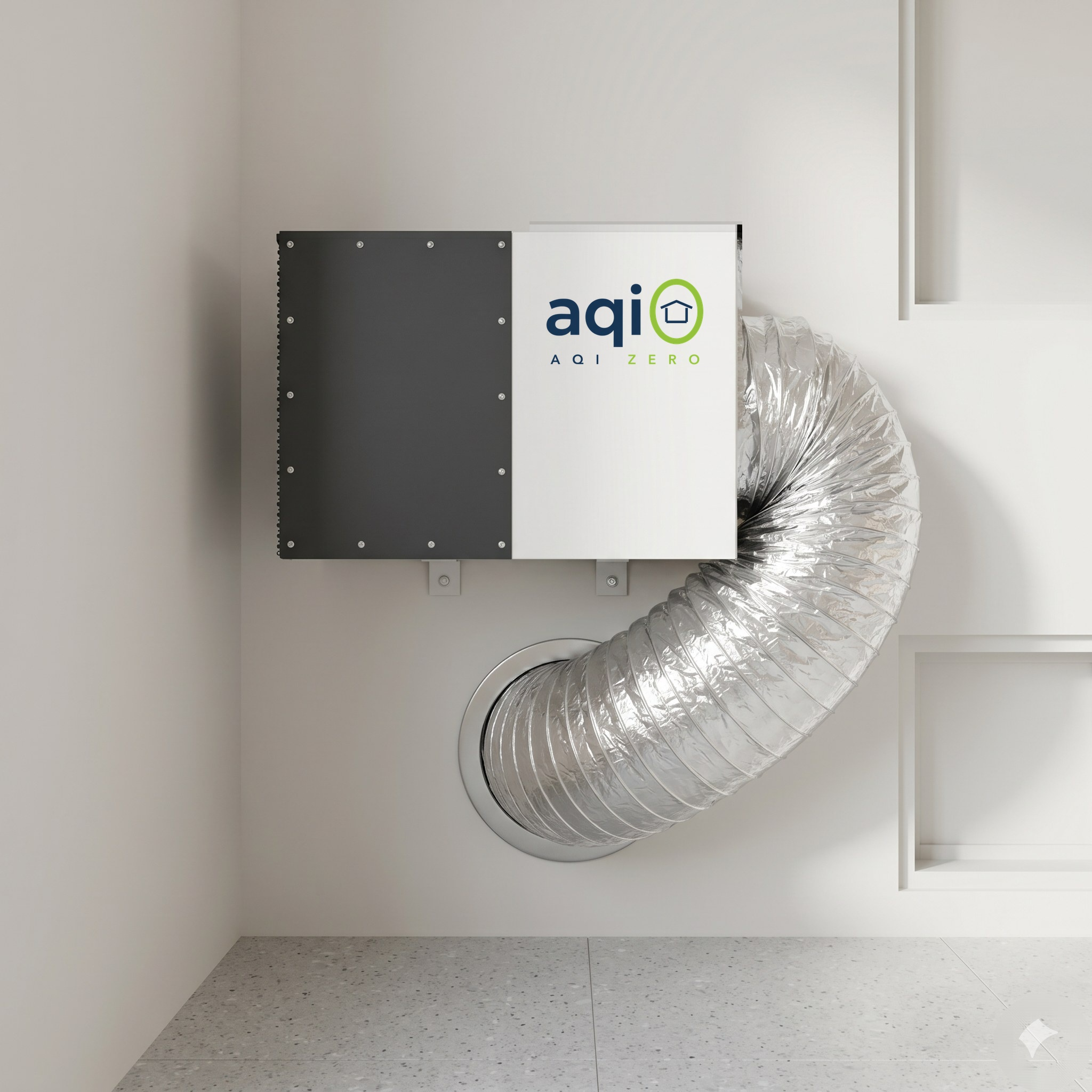
An aqi0 fresh air system installed on an interior wall — louver, intake duct, filter housing and indoor unit

How the aqi0 Fresh Air System Works

Most whole-home air purifiers — what we technically call fresh air systems — are sold as a box on a wall: you don’t get to see what’s inside, you don’t get airflow numbers, you don’t get a filter spec. We’ve taken the opposite approach. This page walks through every component of the aqi0 system, why we chose it, and one decision about the filter that’s the opposite of how this industry usually works.

Watch · the full argument in 8 minutes the canonical aqi0 walkthrough — the stakes, the year-round physics, the mass-balance limit of every room purifier, the AQI Zero promise, and the recovery evidence, all in one narrated video.

The job, in one paragraph

A fresh air system has one job: replace the air inside your home with cleaner air, continuously. Outdoor air — the bad stuff, full of PM2.5, PM10, and traffic-grade pollutants — gets pulled through filtration, pushed indoors at slight positive pressure, and the displaced indoor air (which is now full of CO₂, cooking VOCs, and exhaled humidity) leaks out through the natural gaps every home has: door undercuts, exhaust ducts, kitchen chimneys, window seams. There is nothing exotic about the physics. The engineering is in doing this quietly, efficiently, and for years in conditions far worse than what a Western system was designed for.

Our system is built specifically for Indian conditions: PM2.5 outdoor concentrations that hit 300+ µg/m³ in winter, dust loads from construction and unpaved roads, monsoon humidity, and an electrical environment that swings ±10% on any given day. Delhi NCR is not the only city with this problem — the Indo-Gangetic Plain (Lucknow, Patna, Kanpur, Varanasi, Agra), Kolkata in winter, and even cities long thought “clean” (Mumbai, Pune, Bengaluru, Chennai) all sit above WHO PM2.5 guidelines, year-round. And the body does not “adapt” to that air — it accumulates damage from it, the same way it would accumulate damage from contaminated drinking water (why).

Here’s what’s inside.


The five components

            OUTDOOR                  WALL                   INDOOR

                                    ┌────┐
            polluted air ───────────│ 1  │──────────────────► clean air
            (PM2.5, dust, VOCs)     │ 2  │                    enters home
                                    │ 3  │                    at positive
                                    │ 4  │                    pressure
                                    │ 5  │
                                    └────┘

            1. Outdoor intake louver (10" duct)
            2. Washable pre-filter — coarse particles
            3. H13 HEPA filter (362×276×50 mm) — fine particles
            4. EC fan — variable speed, low-watt
            5. Indoor outlet vent

Five things. That’s the whole system. We’ll go through each.


1. The outdoor intake

The system starts with a 10-inch circular opening in your external wall — either core-cut through brick/RCC, or cut through toughened glass. A weatherproof louver sits flush with the outer face. Inside, a 10” aluminium duct runs to the unit (typically a 1–7 metre run depending on where the unit sits relative to the wall).

Why a louver, not just an open hole: rain ingress protection, large-debris exclusion (leaves, insects), and a small bug-screen that we keep in front of the pre-filter so the pre-filter never sees anything bigger than a few millimetres.

What this does not do: it doesn’t filter anything. The louver is just a weatherproof entry. All filtration happens inside the unit, two stages deep.


2. The pre-filter — your DIY layer

The first filtration stage is a washable pre-filter. It traps the heavy stuff: dust, lint, hair, anything visible to the eye, anything you’d see settle on a window ledge in Gurugram in three days.

It looks like and works like an AC pre-filter. You pull it out, vacuum or rinse it, and slide it back in. Two minutes. We recommend doing this every 7–10 days during the active pollution season (October to February) and every 2–3 weeks the rest of the year.

Why is this a separate stage? Because the H13 HEPA filter behind it is expensive. A pre-filter that catches 90% of the visible particles before they hit the HEPA means the HEPA stays cleaner, lasts longer, and maintains its rated efficiency for the full filter-change interval. Without a pre-filter, the HEPA loads up in weeks instead of months.

This is also the only DIY-maintainable part of the system. The customer never has to touch the HEPA — that’s our job, on the AMC visit.


3. The HEPA filter — and the decision behind it

This is where most fresh-air-system pages get vague. Brands talk about “true HEPA” or “99.97% efficiency” without ever telling you the filter grade, the dimensions, or where you’d buy a replacement if the brand disappeared tomorrow.

We’re going to tell you all of that.

What’s in our system

Filter grade: H13 HEPA. Captures 99.95% of particles ≥ 0.3 µm, including PM2.5, PM10, smoke, pollen, viral aerosols, and most bacteria. Rated to EN 1822, the European standard for HEPA classification.

Filter dimensions: 362 × 276 × 50 mm, with ~80 pleats at a 4 mm pitch on PP melt-blown media (no fibreglass).

That second number — the dimensions — is where the interesting decision is.

The dimensions decision

Walk into any fresh-air-system competitor’s product page and you’ll notice something: nobody publishes the filter dimensions. Why? Because most fresh-air-system brands in this category use odd, proprietary filter sizes that are not available anywhere else. Not at any major electronics retailer, not at Croma, not on Amazon, not in any HVAC parts catalog in the world. If your filter is some non-standard size like 380 × 290 × 45 mm or 410 × 305 × 60 mm, the only place on the planet you can buy a replacement is the same company that sold you the system. That’s not an accident. That’s the business model — bind you to the size, then bind you to the price.

We chose the opposite path on purpose.

The filter size we use — 362 × 276 × 50 mm — is the same dimensional standard used across the large-room indoor air purifier category in India for consumer-replacement filters. That’s a deliberate choice. It means:

  1. You are never locked in. If something happens to us — and we’re a young company, we have to be honest about that — H13 replacement filters in this exact size are stocked at Croma, Reliance Digital, Amazon India, and across half the country’s electronics retail. You can keep your system running.

  2. Your AMC is on a competitive footing forever. We have to deliver value better than the off-the-shelf alternative, because the off-the-shelf alternative is real and accessible. There’s no proprietary-filter rent we can extract.

  3. The system isn’t held hostage by us. A fresh air system installed in your home is a 10+ year asset. The economics of the next ten years should not depend on us not raising prices.

This is the opposite of how almost every other fresh-air-system brand sets up the maintenance economics — and it’s deliberate.

Standard-sized, but built for outdoor

Here’s the part that took longer to figure out.

An off-the-shelf H13 filter at this size will physically fit in our unit. You can install one tomorrow if you want to. It will work. But the off-the-shelf consumer-replacement filters in this size are designed for indoor recirculation — already-conditioned room air, low humidity, low dust load. That’s a comfortable filtration job.

Our system is doing the harder job: filtering raw outdoor air at the point of intake — Delhi NCR air that hits 300+ µg/m³ PM2.5 in winter, carries monsoon humidity, construction dust, and seasonal smoke from stubble burning and Diwali. The same filter media performing both jobs will load faster and lose efficiency on the outdoor side.

So our filter sits in the same external dimensions as the consumer-replacement standard, but the media inside is engineered specifically for outdoor intake — moisture-tolerant, higher dust-load tolerance, and rated to hold efficiency for the full AMC interval under real Delhi-NCR conditions.

The customer position is simple: industry-standard sized, but built better for outdoor. An off-the-shelf replacement will work as a fallback. Ours performs better at the same size, for the harder job our system is actually doing.


4. The fan — quiet, low-watt, 24/7

The fan is a backward-curved EC centrifugal fan, mounted in-line behind the HEPA stage. EC stands for “electronically commutated” — a brushless DC-style motor with a built-in driver. The two practical implications:

Rated airflow: ~700 m³/h. Effective airflow (after pressure loss across the loaded HEPA): ~500 m³/h.

That’s enough to deliver one full air change every 30 minutes in a 1,000 sq ft home, every 46 minutes in 1,500 sq ft, and every 61 minutes in 2,000 sq ft (assuming 9 ft ceilings). Most homes are sized for one unit; homes above 2,500 sq ft typically get two.

Power draw: ~30 W at the normal operating voltage of 4–5 V on the potentiometer. Even running 24×7, that’s under ₹170/month at ₹8/unit. Cheaper than the standby power on most refrigerators.

Sound level: comparable to a ceiling fan on speed 2 — measurable, but not noticeable in normal household ambient sound. The fan sits behind the filtration stages, not directly inline with the outlet vent, which helps. We can dial it up to 6 V on a peak-AQI day to push more air; the sound increases proportionally.

Why an EC fan specifically: rated 40,000-hour operating life on the bearing, well-documented serviceability, and 1-year fan warranty no-questions-asked. EC technology is the standard in commercial HVAC for the same reasons — high efficiency at low RPM, long bearing life, and predictable, repairable failure modes.


5. The body and electricals

The unit body is high-grade sheet metal — what we call our “Clean Cut” enclosure. Powder-coated, fully sealed at the seams. Dimensions: roughly 14” wide × 17” tall × 20” deep (about 1.15 × 1.4 × 1.65 ft), small enough to mount in a utility closet, false ceiling void, or behind a custom MDF cover.

Filter access: a hinged door on the side gives one-pull access to the pre-filter. The HEPA sits one layer behind, accessible via a second panel.

Electrical: standard 6 A plug point near the unit. No special wiring, no inverter compatibility issues — the unit is small enough that you can plug it into a UPS-backed line if you want it to keep running through power cuts.

Mounting: wall-bracket suspension, vibration-dampened. The unit is rigid; the duct is flexible aluminium.


How you operate it

Three rules, in priority order:

  1. Run it 24/7. Switch off only if you’re traveling for 4+ days. The whole logic of positive-pressure ventilation breaks if you cycle the unit on and off — you lose pressurization, polluted air starts leaking in through the same gaps that should be venting clean air out.
  2. Keep doors and windows closed. The system is the ventilation. Opening windows during high-AQI hours pulls in unfiltered air that overwhelms what the unit can clean. (Open windows post-monsoon or on a 30-AQI day if you want — but on a 200-AQI day, the system is doing the job.)
  3. Use the kitchen chimney while cooking, with the kitchen door closed if possible. Cooking generates a high-PM2.5 plume that’s specifically meant to exit through the chimney — and this is a positive-pressure system, so the kitchen door being closed during cooking lets the plume vent properly through the chimney instead of getting pushed back into the rest of the home.

The full spec, on one screen

Spec Value
Coverage Up to 2,000 sq ft (2–4 BHK). Two units for 2,500+ sq ft.
Rated airflow ~700 m³/h
Effective airflow ~500 m³/h (with loaded H13 HEPA)
Filter grade H13 HEPA (EN 1822, 99.95% @ ≥0.3 µm)
Filter dimensions 362 × 276 × 50 mm — industry-standard consumer-replacement size, off-the-shelf compatible (deliberate, see above)
Filter media PP melt-blown, no fibreglass
Fan type EC backward-curved centrifugal
Speed control 0–10 V potentiometer, set-and-forget
Operating voltage 4–5 V normal, up to 6 V peak AQI
Power draw ~30 W (normal)
Electricity cost Under ₹170/month at 24/7, ₹8/unit
Sound level Comparable to ceiling fan speed 2
Dimensions (unit) ~14” W × 17” H × 20” D
Wall opening (intake) 10” circular
Filter access opening 12” × 12” square
Electrical requirement 6 A plug point near the unit
Body High-grade sheet metal, powder-coated
PM2.5 result <10 µg/m³ with fresh filters; <15 µg/m³ sustained (WHO 24-h guideline)
CO₂ result <1,000 ppm continuous (WHO guideline)


What it costs

All-in installed price: ₹82,600 (incl. 18% GST). Annual maintenance contract: ₹14,750/year (incl. GST) — covers six filter-change visits per year, machine cleaning, and the aqi0 Wi-Fi AQI monitor stays included free if the AMC is signed on the same invoice as the install.

Same pricing across Delhi NCR. Installation (core cut, ducting, electrical termination, louvre placement, post-install AQI verification) is included in the unit price. Two-year prepay options and the full pricing breakdown live on the pricing page.


What we don’t do, and why

A few things we deliberately don’t include — for now or by design:


Where this fits in your decision

If you’re comparing fresh air systems for your home, the things to actually compare across brands are:

If a brand won’t answer those questions in writing on their product page, that’s information too.

We’ve put all of ours on this page on purpose.


Want to see one running?

If you live in Delhi NCR and you want to see the system in operation before you commit, we’ll bring an AQI monitor to your home and run a 20-minute before-and-after measurement at no cost. Outdoor reading, indoor reading after install, no obligation.

Call or WhatsApp +91 9667672740 — or request a site visit and we’ll come out within a week.