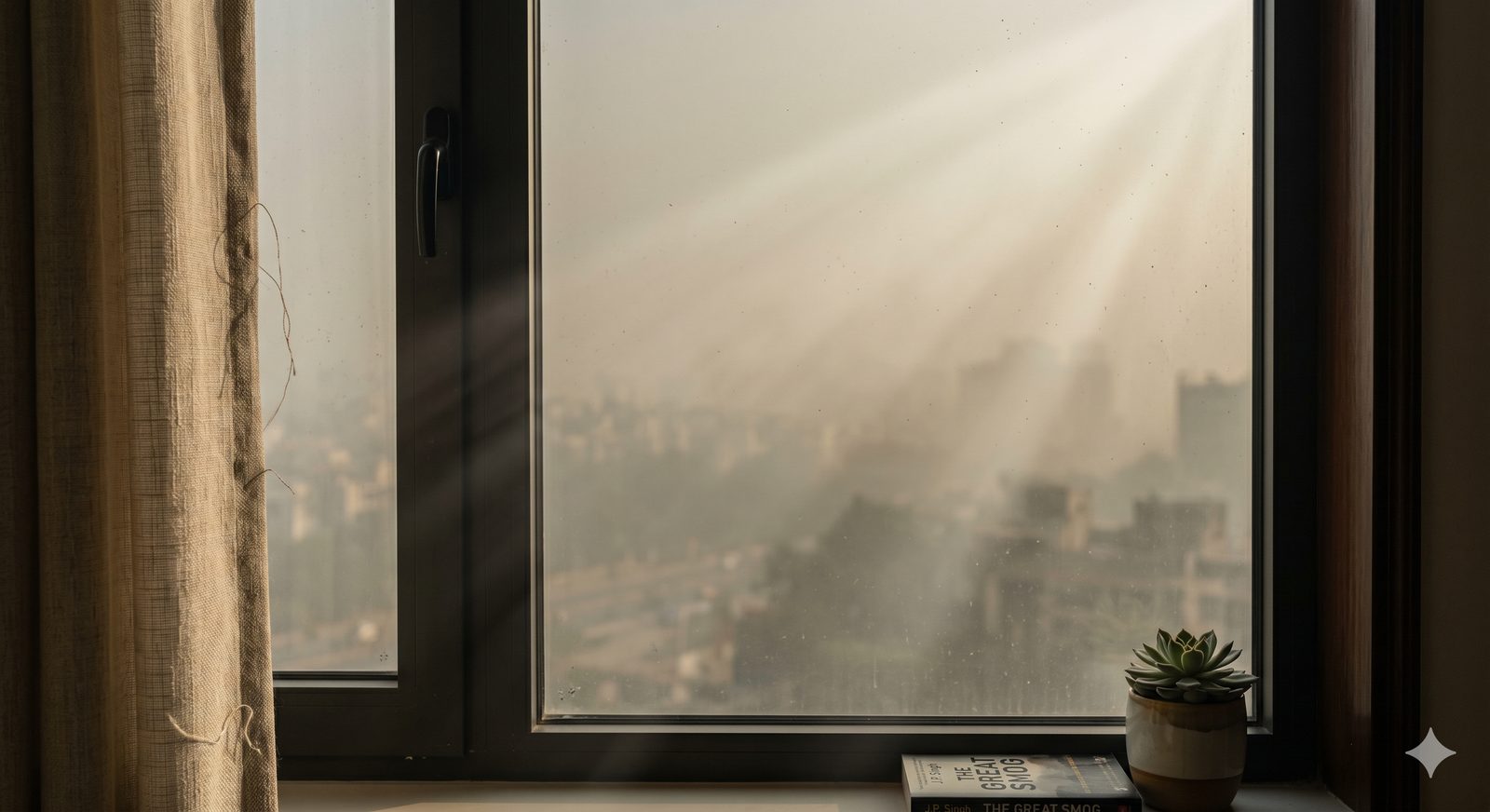
Sunlight through a home window — what clean indoor air should look like

How to Reduce PM2.5 at Home in India: 10 Methods, Ranked Honestly

The single-paragraph answer: the only intervention that reliably keeps indoor PM2.5 under the WHO safe limit (15 µg/m³) year-round in an Indian metro is a positive-pressure fresh air system with H13 HEPA filtration. Air purifiers work but only one room at a time. Most other “solutions” — houseplants, window fans, ionizers — are placebo or counterproductive. Detailed breakdown below.


The situation we’re up against

Delhi NCR’s annual mean PM2.5 is 80-110 µg/m³ — 6-7× the WHO 24-hour guideline of 15. Mumbai, Bengaluru, Chennai, Hyderabad, Kolkata all exceed the WHO limit for 8-10 months a year. Indian homes are not sealed environments; research across Indian cities shows indoor PM2.5 is typically 60-110% of outdoor levels when nothing is done to control it.

Indoor sources add to this: - Cooking on gas/LPG stoves without a chimney — spikes of 200-500 µg/m³ during cooking - Candles, incense, mosquito coils — each emit intense PM2.5 for their duration - Dust from infiltration — every gap in doors, windows, and walls - Indoor activities — vacuuming stirs settled dust back into the air

Fixing this needs a layered strategy. Not every method works. Below is the honest ranking, based on measurement data from residential installs and the peer-reviewed literature.


Method 1 — Install a fresh air system with H13 HEPA

Effectiveness: ★★★★★ (highest)

A positive-pressure fresh air system pulls ~500 m³/h of outdoor air through a clinical-grade H13 HEPA filter (≥99.95% at 0.3 µm) and pushes it into your home. The slight positive pressure created (~10-25 Pa) prevents unfiltered outdoor air from leaking in through gaps — the single biggest indoor-PM2.5 source in typical homes.

What you get: - Indoor PM2.5 < 15 µg/m³ sustained (under the WHO limit) most of the year - Indoor PM2.5 < 45 µg/m³ even during peak outdoor AQI 500+ episodes - Whole-home coverage from a single unit (up to 2,000 sq ft) - CO₂ simultaneously controlled (< 1,000 ppm) — no purifier does this

Cost & effort: One-time install ₹70,000 + GST (₹82,600 all-in) + ₹12,500 + GST/year AMC (₹14,750 all-in) + ~₹170/month electricity.

Caveats: Requires an exterior wall or window with duct access. Typically needs one full day to install.

Full spec and pricing → · How it works →


Method 2 — Air purifier per room (H13 HEPA)

Effectiveness: ★★★★ on a “moderate” outdoor-AQI day, ★★ once outdoor AQI crosses 250

A HEPA air purifier recirculates the air already in one room through a filter. On a “moderate” outdoor day (PM2.5 ≤ 80 µg/m³), a sized purifier (CADR ≥ 300 m³/h) can hold a closed bedroom around 60-80% below outdoor. Performance drops sharply as outdoor concentration rises. An independent 9-day test in a Delhi office measured 49% average PM2.5 reduction by a premium purifier, and indoor air at its best was still 2.5× the WHO 24-hour limit. The math is mass balance: as outdoor PM2.5 climbs, infiltration into the room scales with it, and a single recirculating box can’t outrun an unbounded source. (Why purifiers stall above outdoor AQI 250 →)

What it can’t do: - Reduce CO₂ (purifiers are filters, not ventilators — see Fresh Air vs Purifier →) - Work across multiple rooms simultaneously - Block infiltration — new unfiltered air keeps entering - Keep indoor PM2.5 anywhere near the WHO 15 µg/m³ limit when outdoor crosses 250 µg/m³ — true for the category, not any one brand

Cost: ₹20,000-₹40,000 per unit, plus ₹4,000-₹8,000/year in replacement filters. For a 4-room home, that’s ₹1-1.5 lakh upfront + ₹25,000/year.

Best use case: Temporary short-term protection (e.g. during Diwali week before permanent fix is installed), or a single-room situation like a studio apartment.


Method 3 — Aggressive kitchen exhaust

Effectiveness: ★★★ (essential, but limited scope)

Cooking on gas/LPG without good exhaust ventilation generates PM2.5 spikes 10-20× your normal indoor baseline. This isn’t optional — it’s the single biggest preventable indoor source.

What to do: - Use the chimney/exhaust on high for the full duration of cooking, plus 10 minutes after - Keep the kitchen door closed during cooking (contains the point source) - Open kitchen windows only after outdoor AQI is verified low - Consider upgrading underpowered chimneys (minimum 1200 m³/h suction for Indian kitchens)

This fix only addresses cooking-generated PM2.5, not outdoor infiltration — but cooking alone can contribute 30-50% of daily PM2.5 exposure in homes where chimney use is sporadic.


Method 4 — Eliminate indoor combustion sources

Effectiveness: ★★★ (underrated)

Substitutes: electric diffusers (no combustion), LED candles, plug-in mosquito repellent (not perfect, but cleaner than coils), external smoking area.


Method 5 — Seal major infiltration paths

Effectiveness: ★★ (trade-off with CO₂)

Sealing gaps around doors, windows, AC wall sleeves, electrical conduits, and plumbing penetrations reduces how much unfiltered outdoor PM2.5 enters the house.

Catch: Sealing also traps CO₂. A well-sealed home with 4 occupants will see CO₂ climb past 1,500-2,500 ppm overnight, which impairs sleep quality and next-morning cognitive performance (see CO₂ in the bedroom → — coming soon).

Conclusion: Worth doing if you have mechanical ventilation (a fresh air system) to replace the infiltration path. Counterproductive if it’s your only air-quality strategy.


Method 6 — Use an HEPA-filter vacuum, damp-mop don’t sweep

Effectiveness: ★★

Impact is modest in terms of averaged daily PM2.5, but real during and after the activity.


Method 7 — Don’t dry laundry indoors

Effectiveness: ★★

Drying wet clothes indoors raises humidity, which keeps airborne particulates suspended longer and encourages mould in humid-climate cities. In summer-monsoon (Jun-Sep), if outdoor drying isn’t viable, use a tumble dryer, an enclosed balcony with cross-ventilation, or a dehumidifier.

Secondary benefit: reduces mould spore contribution to respiratory symptoms, which is separate from PM2.5 but correlated in most air-quality-sensitive households.


Method 8 — Check your own AQI (the awareness fix)

Effectiveness: ★★ (you can’t improve what you don’t measure)

A simple CO₂ + PM2.5 monitor (₹3,000-₹5,000 on Amazon India) transforms the problem from abstract to actionable. You’ll see: - How high PM2.5 climbs during cooking without the exhaust on - How CO₂ rises when bedroom doors are closed overnight - Whether outdoor AQI today is worth opening windows for

Brands commonly available in India: IKAIR, Temtop, Atmotube, Kaiterra (also aqi0’s own monitor, launching mid-2026).

This doesn’t reduce PM2.5 by itself, but it changes behaviour in ways that do.


Method 9 — Window fans and whole-house fans

Effectiveness: 0 to negative (do not use in Indian cities)

Window fans pull outdoor air directly inside. In Delhi NCR during most of the year, outdoor PM2.5 is 100-300+ µg/m³. Pulling that air in unfiltered increases indoor exposure.

A whole-house fan (attic exhaust) is designed for cooling in moderate climates — it pulls outdoor air through open windows. Also 100% counterproductive in Indian cities.

These tools are designed for contexts where outdoor air is clean. That’s not us.


Method 10 — Houseplants

Effectiveness: 0 (placebo)

This one needs to be said explicitly because the internet is saturated with plant-filled Pinterest boards claiming to “clean your indoor air”.

The evidence: - The original NASA “clean air plants” study (1989) used sealed chamber tests — not representative of real rooms with air exchange. - Cummings and Waring (2020), “Potted plants do not improve indoor air quality: a review and analysis of reported VOC removal efficiencies”, published in Journal of Exposure Science & Environmental Epidemiology, concluded that you’d need 100-1,000 plants per square meter of floor space to match the air-exchange effect of a single outdoor-air intake. - For PM2.5 specifically, houseplants have effectively zero measurable effect in residential-scale deployment.

Have plants because they look nice. Don’t expect them to reduce PM2.5. They don’t.


Ionizers, ozonators, electrostatic precipitators — avoid

These deserve a separate warning, though they don’t make the “methods that work” list:

If a product promises “fresh air” through any kind of charged-particle or ozone mechanism, skip it. HEPA + ventilation is the answered science.


The stack that actually works

Honest priority order for an Indian home trying to reduce PM2.5:

  1. Fresh air system with H13 HEPA — the one intervention that reliably hits WHO-guideline indoor levels. Whole home, all year.
  2. Aggressive kitchen exhaust — solves the single biggest indoor source
  3. Eliminate indoor combustion (incense, mosquito coils, indoor smoking) — free to fix, significant impact
  4. HEPA vacuum, damp-mop — eliminate the activity-driven spikes
  5. Check your own AQI with a ₹5k monitor — behavioural awareness

Everything beyond this list is either marginal or placebo. Don’t invest time or money in methods 6-10 until 1-5 are in place.


The one-shot answer for the busy reader

If you have ₹90k-1 lakh and want the most impactful single purchase: install a positive-pressure fresh air system with H13 HEPA. Nothing else matches the whole-home year-round reduction. Purifiers are a stopgap. Everything else is incidental.

If you don’t have that budget today, start with the kitchen exhaust, eliminate incense/coils, and get a ₹5k AQI monitor to make the problem visible. Then save for the fresh air system.


Frequently asked

What about Delhi’s “outdoor air is too polluted, so staying indoors is safer”?

This assumes homes are sealed environments. They aren’t. Indoor PM2.5 in typical Indian homes is 60-110% of outdoor. Being indoors without filtration is barely different from being outdoors, except you also accumulate CO₂.

Do AC units filter PM2.5?

Standard split AC filters are MERV 4-8 — they remove large particles but let PM2.5 pass through. Some premium ACs (Daikin, LG, some Samsung) offer “PM2.5 filters” that are typically MERV 13-15; these reduce PM2.5 in the air the AC circulates but don’t address new air entering the home through gaps. Helpful but not sufficient.

How much can opening windows help?

On rare days when Delhi AQI is below 50 (maybe 10-20 days a year during August-September monsoon peak), opening windows briefly is genuinely refreshing. Otherwise, check the AQI first — if outdoor PM2.5 is above 35 µg/m³, opening a window increases your exposure.

What’s the first measurable PM2.5 reduction I’ll see after a fresh air system installs?

Customer data across our Indian installs shows indoor PM2.5 drops from 80-180 µg/m³ (typical pre-install baseline during NCR winter) to under 20 µg/m³ within 2-3 hours of first operation. Live monitor readings during install make this visible to the homeowner in real-time.


Book a free site survey

aqi0 installs across Gurugram, South Delhi, Noida, and Faridabad. Our team measures your current indoor PM2.5 and CO₂, recommends the right configuration, and gives a detailed quote with no obligation.

+91 9667672740  •  WhatsApp  •  [email protected]