When Will Indian Air Be Clean?
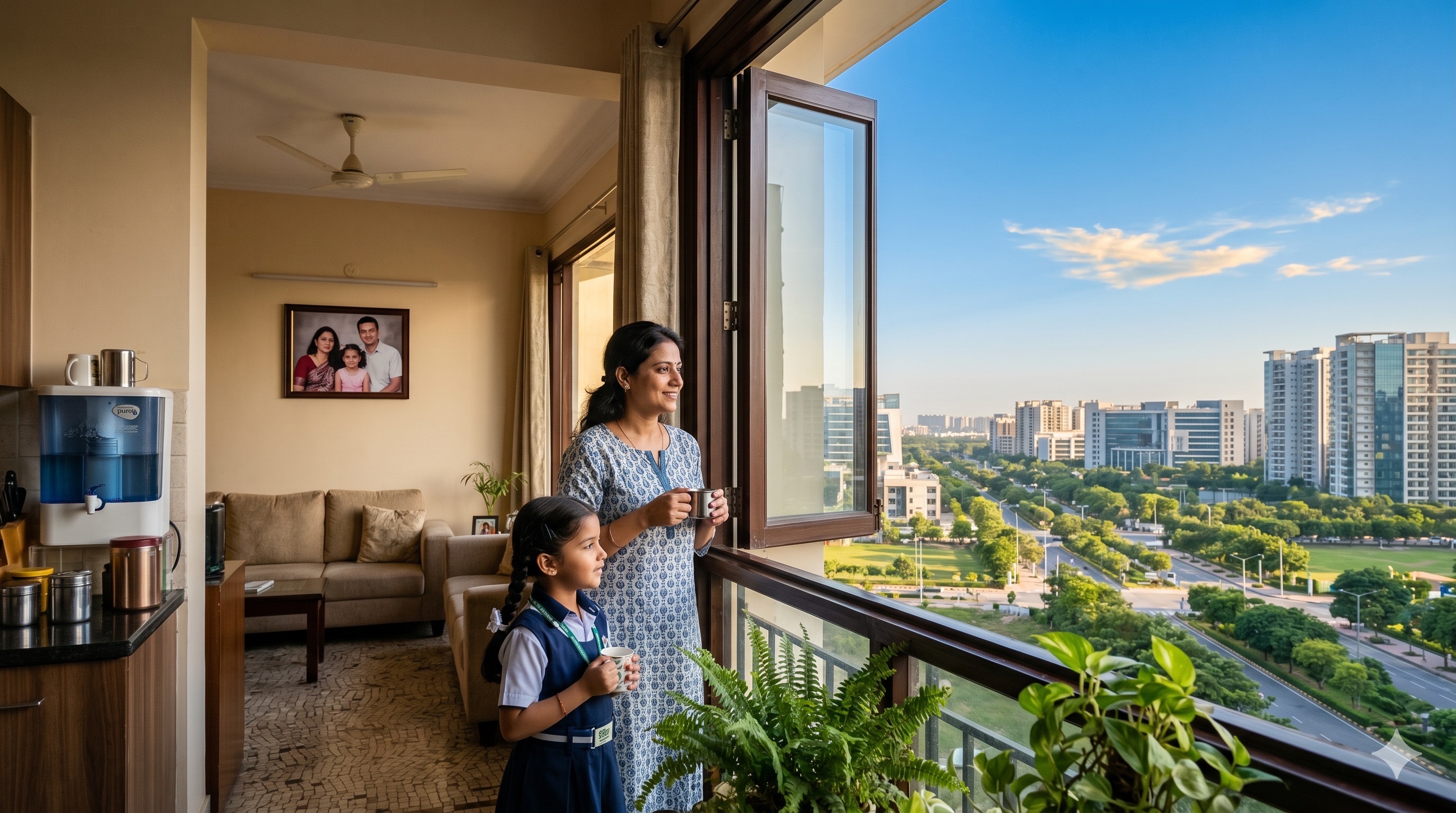
A Delhi morning where the sky is actually blue. A Gurugram school bus stop where children are not in masks. A Jaipur winter when grandparents take walks without coughing. Other countries already have this. India will too. The honest question is not “if” but “when” — and what your family does about the years in between. This piece walks through where the cleanest cities in the world sit today, how they got there, where India currently stands, and the realistic timeline that the data supports.
The destination — what “clean” actually looks like
The World Health Organization’s annual PM2.5 guideline is 5 µg/m³ — the level above which measurable harm starts accumulating in lung, heart, brain and metabolic systems. In 2025, the IQAir World Air Quality Report found that just 14 percent of cities worldwide met that guideline, down from 17 percent the year before.
A handful of places sit far below it.
| Place | Annual PM2.5 (µg/m³) | Context |
|---|---|---|
| Nieuwoudtville, South Africa | 1.0 | World’s cleanest city, 2025 |
| Reykjavik, Iceland | 3-5 | Geothermal energy, North Atlantic winds |
| Helsinki, Finland | 5-6 | Most Nordic capitals sit near WHO guideline |
| Most of Oceania (61% of cities) | under 5 | Auckland, Sydney, Hobart, Wellington |
| Seattle, Washington (USA’s cleanest major city) | 7-9 | Pacific coast wind patterns, low industry |
| Zurich, Switzerland | 7-9 | European clean-air benchmark |
| Tokyo, Japan | 9-12 | Above WHO guideline in 2024 and 2025 — even traditionally clean cities are now slipping |
| WHO annual guideline | 5 | The line below which health risk plateaus |
In a typical year, only 13 countries and territories meet the WHO PM2.5 guideline as a whole — most of them in Latin America, the Caribbean and Oceania. East Asia, including Japan, did not have a single city below 5 µg/m³ in 2024 or 2025. The line is not easy to hold even for wealthy clean-coded countries.
Where India currently sits
India in 2025 is not just above the line. It is the line.
According to the same 2025 IQAir World Air Quality Report, the world’s 25 most polluted cities were all located in India, Pakistan and China — with India home to three of the top four.
| Indian city | Annual PM2.5 (µg/m³) | Multiple of WHO guideline |
|---|---|---|
| Byrnihat, Assam | 126 | 25× |
| Delhi | 105 | 21× |
| Gurgaon, Haryana | 91 | 18× |
| Lucknow | 80-100 | 16-20× |
| Patna | 80-95 | 16-19× |
| Mumbai | 35-50 | 7-10× |
| Bengaluru | 25-40 | 5-8× |
| Chennai | 25-40 | 5-8× |
In CPCB’s own NCAP progress report, of 256 Indian cities with reliable PM2.5 data, 150 exceed even India’s domestic National Ambient Air Quality Standard of 40 µg/m³ — eight times the WHO line. Twenty-two of 24 monitored Haryana cities exceed it. So do 20 of 23 in Bihar, 26 of 36 in Rajasthan, and 13 of 20 in Uttar Pradesh.
The honest scale of the gap: a child growing up in Delhi today breathes 20 to 25 times the WHO-safe annual dose. A child growing up in Jaipur or Agra is in the same range. A child growing up in Bengaluru breathes 5 to 8 times the safe dose.
How the cleanest places got there
This is where the hope lives. Every “clean” country once had air far worse than what India has today. The transitions are documented.
London — the 50-year arc
December 1952. The Great Smog of London — five days of coal-smoke fog trapped over the city — killed roughly 12,000 people. The British government passed the Clean Air Act of 1956, the first national legislation of its kind anywhere in the world. It mandated “smokeless fuels” in dense areas, controlled chimney emissions, and started moving coal-fired power stations out of the city.
The transformation took decades.
| Year | London air quality status |
|---|---|
| 1952 | The Great Smog — 12,000 deaths |
| 1956 | Clean Air Act passed |
| 1962 | Last major “killer fog” |
| 1968 | Second Clean Air Act, broader controls |
| 1970-1980s | Diesel and petrol regulated, coal heating phased out |
| 1990s | EU clean-air directives layered on top |
| 2008+ | Low Emission Zones for vehicles |
| 2019 | Ultra Low Emission Zone (ULEZ) |
| 2020 | Cumulative result — NOx down 76%, fine particulates down 85% vs 1970 |
Total arc: about 50 years, with the steepest gains in the first 30. Today London still has PM2.5 around 10-12 µg/m³ (above WHO, but a fraction of its 1952 levels).
Pittsburgh and Los Angeles — the American arc
Pittsburgh in the 1940s was nicknamed “the city where noon was night” — steel-mill smoke routinely turned the sky black at midday. Los Angeles in the 1950s and 1960s had photochemical smog so thick that schoolchildren were kept indoors during summer afternoons. Both cities transformed over 30 to 50 years through a combination of federal Clean Air Acts (1963, 1970, 1990), vehicle emissions standards, fuel reformulation, and industrial pollution controls. LA today still has PM2.5 around 10-12 µg/m³ — twice WHO but a fraction of 1960s levels.
Beijing — the 10-year arc
The most relevant case study for India.
In January 2013, Beijing’s daily PM2.5 hit 886 µg/m³ during a multi-week “airpocalypse”. International coverage was relentless. The Chinese central government declared “war on air pollution” and launched the Air Pollution Prevention and Control Action Plan (APPCAP) — a national framework with hard PM2.5 reduction targets, enforcement teeth, and coordinated regional implementation.
| Year | Beijing annual PM2.5 (µg/m³) | Change vs 2013 |
|---|---|---|
| 2013 | 89.5 | baseline |
| 2017 | 58 | -35% |
| 2020 | 38 | -57% |
| 2023 | 32 | -64% |
| 2024 | 30.5 | -65.9% |
Beijing’s coal use dropped from 21.8 million tonnes in 2012 to under 600,000 tonnes in 2024 — a 97% reduction. The number of “heavily polluted days” fell from 58 in 2013 to just 2 in 2024. The UN Environment Programme called this the “Beijing Miracle” — what took developed countries 20-30 years, China achieved in roughly 10.
Beijing is still above WHO 5 µg/m³ — but the trajectory and the speed of change is what India can study most closely.
India’s current trajectory
India launched the National Clean Air Programme (NCAP) in January 2019, targeting 20-30 percent reductions in PM2.5 and PM10 across 131 non-attainment cities by 2024 (extended to 2026). The programme is real, funded (₹11,211 crore released through 2025), and has shown measurable progress:
- 95 of 131 cities improved on PM10 vs the 2017-18 baseline
- Delhi PM2.5 dropped from 128 to 106 µg/m³ between 2018 and 2023 — a 17% reduction in five years
- The national monitoring network grew from a few dozen stations to 1,524 stations by 2024
- BS-VI fuel standards rolled out across the country in April 2020
- Electric two-wheeler and four-wheeler adoption is accelerating
- Coal-to-gas conversions for brick kilns and industrial clusters are progressing
Progress is real but uneven. Only 41 cities have hit the 20-30% PM10 reduction target. The funding mix is heavily weighted toward road dust (67% of disbursed funds) and lighter on the bigger sources — industry, domestic biomass, and vehicle emissions.
Extrapolating Delhi’s current pace: at 17% reduction in 5 years, getting from today’s 106 µg/m³ to WHO’s 5 µg/m³ would take roughly 45-60 years of linear progress. At Beijing’s 65% reduction in 10 years, the same trip would take 15-20 years. The realistic Indian arc, based on current policy momentum, sits somewhere between — roughly 25 to 40 years for Delhi NCR to approach WHO-compliant air.
For Indian children in 2026, that means their entire childhood, adolescence and early adulthood will happen in air that exceeds the safe threshold. The window in which lung development happens — birth to age 18 — closes before the country’s outdoor air does.
What this means for an Indian family in 2026
Two truths can be held together. Both matter.
Truth one: India will get there. Other countries already have. The policy framework exists, the technology has been proven elsewhere, and the trajectory is real if slow. Every year of NCAP execution and every year of clean-energy transition adds up.
Truth two: “There” is one to four decades away. The children alive today cannot wait. Lung capacity, cognitive development, sleep quality, cardiovascular baseline — these things are being shaped right now, every day, by the air that exists right now.
The country your child lives in tomorrow is going to be cleaner than the country they live in today. The country they live in today is the one whose air is shaping their lungs.
This is exactly the position Indian households were in with drinking water a generation ago. Municipal water quality has improved across many Indian cities since the 1970s. It is still not safe to drink straight from the tap in most of urban India. So every middle-class kitchen treats its water — boiled, candle filter, Aquaguard, Pureit, RO, inline tap filter. Nearly half of Indian households (NFHS-5) practise some form of water treatment, and in urban kitchens the share is much higher. The form changes by household and decade; the habit is unconscious. Nobody waited for the municipality to reach WHO drinking-water standards before treating their family’s water. They built the next utility themselves.
Air is the same logic, applied to a different contaminant.
The aqi0 promise — until then
A positive-pressure fresh-air system holds indoor PM2.5 under WHO 15 µg/m³ continuously, across the entire home, regardless of what is happening outside. CO₂ stays under 1,000 ppm. Outdoor air enters only after passing through a medical-grade H13 HEPA filter. Slight positive pressure (10-25 Pa) ensures that air leaks out through gaps, not in.
For an Indian family in 2026, that means:
- The 10-14 hours a day spent at home are spent in Reykjavik-grade indoor air
- Lung development happens in clean conditions, even as the country works on the outdoor arc
- Sleep, focus, mood and cardiovascular markers respond within 48-72 hours of clean indoor exposure (twelve randomised controlled trials across four continents)
- The 25-40 year wait for India’s outdoor air to catch up doesn’t compromise the family’s biology in the meantime
This is not a substitute for the country’s outdoor air-quality work. It is a bridge — the same bridge water filtration provided for tap water during India’s 50-year water-infrastructure arc.
The closing line
Air will be the next utility. Water already is. Until then, your home can be the country we don’t have yet.
When Delhi NCR reaches WHO levels — twenty-five, thirty, maybe forty years from now — the children growing up in 2026 will be adults watching their own children breathe outdoor air that is finally safe. Their lung capacity, their cardiovascular baseline, their cognition, will reflect the air they breathed during those 30-odd years of waiting. The variable in their favour is where they breathed that air. Indoors, every day, in homes that did not wait.
Book a free site survey
We measure your home’s current PM2.5 and CO₂, show you where a fresh air system would go, and give you a quote. No obligation.
Related reading
- The complete aqi0 argument in one walkthrough
- Delhi takes 11.9 years off your life
- Delhi NCR AQI is a year-round problem
- Why air purifiers can’t handle Delhi winters
- Can the body adapt to air pollution?
- Live AQI for Delhi · Gurugram · Noida