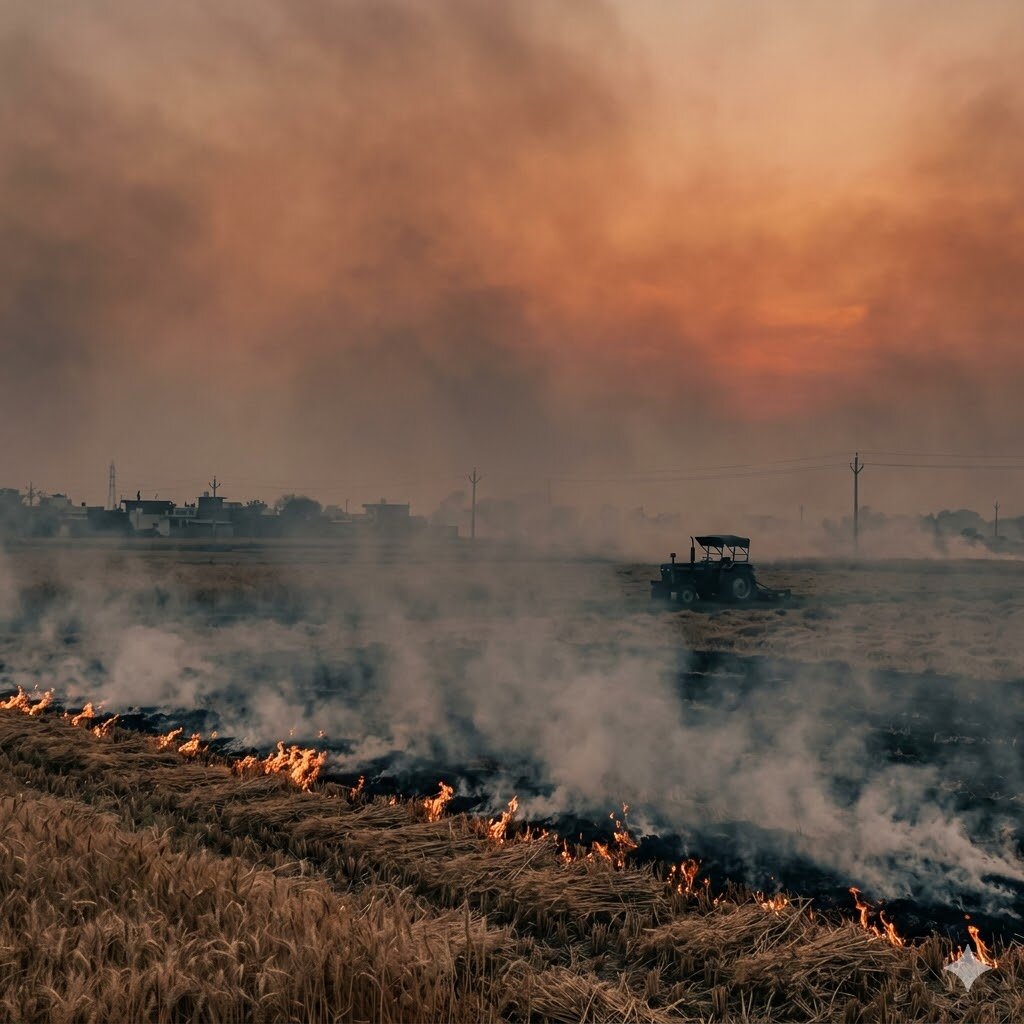
Stubble Burning, Explained: The Policy Change That Made It Inevitable
Every October and November, news anchors blame Delhi’s smog on Punjab and Haryana farmers burning crop residue. The story is real but incomplete. Stubble burning contributes between 5% and 40% of Delhi’s PM2.5 on any given autumn day, varying widely with wind direction and time of year. More importantly, it explains only six to eight weeks of pollution. Delhi NCR’s air is unhealthy for roughly ten months a year. This page covers what stubble burning actually is, why it happens, and why solving it alone will not give Delhi clean air.
Key numbers
- ~22 million tonnes — paddy residue generated across Punjab and Haryana annually (ICAR / Ministry of Agriculture estimates); of this, roughly 7–10 million tonnes is burnt in the field
- 15 days — typical window between rice harvest and wheat sowing during which farmers must clear fields
- 5–40% — contribution of stubble fires to Delhi’s PM2.5 on autumn days, depending on wind
- ~6 weeks — the duration of the stubble-burning season (mid-October to late November)
- ~10 months — the duration of Delhi NCR’s unhealthy air (PM2.5 above WHO 24-hour limit of 15 µg/m³)
What is stubble?
After a combine harvester cuts paddy, it leaves the lower 4–6 inches of the rice plant rooted in the ground. This residue is called parali in Punjab and khoonti or sutli elsewhere. A hectare of rice produces 5–6 tonnes of stubble.
The farmer’s problem: this stubble must be removed before wheat can be sown. Wheat seed needs bare soil contact. The window between rice harvest and the latest viable wheat sowing date is short — about two weeks.
Why it gets burnt
Setting fire to the field is the fastest, cheapest, and historically the most common way to clear stubble. Alternatives exist:
- Happy Seeder / Super Seeder — a tractor attachment that sows wheat directly into standing stubble. Costs ₹1.5–2.5 lakh, often beyond the budget of small farmers without subsidy
- Pusa decomposer (bio-decomposer) — a microbial spray that decomposes stubble in 20–25 days. The problem: the farmer needs 20–25 days, and only has 15
- Baling and removal — mechanically baling stubble for use as fodder, packaging, or biomass fuel. Logistics and economics rarely favour this for small holdings
- Incorporation by ploughing — works, but adds three to five passes of tractor time per hectare
Set against these, a matchstick is free. The fire takes one afternoon.
The policy change that made it worse
Stubble burning was a minor problem before 2009. Two policy decisions made it the autumn crisis it is today.
1. The 2009 Punjab Preservation of Subsoil Water Act and the Haryana equivalent. Faced with falling groundwater tables, Punjab and Haryana legislated late paddy transplanting. Transplanting before 10 June (Punjab) or 15 June (Haryana) was made illegal, so that monsoon rains rather than groundwater would supply the paddy crop. The law has substantially helped water tables.
It also shifted the harvest. Paddy now matures in mid-October instead of late September. The window between paddy harvest and wheat sowing — once five to six weeks in some districts — collapsed to two weeks or less.
2. The shift to combine-harvester-friendly long-stem varieties. Government-promoted high-yield basmati and PR (Punjab Rice) varieties grow taller and leave more stubble than the older varieties they replaced. More stubble per acre, less time to clear it.
The combination is unforgiving: a farmer who waits 25 days for Pusa decomposer misses the wheat sowing window and loses a season’s income. A match takes one afternoon.
Why the smoke reaches Delhi
Three meteorological factors:
1. Wind direction. Late October to November sees prevailing winds from the northwest — exactly the direction of Punjab and Haryana. The same wind that brings winter chill brings smoke.
2. Temperature inversion. As nights get colder, a layer of warm air settles 100–300 metres above ground level. Smoke that would normally rise and disperse hits this lid and accumulates near the surface. The full mechanism is covered at Delhi temperature inversion.
3. Low wind speeds. Autumn morning wind speeds drop below 3–4 km/h. Pollution that would be blown out to sea in a coastal city sits over Delhi for days.
These three factors are why the same volume of smoke produces different air quality in different weeks. A windy day at 12 km/h dilutes everything; a still inversion morning concentrates it.
What share of Delhi’s PM2.5 is actually from stubble burning?
This is contested in public discussion but well-documented in scientific literature.
- Annual average: stubble fires contribute 4–8% of Delhi’s PM2.5
- Peak autumn days (late October to mid-November): 25–40% on the worst days, occasionally higher under specific wind conditions
- Rest of the year: essentially zero
Sources include the IIT-Kanpur 2015–16 “Comprehensive Study on Air Pollution and GHGs in Delhi” (Sharma & Dikshit), TERI’s 2018 NCR source apportionment study commissioned by EPCA, and SAFAR-India’s daily real-time tracking maintained by IITM Pune.
The other 60–95% of Delhi’s PM2.5 — even during the burning season, and 100% of it for the other 10 months — comes from vehicle exhaust, brick kilns, construction dust, industrial emissions, road dust, biomass cooking in surrounding villages, and waste burning.
Why solving stubble burning will not give Delhi clean air
If every farmer in Punjab and Haryana switched to Pusa decomposer tomorrow, Delhi would still:
- Cross the WHO 24-hour PM2.5 limit on more than 300 days a year
- Have annual average PM2.5 between 70 and 90 µg/m³, well above the WHO annual limit of 5
- See unhealthy AQI through summer, monsoon and winter (every season except a brief monsoon window)
- Suffer winter inversions that concentrate vehicle and brick-kiln pollution into the same toxic soup
The stubble-burning narrative is convenient because it has a clear villain and a clear season. The full picture, covered in Delhi NCR AQI is a year-round problem, is harder to slogan but more honest.
What is actually changing
Two slow shifts are underway:
1. Mechanisation. Happy Seeder adoption has roughly doubled in five years, helped by subsidies of 50–80% on equipment. Custom-hiring centres rent the machines to small farmers who cannot afford ownership.
2. Pusa decomposer. ICAR has scaled production. Aerial spraying trials have shown 70–80% decomposition in 20–25 days. The 15-day window remains a constraint.
Neither will eliminate burning quickly. Stubble fires have declined from ~80,000 incidents in 2016 to ~30,000–40,000 in recent years, but the per-fire smoke load is higher because remaining fires concentrate in fewer days.
What this means for an NCR resident
Two things follow:
1. Year-round indoor air protection matters. If your home is only protected during the burning season, you are exposed to unhealthy air for ten months out of twelve. Sealing the home and running a fresh-air system year-round is the only honest answer.
2. Avoid blaming farmers as a complete explanation. It feels good but it misdiagnoses the problem. The pollution that will give your child smaller lungs by age eight is the pollution they breathe in March, April, May, June, August and September — not just October.
FAQ
Are farmers the main cause of Delhi’s air pollution? For about 30 autumn days, they are a major contributor. For the other 335 days, they contribute essentially nothing. Annual average contribution is 4–8%.
Why don’t they just use the Pusa decomposer? It takes 20–25 days. The window between paddy harvest and wheat sowing is 15 days. Until that mismatch is fixed, the decomposer cannot replace burning at scale.
Has stubble burning increased or decreased? Decreased overall — from ~80,000 fires in 2016 to ~30,000–40,000 in recent years. Per-fire emissions have intensified as remaining fires concentrate in fewer days.
Would banning combine harvesters help? Manual harvesting leaves shorter stubble but is economically infeasible at current labour rates. Some experiments combine machine harvest with mechanical removal of standing stubble for fodder.
If I leave Delhi in October–November, will I be safe? You will avoid the worst days. You will not avoid the other ten months of unhealthy air.