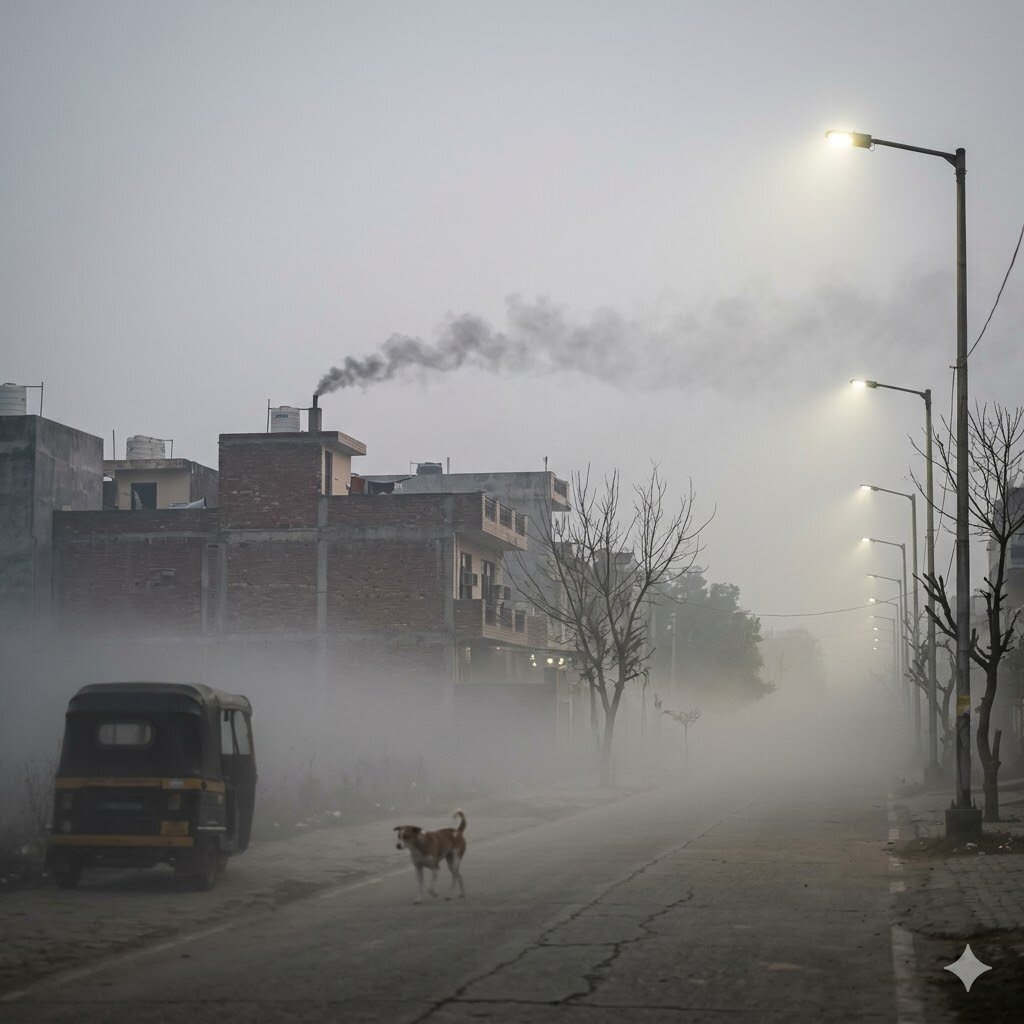
Delhi winter morning inversion — warm-air lid trapping cold smoke beneath

Temperature Inversion: Why Delhi’s Winter Air Gets Trapped Just Above Your Head

Delhi NCR’s pollution sources do not change much between July and November. Vehicles, brick kilns, construction sites, the local fires that keep night watchmen warm — they emit roughly the same daily volume. What changes is the air’s ability to carry the pollution away. In summer, a hot day pushes air upward and outward; pollution disperses. In winter, a phenomenon called temperature inversion caps the city with a layer of warm air sitting on top of a much colder, denser surface layer. Pollution emitted into that cold layer cannot rise. It accumulates. The “winter smog” Delhi is famous for is largely this trapping effect.

Key numbers

Normal atmospheric layering

In a healthy atmosphere, air temperature falls with altitude — about 6.5°C per kilometre on average. Air at ground level is warmer than air higher up. Warmer air is less dense, so it rises naturally. Pollution emitted at ground level rises with the air, mixes vertically, and disperses across a large volume.

This vertical mixing zone is called the boundary layer or mixing layer. Its top is the mixing height — the altitude above which air is no longer mixing freely with the surface.

In summer, Delhi’s mixing height reaches 2,000–3,000 metres on hot afternoons. Whatever the city emits gets diluted into a column of air several kilometres tall.

What changes in winter

In winter, the ground loses heat at night through long-wave radiation. By dawn, the air immediately above the surface is colder than the air a few hundred metres up. The temperature gradient inverts:

This is the inversion. The cold air below cannot rise through the warmer layer above; warm air is buoyant relative to it. The atmospheric “lid” sits 100–500 metres up.

All ground-level emissions during the inversion are trapped within that 100–500 m zone. Vehicle exhaust, kitchen smoke, brick-kiln fumes, the watchman’s wood fire — none of it disperses upward. The same emission mass that would spread across a 2,000 m column in summer is now packed into a 500 m one. Concentration is 4× higher for the same emission.

Why early morning is the worst

Inversions form overnight as the ground cools. By 4–8 AM:

By mid-morning, the sun heats the ground, the surface air warms, and the inversion breaks down as the cold layer becomes less dense than the warm layer above. By noon, normal vertical mixing resumes.

This is why morning AQI in Delhi winter is often 2–3× worse than afternoon AQI on the same day. The pollution is the same; the trapping is changing.

The three things that make Delhi’s inversions worse than other cities

1. Geography. Delhi sits in the Indo-Gangetic Plain, far from coastal winds. Air movement comes from the northwest in winter — slow, cold, dry. Coastal cities (Mumbai, Chennai) have sea breezes that disturb inversions. Delhi has none.

2. Cold ground. The Punjab–Haryana–Delhi belt cools more aggressively in winter than coastal regions because of the dry continental climate. The night-time ground temperature gradient is steeper, the inversion is stronger.

3. Existing pollution load. A clean city with a strong inversion has elevated but tolerable concentrations. A high-emission city with a strong inversion has dangerous concentrations. Delhi is both.

The interaction with stubble burning

Stubble fires in Punjab and Haryana peak in late October to mid-November — exactly when Delhi’s inversion regime is intensifying. The combination is uniquely bad:

For 6–8 weeks each year, Delhi’s air is being amplified by stubble burning. For the other 44 weeks, the inversion trap continues to amplify local sources — the same trap, just without the imported smoke.

What the inversion means for daily decisions

Three practical implications for NCR residents:

1. Morning exercise is worse than afternoon. Counter-intuitive but well-established. The 6 AM jog in the park during November is happening in PM2.5 concentrations that may exceed 400 µg/m³. The 2 PM walk in the same park, same day, may see 200 µg/m³. If you’re running outdoors during winter, do it in the afternoon if you can.

2. School commute timing matters. Most Indian school start times put children on the road during peak inversion hours. Schools that start at 9 AM instead of 7:30 AM expose children to substantially lower PM2.5 during commute. The choice is largely outside parental control but worth understanding.

3. Outdoor activity during weather changes. Wind events break inversions. A windy December afternoon in Delhi has dramatically better air than a calm December afternoon. Plan outdoor activity around the forecast.

How indoor air systems interact with inversion

A positive-pressure fresh-air system filters outdoor air before bringing it inside. During peak inversion mornings when outdoor PM2.5 is 400 µg/m³, the same system that delivered 8 µg/m³ indoor air yesterday continues to deliver under 10 µg/m³ today.

The H13 HEPA filter does not care about outdoor conditions. It captures 99.95% of particles regardless of whether outdoor concentration is 50 µg/m³ or 500 µg/m³. The indoor environment is decoupled from the inversion.

For the 4–8 AM exposure window when children are getting ready for school and outdoor pollution is at its peak, indoor air protection is the most consequential single intervention.

FAQ

Does the inversion happen every winter night? Yes, to varying degrees. Clear, calm, cold nights produce the strongest inversions. Cloudy, windy or rainy nights produce weak or no inversion.

Can the inversion be broken artificially? Theoretically yes (cloud seeding, weather modification), but at scale and reliably, no. Wind is the natural inversion-breaker. Delhi gets few strong winter wind events.

Why doesn’t this happen in summer? Hot daytime surface temperatures prevent the inversion from forming. The boundary layer is well-mixed and tall.

Is climate change making this worse? The relationship is complex. Warmer winters might reduce inversion intensity, but increased emissions and altered weather patterns may offset this. Net trend is unclear.

Does AQI track inversion strength? Indirectly. AQI measures concentration, which depends on both emission and trapping. Days with strong inversion + normal emission look identical in AQI terms to days with normal mixing + extreme emission.