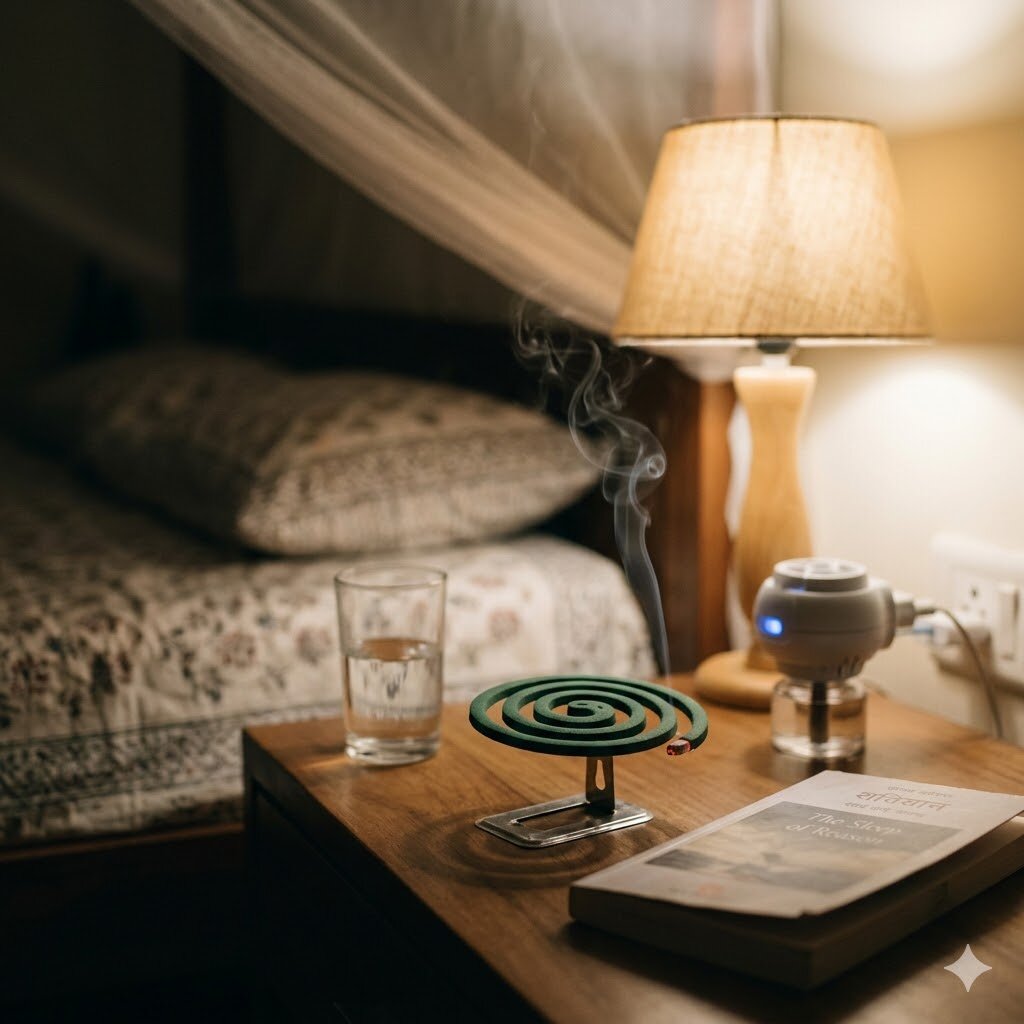
Mosquito Coils, Liquid Vaporisers and Mats: The Indoor Smoke You’re Choosing
A single mosquito coil burning in a closed bedroom releases the same mass of fine particulate matter as 75 to 135 cigarettes, depending on the base material (typically sawdust or coconut husk). The active mosquito-killing chemicals — pyrethroids — are the smaller problem. The far bigger problem is the smouldering combustion that the coil’s chemistry depends on. Liquid vaporisers and mats are not innocent either: they produce less particulate but emit volatile pyrethroids and aldehydes continuously through the night. This page covers what the testing has shown, what to use instead, and what to do if you have small children.
Key numbers
- 75–135 cigarettes — particulate emission equivalent of one mosquito coil (Mongabay India, Discover Applied Sciences 2019)
- 51 cigarettes — formaldehyde emission equivalent of one coil
- 830% — increase in PM2.5 during the burning phase in Indian indoor-chamber studies (5 major brands tested: Mortein, Maxo, All Out, Good Knight, Good Knight Neem)
- Pyrethroids — d-allethrin, prallethrin, transfluthrin, meperfluthrin — the active ingredients in most Indian repellents
- 0.3% (allethrin), 1.6% (prallethrin) — typical concentrations in commercial Indian formulations
Why a coil is so PM2.5-heavy
A mosquito coil is essentially a low-grade biomass briquette laced with a pyrethroid insecticide. The base material — sawdust, coconut husk, sometimes coal dust — is the dominant emission source. The coil smoulders at low temperature (incomplete combustion), which is exactly the regime that maximises PM2.5 formation per gram of fuel burned.
Compared with a cigarette (which uses tightly packed cured tobacco and burns hotter), the coil burns longer and dirtier. An 8-hour overnight coil emits 75–135 cigarettes’ worth of PM2.5 because:
- More total fuel burned per session
- Lower combustion temperature → higher particulate yield
- Burns continuously for hours rather than ~10 minutes
The particles are mostly in the PM2.5 size range — deep-lung penetrating, with the same health pathway as outdoor combustion PM2.5.
What’s in the smoke beyond PM2.5
Indian chamber studies (e.g., the Discover Applied Sciences 2019 paper) tested five common Indian brands — Mortein, Maxo, All Out, Good Knight, Good Knight Neem — for emissions of:
- PM2.5, PM10, PM1, ultrafine particles — all elevated 800–1000% during burning phase
- Formaldehyde — equivalent to 51 cigarettes per coil
- Polycyclic aromatic hydrocarbons (PAHs) — known carcinogens
- Trace metals — including chromium, cadmium, lead in some samples (from base material contamination)
- The pyrethroid itself — d-allethrin or similar, present as vapour and adsorbed onto particles
The “neem” or “natural” variants showed lower trace-metal content but comparable PM2.5.
Liquid vaporisers and mats — different problem, not better
Liquid mosquito vaporisers (electric plug-in with a refill bottle) and mats produce far less PM2.5 because there is no smouldering biomass. Different concerns:
1. Continuous pyrethroid emission. A liquid vaporiser releases prallethrin or transfluthrin into the air for 6–8 hours of the cycle. The active ingredient is the same family of compound as the coil’s d-allethrin. The total mass of pyrethroid delivered per session can be comparable.
2. Heated solvents. Liquid vaporiser refills are pyrethroid dissolved in petroleum solvents (kerosene, naphthalene derivatives). The heating element vaporises both the active ingredient and the solvent. The solvent fraction is itself a VOC source.
3. Aldehydes from heated formulation. Continuous heating of the wick generates formaldehyde and acetaldehyde, both Group 1 carcinogens.
4. Closer to the breathing zone. Vaporisers are typically plugged in next to the bed, putting the emission source within a metre of the sleeping occupant.
A liquid vaporiser is plausibly better than a coil on a per-session basis (much less PM2.5), but the cumulative pyrethroid and VOC exposure across years of nightly use is non-trivial.
What pyrethroids actually do to you
Pyrethroids are designed to target insect nervous systems but also affect mammals at higher doses. In normal Indian home use, acute toxicity is rare. The concerns are:
- Children — lower body weight relative to dose; immature liver enzymes for clearance. Pediatric guidelines from US and EU bodies advise minimising exposure for children under 2.
- Chronic low-dose exposure — emerging evidence on endocrine disruption, developmental effects.
- Indoor air quality cumulative effect — pyrethroids are one input on top of PM2.5, VOCs, CO₂ and other indoor pollutants. The cumulative load matters.
- Allergic and respiratory sensitisation — some users develop coughing, wheezing or itching with chronic use.
WHO classifies most pyrethroids as moderately hazardous (Class II) or slightly hazardous (Class III). They are not in the same risk class as DDT or organophosphates.
What actually works against mosquitoes
Five interventions, in order of effectiveness and safety:
1. Window and door screens (mosquito mesh / jaali). The boring, durable, zero-air-quality-cost solution. Properly installed and maintained mesh stops more mosquitoes than any chemical product.
2. Mosquito nets (machhardani). For sleeping spaces. Permethrin-treated nets (LLINs) used in WHO malaria programmes provide both barrier and short-range repellent effect; standard cotton nets without treatment are also effective barriers.
3. Topical DEET, picaridin, or oil of lemon eucalyptus. On exposed skin for evening outdoor time or known-mosquito environments. CDC-recommended; far smaller air-quality footprint than burning anything indoors.
4. Fan currents. Mosquitoes are weak flyers; a ceiling fan on medium speed makes a room significantly less hospitable. Combined with a net, often sufficient.
5. Source reduction. Standing water in plant saucers, AC trays, terrace pots — the breeding sites for Aedes (dengue, chikungunya). Empty weekly.
6. (Only if needed) Liquid vaporiser used for the first 1–2 hours of the night, then switched off. Reduces continuous overnight exposure while still depressing peak mosquito activity hours.
Avoid: - Coils in sleeping rooms, especially with children - Plug-in vaporisers running all night, every night - Multiple repellent devices stacked in the same small room
What aqi0’s fresh-air system does (and doesn’t) do
A positive-pressure fresh-air system:
- Dilutes pyrethroid concentrations by continuously replacing room air
- Drops PM2.5 from coil combustion by ~70–90% from sealed-room baseline
- Doesn’t help against mosquitoes directly — the air supply itself is filtered, but the mosquito problem is biological, not air-quality
For homes that switch from coils to physical barriers (mesh, nets) plus a fresh-air system, the indoor air quality improvement is substantial. The mosquito problem is solved better than burning anything indoors ever did.
FAQ
Are “neem” or “natural” mosquito coils safer? Marginally. They emit slightly fewer trace metals than conventional coils. PM2.5 emission is comparable because the smouldering biomass is the primary source, regardless of additive.
Is the smell of the coil the dangerous part? The smell is the pyrethroid vapour, which is the smaller problem. The bigger problem is the invisible PM2.5 and aldehydes you don’t smell as strongly.
What about ultrasonic mosquito repellents? No reliable evidence they work. Multiple peer-reviewed studies have found no effect on mosquito biting rates.
Can I just open a window? On low-AQI days outside, partly. On bad-AQI days you trade pyrethroid for outdoor PM2.5. Mosquito mesh on the window is the better answer.
Are mosquito coil emissions worse than Delhi outdoor air? For PM2.5 during the burning hour, yes — often substantially worse than even peak winter Delhi air, because the source is in the room with you. After-the-fact, residual concentrations stay elevated for 1–3 hours.