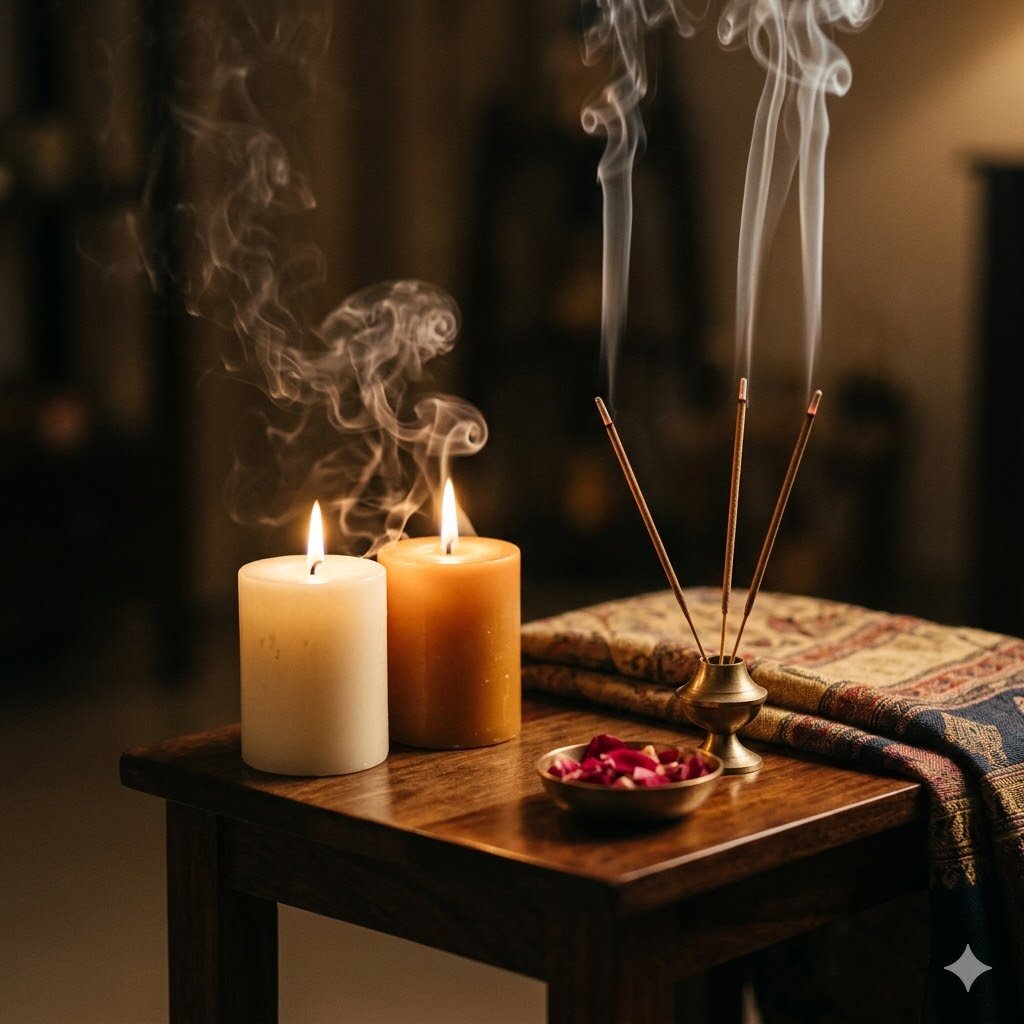
Candles, Incense and Agarbatti: The PM2.5 You Light Yourself
Indoor PM2.5 concentration during a single stick of agarbatti burning in a closed puja room can exceed 1,500 µg/m³ — about ten times worse than the worst outdoor Delhi air ever recorded. Indian temple studies have measured PM10 concentrations above 2,000 µg/m³ during ritual hours. Paraffin candles emit smaller but still significant PM2.5 plus aromatic VOCs including benzene and toluene. This is one of the most personally controllable indoor air sources in Indian homes, and one of the least discussed. This page covers what the testing shows, the religious and cultural context, and how to retain the practice without the pollution cost.
Key numbers
- 1,775 µg/m³ — mean PM2.5 during dhoop burning in indoor study conditions (Indian Journal of Allergy, Asthma and Immunology 2014)
- >2,000 µg/m³ — PM10 measured inside Indian temples during ritual hours
- >99% — fraction of incense particles in the PM2.5 size range
- ~5× — PM2.5 emission rate of incense vs. cigarettes per unit
- 12% / 10% — increased cardiovascular mortality / coronary heart disease risk in long-term incense users (epidemiological studies)
- WHO 24-hour PM2.5 limit: 15 µg/m³
The chemistry of combustion incense
Agarbatti, dhoop and dhuni all rely on incomplete combustion of organic material to release fragrance and visible smoke. The basic structure:
- Combustible base — sawdust, charcoal, bamboo stick, joss powder
- Binder — guar gum, natural resins
- Aromatic ingredients — sandalwood powder, essential oils, gums (myrrh, frankincense), herbs, sometimes synthetic fragrance compounds
- Sometimes — colourants, fixatives
When lit and allowed to smoulder, this assembly burns at low temperature (200–800°C) with insufficient oxygen for complete combustion. The result is high yields of:
- PM2.5 and PM10 — fine particulate from incomplete burning
- Polycyclic aromatic hydrocarbons (PAHs) — benzo[a]pyrene, naphthalene, fluoranthene; known and probable carcinogens
- Volatile organic compounds — formaldehyde, benzene, toluene
- Carbon monoxide — from incomplete combustion
The same fragrant compounds released as smoke also include phthalates from synthetic fragrance carriers (Moo et al., Indoor Air 2025, on incense and phthalate exposure).
What chamber and field studies have measured
Three streams of evidence:
1. Chamber studies (Indian and Asian). Indian Journal of Allergy, Asthma and Immunology (2014) measured mean PM2.5 of 1,775 µg/m³ during dhoop burning in chamber conditions. Comparable Taiwanese and Vietnamese studies on temple incense report PM2.5 above 1,000 µg/m³ in indoor temple settings.
2. Temple field measurements. Indian temple interiors during ritual hours have shown PM10 levels of 2,000+ µg/m³ — twenty times the Indian CPCB ambient standard and well above any outdoor environment in the country. More than 99% of these particles are in the PM2.5 range.
3. Long-term epidemiology. Studies in Asian populations with daily home incense use have shown elevated risk for cardiovascular mortality (~12% increase) and coronary heart disease (~10% increase). Effects scale with duration and intensity of exposure.
Paraffin candles
Standard paraffin candles (the wax most commercial candles use) emit:
- PM2.5 at lower rates than incense but still meaningful
- Aromatic VOCs including benzene and toluene
- Black carbon (soot) from incomplete combustion, especially with longer wicks
- Formaldehyde from heated paraffin
Scented paraffin candles add fragrance VOCs on top of combustion products. Soy candles and beeswax candles emit cleaner combustion products but still produce PM2.5 and combustion VOCs. No burning candle is air-quality neutral.
A single 60-minute paraffin candle in a closed bedroom can elevate PM2.5 by 50–200 µg/m³ above baseline, depending on wax quality and wick.
The cultural context
Incense and dhoop in Indian Hindu, Buddhist and Jain practice are deeply rooted. Daily puja, festival worship, and traditional housekeeping (“dhuni”) all involve combustion ritual. Asking people to stop entirely is neither realistic nor respectful.
What is achievable:
1. Time-limited burning. Light incense for the duration of puja (5–15 minutes), then extinguish promptly rather than letting it burn out completely. Reduces total emission mass.
2. Single stick, not bundles. Many puja routines burn multiple agarbatti simultaneously. One stick has the same ritual function with a fraction of the emission.
3. Open ventilation during and after. Open a window or run a kitchen/bathroom exhaust during burning. Run the exhaust for 10–20 minutes after extinguishing.
4. Move outdoors when possible. Festival aarti and large dhoop offerings done on a balcony or in an open verandah produce the same religious experience with dramatically lower indoor concentration.
5. Choose better products. Natural sandalwood or pure resin incense (smaller mass burnt, cleaner composition) is preferable to mass-market scented agarbatti with synthetic fragrance carriers and PVC binders.
6. Avoid burning near children or asthmatic family members. Children’s lung development and people with active asthma are most sensitive. Time religious burning when these family members are out of the puja room.
What this looks like in real homes
aqi0 site surveys frequently encounter homes where puja-room PM2.5 sits at 200–600 µg/m³ for hours per day. The puja room is often near the kitchen and bedrooms; the elevated PM2.5 migrates through the home.
Three common patterns:
- Morning puja, 15-minute burn: PM2.5 in puja room peaks at 800–1,500 µg/m³, stays above 100 µg/m³ for 2–3 hours afterward.
- Festival use (Karva Chauth, Diwali, Janmashtami): continuous multi-hour burning + multiple oil lamps; PM2.5 stays above 500 µg/m³ for the entire ritual window.
- Dhuni / sant burning: large smoke loads; concentrations into the multiple-thousand µg/m³ range; whole-home migration in minutes.
A positive-pressure fresh-air system continues to supply filtered outdoor air during all of this. Indoor PM2.5 outside the puja room itself stays under the WHO limit even when the puja room measures 500 µg/m³. With the door closed and the system running, the rest of the home is not contaminated.
What about electric / LED alternatives?
Electric “diya” lamps and LED candles produce zero combustion products. For ritual where light symbolism is sufficient (not smoke or fragrance), they are a clean option.
For incense specifically, no electric alternative perfectly substitutes for the smoke-and-scent experience. Ultrasonic essential oil diffusers come closest in fragrance, but the cultural meaning differs.
FAQ
Is incense in puja really harmful? For short, ventilated, daily ritual use — modest cumulative impact. For long, multi-stick, unventilated use over years — measurable health effect.
Are “natural” or “herbal” agarbatti safer? Cleaner composition than mass-market versions but the combustion physics is the same. Burning anything indoors produces PM2.5. Natural sticks may have fewer phthalates and synthetic VOCs.
What about Buddhist / Jain ritual burning? Same chemistry applies. The traditional Buddhist preference for thin, short-duration incense produces lower emissions than typical Indian agarbatti.
Does an air purifier handle incense smoke? A HEPA-equipped purifier removes PM2.5 reasonably well once burning ends. During burning, it can’t keep up with peak emission. Better strategy: ventilate during, purifier or fresh-air system after.
Is the smell after agarbatti “all gone” the same as the pollution being gone? No. The smell molecules disperse faster than the particles. PM2.5 stays measurable for 1–3 hours after the smell has faded.