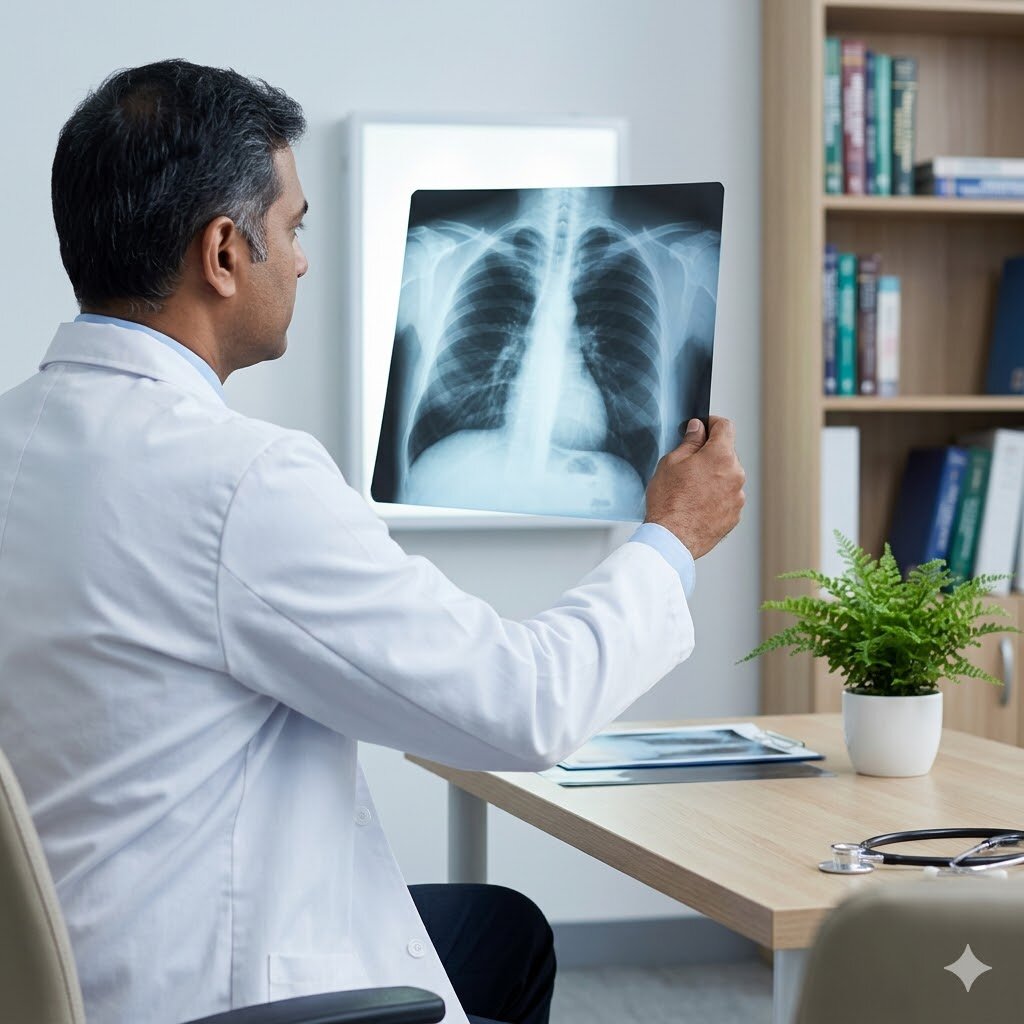
What Happens to PM2.5 After You Breathe It In: The Journey from Nose to Bloodstream
PM2.5 is the term for airborne particles smaller than 2.5 micrometres — about thirty times thinner than a human hair. Particles this small are not stopped by the nose, the throat, or the upper airway. They travel all the way to the alveoli (the deepest pockets of the lung), cross into the bloodstream, and circulate to every organ in the body. This page traces the journey, what each step does, and why “outdoor air pollution” is really a whole-body exposure.
Key numbers
- 2.5 micrometres — the upper size threshold of PM2.5
- 0.1 micrometres — typical size of the most dangerous fraction (ultrafine particles, UFP)
- ~95% — fraction of inhaled PM2.5 that bypasses nasal filtration and reaches the lung
- ~50% — fraction that deposits in the alveoli rather than being exhaled
- 24-hour WHO limit: 15 µg/m³
- Annual WHO limit: 5 µg/m³
- Delhi NCR annual average (2024–25): ~95–110 µg/m³
Stage 1: Nose and upper airway
Healthy nasal mucosa traps particles larger than about 10 micrometres (dust, pollen, hair). Cilia in the nasal passages move trapped particles toward the throat, where they are swallowed. This is the body’s first defence and it works well — for large particles.
PM2.5 is too small to be caught by these mechanisms. It slips through the nose with nearly the same concentration that exists outdoors. Mouth-breathing makes this worse: it bypasses even the limited filtration the nasal cavity offers.
Stage 2: Bronchi and bronchioles
PM2.5 reaches the bronchi (large airways) and bronchioles (smaller branches). Mucus and macrophages clear some of it, but the smaller the particle, the further down it goes. Particles in the 1–2.5 µm range tend to deposit on bronchiolar walls. Particles below 1 µm continue deeper.
Repeated deposition irritates the airway lining, increases mucus production, and over time contributes to chronic bronchitis and reduced lung function. This is the part of the journey that produces the “Delhi cough.”
Stage 3: Alveoli
The alveoli are 300 million microscopic air sacs where oxygen crosses into the blood. The alveolar wall is only one cell thick. There are no cilia and very little mucus at this depth.
PM2.5 — especially the ultrafine fraction below 0.1 µm — deposits here and stays. Macrophages try to engulf the particles but cannot break down inorganic content like soot, metal oxides, or silica. The macrophages either die in place or migrate into the interstitium of the lung, where the particles accumulate over a lifetime.
This is the stage that causes irreversible damage. Imaging studies of Delhi residents who have never smoked routinely show black deposits in lung tissue indistinguishable from a long-time smoker’s.
Stage 4: Crossing into the bloodstream
The alveolar membrane is so thin that ultrafine particles can pass through it directly into capillaries. From this point, “air pollution” becomes a circulatory exposure rather than a respiratory one.
Particles in the bloodstream have been detected in:
- The heart and coronary arteries — increased risk of plaque rupture, heart attack, and stroke
- The brain — linked to increased risk of dementia, Alzheimer’s disease, and reduced cognitive performance in children
- The liver — elevated inflammation markers, fatty-liver progression
- The kidneys — accelerated decline in eGFR (glomerular filtration rate)
- The reproductive system — reduced sperm count and motility in men, ovarian reserve effects in women
- The placenta — particles have been recovered from placental tissue of women living in polluted areas
- The newborn’s blood — measurable burden at birth
The journey from “the air outside” to “the unborn baby’s bloodstream” takes between 30 minutes and a few hours.
What this means in numbers
Air pollution is now the second leading risk factor for death globally (Global Burden of Disease, 2024 update). In India, it sits ahead of high blood pressure and tobacco use combined. Specific links established in peer-reviewed literature include:
- Cardiovascular: every 10 µg/m³ increase in long-term PM2.5 exposure raises cardiovascular mortality risk by 12–16% (Liang et al. meta-analysis, HR = 1.16, 95% CI: 1.12–1.21)
- Type 2 diabetes: an 11–39% higher risk per 10 µg/m³ PM2.5 across cohort meta-analyses; roughly one in five global type-2 diabetes cases attributable to PM2.5 (Lancet Planetary Health, 2022)
- Dementia: PM2.5 is one of 14 modifiable risk factors named in the 2024 Lancet Commission on dementia; the Commission attributes ~3% (1.65 million) of global dementia cases to air pollution
- Lung cancer: outdoor air pollution and particulate matter are both classified as Group 1 (human) carcinogens by IARC (Monograph 109, 2013) — the same category as tobacco smoke and asbestos
- Reproduction: a 2025 Indian study across 120 Indira IVF centres found men in AQI > 151 regions had an 11% drop in normal sperm DNA integrity; ovarian-reserve and IVF live-birth rate associations are now well documented
- Placental crossing: Bové et al. (Nature Communications, 2019) used femtosecond pulsed-illumination microscopy to detect black carbon particles inside human placental tissue at concentrations correlated with maternal residential exposure
Why “just buy a purifier” undersells the problem
A purifier reduces PM2.5 in one room, while the room is sealed, while you are in it. It does nothing for:
- The eight hours you spend outdoors and commuting
- The CO₂ that climbs to 1,400+ ppm in the same sealed bedroom (see bedroom CO₂)
- The VOCs released by furniture, cleaning products, and cooking
- The other rooms in your home
A whole-home fresh air system delivers filtered outdoor air at positive pressure throughout the house. It addresses PM2.5, CO₂, and odour-class VOCs simultaneously, and it does so 24/7. The mechanism is explained in how positive pressure works.
What you can actually do
In order of effect:
- Reduce indoor concentration year-round — a fresh air system holds indoor PM2.5 under 10 µg/m³ even when outdoor air is at 250 µg/m³
- Avoid combustion indoors — candles, incense, gas burners without exhaust
- Mask outdoors on bad days — a fitted N95 reduces inhaled dose by 90%+ when worn properly
- Keep windows closed in peak season — paradoxically, “fresh air” from a Delhi street in November is worse than your sealed living room
- Measure — a ₹3,000–5,000 monitor changes behaviour faster than any article will
FAQ
Is PM2.5 worse than PM10? For deep-organ damage, yes. PM10 is mostly stopped in the upper airway. PM2.5 reaches the alveoli and bloodstream.
Can the body get rid of PM2.5 once it is in the lungs? Some, slowly. Macrophages clear soluble fractions over weeks. Insoluble particles (soot, metals, silica) largely stay for life.
Do N95 masks really help? A well-fitted N95 or N99 mask filters ~95–99% of PM2.5 by design. Fit matters more than brand — gaps around the nose cut effectiveness in half.
Are indoor plants effective at removing PM2.5? Not at residential scale. The 1989 NASA study that this idea comes from used sealed chambers with one plant per 0.1 m³ — about 600 plants for a typical living room. Real homes see essentially no benefit.
At what age does PM2.5 damage start? At conception. Placental transfer is documented. Children in NCR show measurable lung-function deficits by age 8.