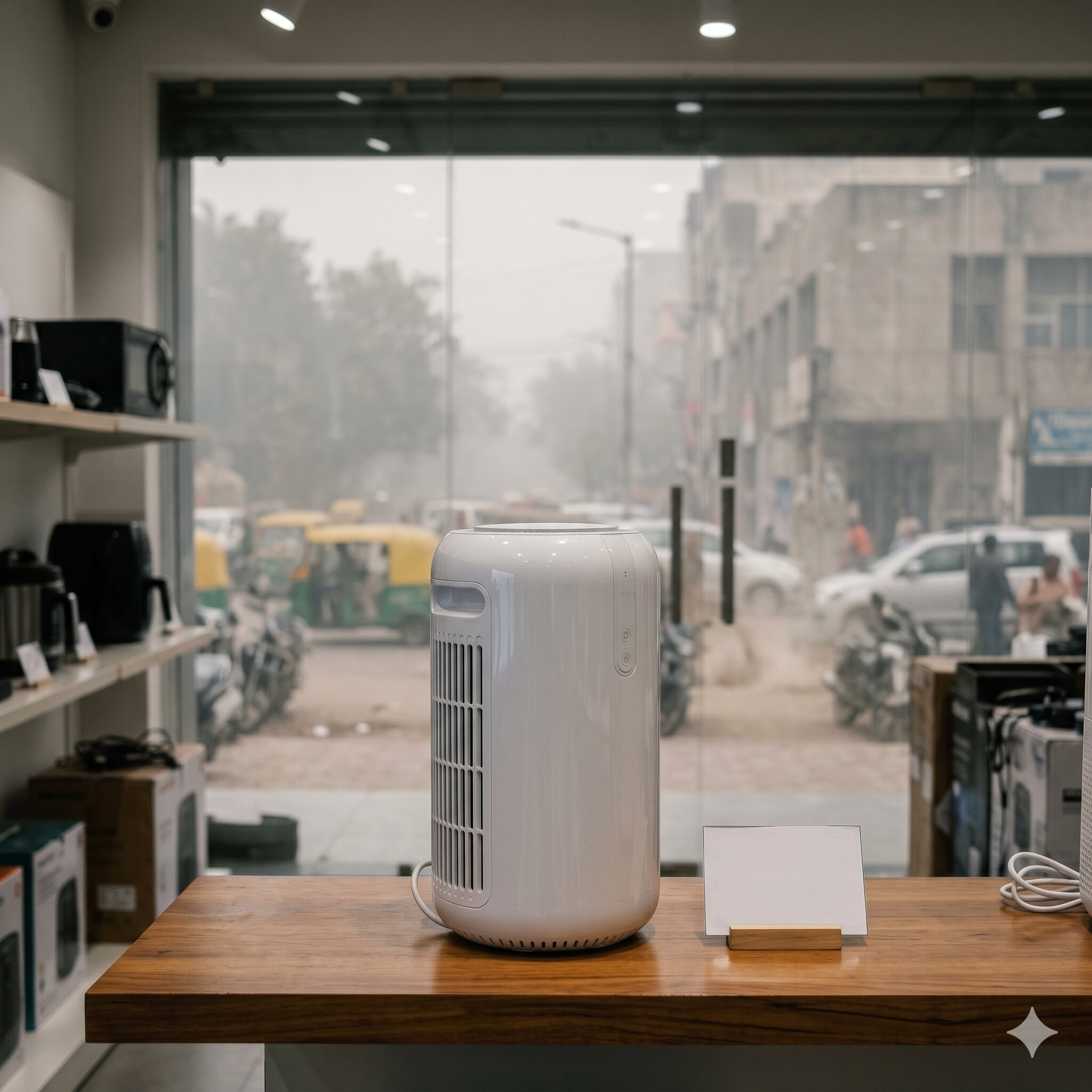
Air purifier showroom — CADR ratings and what they actually measure

CADR Ratings Are Misleading in India — Here’s the Math

Every air purifier sold in India advertises a CADR (Clean Air Delivery Rate) number — typically in the 200–500 m³/h range — as the primary performance metric. CADR is a real, useful metric for the single, specific test condition it was designed to measure. In Indian use, that test condition is far enough from reality that the CADR number badly overstates the actual indoor air-quality benefit. AHAM (the US trade body that defined CADR in the 1980s) tests for 20 minutes. Doesn’t test for ultrafine particles. Doesn’t test for CO₂. Doesn’t test for gases or VOCs. Doesn’t test what an Indian buyer’s home actually deals with. This page covers what CADR measures, what it doesn’t, and how to actually evaluate an air purifier for Indian conditions.

Key numbers

What CADR actually measures

The Clean Air Delivery Rate test, defined by AHAM Standard AC-1, follows a specific protocol:

  1. A standard sealed test chamber of 1,008 cubic feet (~28.5 m³) is filled with a known concentration of test pollutant
  2. The air purifier runs at maximum speed
  3. Pollutant concentration is measured at intervals over 20 minutes
  4. The decay rate gives the “Clean Air Delivery Rate”
  5. Three pollutant categories are tested separately: smoke (PM 0.09–1 µm), dust (PM 0.5–3 µm), pollen (PM 5–11 µm)

CADR is reported as three separate numbers (smoke / dust / pollen) — though most marketing only cites the highest one.

For PM2.5 — the pollutant Indians actually care about — the closest match is the smoke CADR, but it’s not identical (PM2.5 spans 0.1–2.5 µm; smoke spans 0.09–1 µm).

The five limitations CADR ignores

1. Short test duration. 20 minutes captures the initial fast-clean phase. It doesn’t capture how well the purifier maintains low concentration over hours of continuous operation. Real-world use is 8–24 hours of operation, not 20 minutes.

2. Maximum-speed testing only. CADR is measured at top fan speed. In real homes, people run purifiers on lower speeds because top speed is loud. Actual delivered CADR at “sleep mode” is often 30–50% of the rated number.

3. Sealed chamber, no infiltration. The test chamber has no air infiltration from outside. Real Indian apartments have continuous infiltration of outdoor PM2.5 through window seals, door gaps, AC drain pipes, electrical conduits. A purifier “rated for 30 m² coverage” handles that room only if the room is perfectly sealed. In reality, the purifier is competing against continuous infiltration that the test never measured.

4. Ultrafine particles ignored. Particles below 0.1 µm — the ultrafine fraction that dominates indoor particle count and crosses into the bloodstream most easily — are not in the CADR test. A purifier with high “smoke CADR” may pass ultrafines straight through.

5. Gases not tested at all. CO₂, VOCs, NO₂, formaldehyde, benzene — none of these appear in CADR testing. A purifier with “high CADR” tells you nothing about its gas-phase performance.

What this means for Indian buyers

Three practical mis-readings of CADR that lead to wrong purchase decisions:

1. “CADR 450 covers 50 m²” False in Indian use. The room-coverage calculation assumes a perfectly sealed room with no infiltration. A 50 m² Delhi NCR living room with even modest infiltration has continuous PM2.5 ingress that the rated CADR can keep up with only when running on high speed. On low/sleep mode, the steady-state PM2.5 stays elevated.

The honest formula: - AHAM rule of thumb: CADR (CFM) × 1.55 = recommended room size (sq ft) - Indian reality: divide that by 2× for typical infiltration

A purifier “rated for 700 sq ft” handles roughly 350 sq ft in a real Indian apartment.

2. “Higher CADR = better air” False if higher CADR comes with higher noise that forces low-speed operation. A quieter purifier with mid-tier CADR run on high outperforms a loud purifier with extreme CADR run on low. Sustainable operation matters more than peak rating.

3. “CADR handles all my indoor air problems” Categorically false. CADR doesn’t measure CO₂ (purifiers can’t remove it), doesn’t measure VOCs (most consumer purifiers can’t meaningfully remove these), doesn’t measure room-to-room consistency (one purifier per room is the only solution; a 6-purifier home would have wildly inconsistent results).

What you should actually evaluate

If you’re shopping for an air purifier in India, look at:

1. Real HEPA grade (H13 or higher per EN 1822). This tells you the per-pass particle capture efficiency. “Smoke CADR” is a function of (filter efficiency × airflow); high CADR with mediocre filter grade means high airflow with low capture per pass.

2. Total filter mass and depth. A thick deep-pleated H13 HEPA filter outperforms a thin shallow one over time. Visual inspection at the showroom is informative.

3. Activated carbon mass. For VOC concerns, the visible thickness of the carbon stage matters. The carbon filter daylight test tells you whether the carbon is doing real work.

4. Sleep-mode airflow. What CFM does the purifier deliver at the noise level you’ll actually run it at? Look for “quiet mode” or “sleep mode” CFM rating, not just maximum.

5. Power consumption at sleep mode. For 24/7 operation, the energy cost matters. ~30–50W is normal; 100W+ at sleep mode is excessive.

6. Replacement filter cost and frequency. Ongoing cost over 5 years often exceeds the original device price. Some “cheap” purifiers have expensive proprietary filters.

Why the fresh-air system math is different

A positive-pressure fresh-air system has its own performance number — outdoor air delivery rate, typically expressed in m³/h. For aqi0’s system, this is ~500 m³/h.

The key difference: this is outdoor air supply, not internal recirculation. The 500 m³/h doesn’t have to fight infiltration; it is the new air arriving. Per cubic metre of “clean delivered air,” the fresh-air system is more useful because:

CADR is the metric of the wrong product category for Indian conditions.

The CARB compliance question

A separate certification worth mentioning: the California Air Resources Board (CARB) certifies air purifiers for safety, specifically that the device itself doesn’t emit ozone or other byproducts above safe thresholds.

CARB compliance is not about performance — it’s about not actively making the air worse. Some older “ionic” or ozone-generating purifiers can emit ozone (a respiratory irritant) as a byproduct. CARB certification rules these out.

For Indian buyers, look for CARB compliance especially on ionic or “negative ion” purifiers. Pure HEPA filtration purifiers do not have ozone-emission risk.

FAQ

Should I ignore CADR entirely? No. It’s a useful comparative metric for similarly designed purifiers. Don’t treat it as the only metric, and don’t extrapolate beyond what it tests.

Is the EU’s Eurovent rating better? Different methodology, similar limitations. No room-fitting test method is perfect. Best practice is comparing CADR + filter grade + carbon mass + noise + energy consumption together.

What does “CADR for PM2.5” mean? Some manufacturers report a separate PM2.5 CADR. This is closer to what Indian buyers care about than “smoke CADR” but still inherits the 20-minute, sealed-chamber limitations.

Why isn’t CADR adapted for Indian conditions? AHAM is a US trade body. Indian regulators have not defined a domestic equivalent. The Bureau of Indian Standards (BIS) has issued IS 17312 for air purifier testing (~2019) but adoption is limited.

Should I trust IQAir’s HyperHEPA over CADR? HyperHEPA is IQAir’s marketing for ultrafine-particle capture (down to 0.003 µm). It’s a real performance claim backed by separate testing — and yes, more relevant than standard CADR for the smallest particles. But it’s still about particles, not gases.