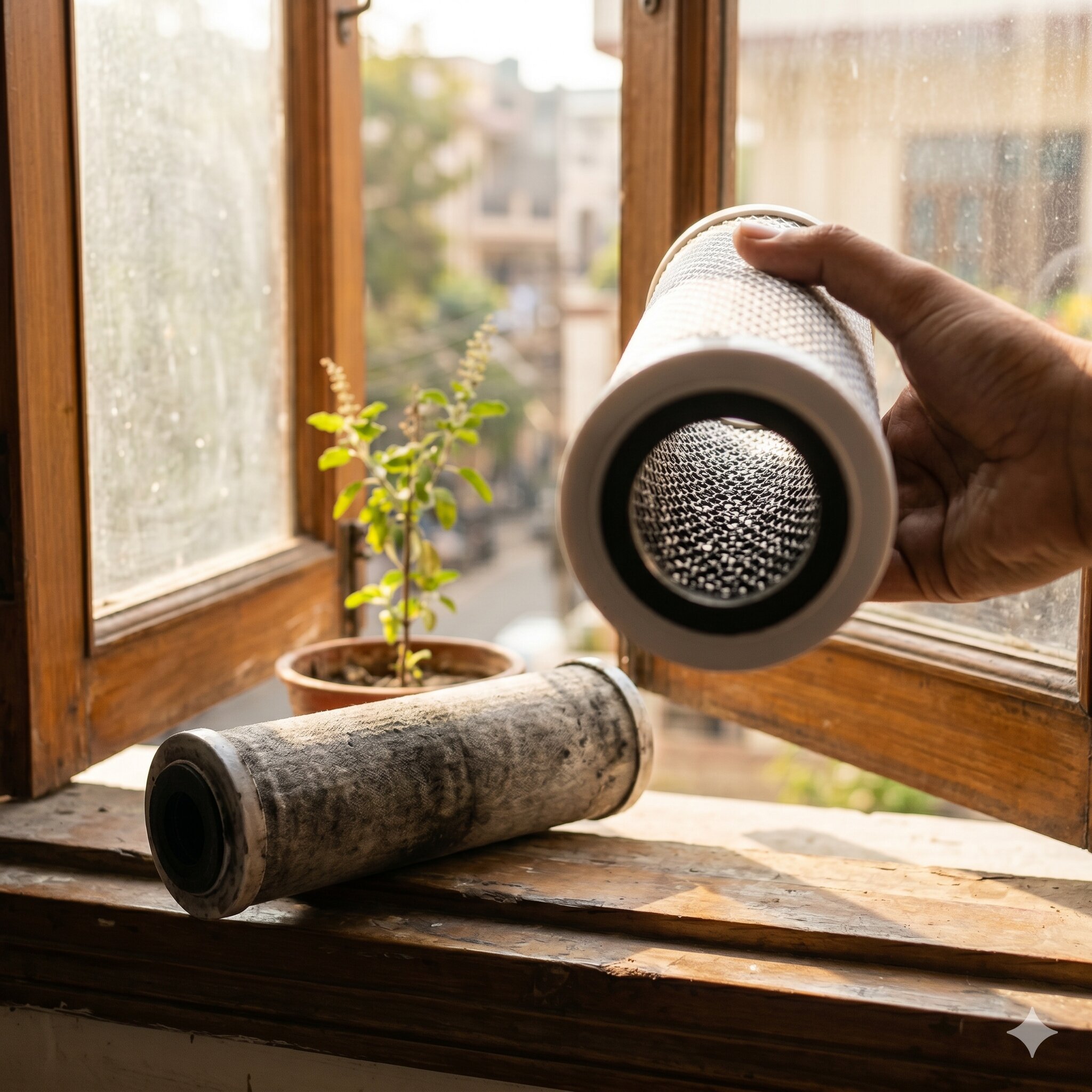
Activated Carbon Filters: What You Can and Cannot Check at Home
Holding a carbon filter against a light is not a performance test. Seeing light through it does not quantify gas removal, and an opaque filter does not prove that air cannot bypass the media. For a buying decision, ask for evidence about the specific filter and pollutants of concern.
Particles and gases need different evidence
A particle-filter rating does not demonstrate removal of gases. EPA explains that gas filtration requires media designed for that purpose, such as activated carbon, and that a substantial amount of material can be important. EPA consumer guide.
Do not treat “activated carbon” on a box as a promise to remove every gas or odour. Also do not treat the absence of a thick carbon stage as proof that the particle-filter stage is ineffective.
Questions to ask before buying
| Ask the supplier | Why it helps |
|---|---|
| Which gases was this filter tested against? | A result for one substance is not evidence for every VOC |
| What were the concentration, airflow and test duration? | A headline percentage without conditions is difficult to interpret |
| What media is used, and how much? | Allows a more useful comparison than filter colour or opacity |
| Is there a replacement recommendation for my use? | Calendar age alone does not describe the exposure history |
| How is the filter sealed into the unit? | The installed assembly matters as well as the media |
Keep the actual test report or product documentation, rather than relying on a photograph of black mesh. Do not estimate remaining capacity by smell alone or create smoke or chemical vapour to test a home device.
What you can inspect at home
With the equipment switched off and following its instructions, check for a correctly seated filter, visible damage and an overdue replacement. Keep a record of the part fitted and the installation date. These checks help with maintenance; they do not measure gas-removal efficiency.
For a persistent concern, identify the likely source and seek an appropriate assessment. A PM2.5 reading is a particle measurement, not a measurement of all gases. A consumer “TVOC” reading is not a substitute for a substance-specific test where that is needed.
What this means for aqi0
The standard aqi0 whole-home air purifier uses a washable pre-filter and H13 HEPA filtration in a standalone outdoor-air supply. Do not assume it removes outdoor gases simply because the air passes through HEPA. Intake placement and the sources around it are part of the installation assessment.
Discuss any specific gas concern and the treatment it requires before selecting equipment. See the technical note for the actual product scope and the fresh-air comparison for the difference between filtration and outdoor-air supply.
FAQ
Should I throw out my air purifier if it fails the daylight test?
Not necessarily. The HEPA stage (white pleated paper section) usually does work for PM2.5 even if the carbon stage doesn’t. You’re getting partial value.
Can I buy a separate carbon filter to add?
Some purifier models accept aftermarket “thick carbon” upgrade filters. For most consumer purifiers, the housing is too small to hold the carbon mass that would be useful.
Does activated bamboo charcoal in pouches work?
Slow, passive adsorption. Useful in small enclosed spaces (wardrobes, shoe cupboards, fridges). Not enough surface area for a room.
Does carbon saturate even when not in use?
Slowly, yes. Carbon exposed to indoor air adsorbs whatever is around, whether the fan is on or off. Replacing every 6–12 months is reasonable; “use only” replacement scheduling underestimates real saturation.
Are zeolite or molecular sieve filters different?
Yes — they target specific molecule sizes more selectively. Useful for specific applications; cost is higher; not typically in consumer air purifiers.