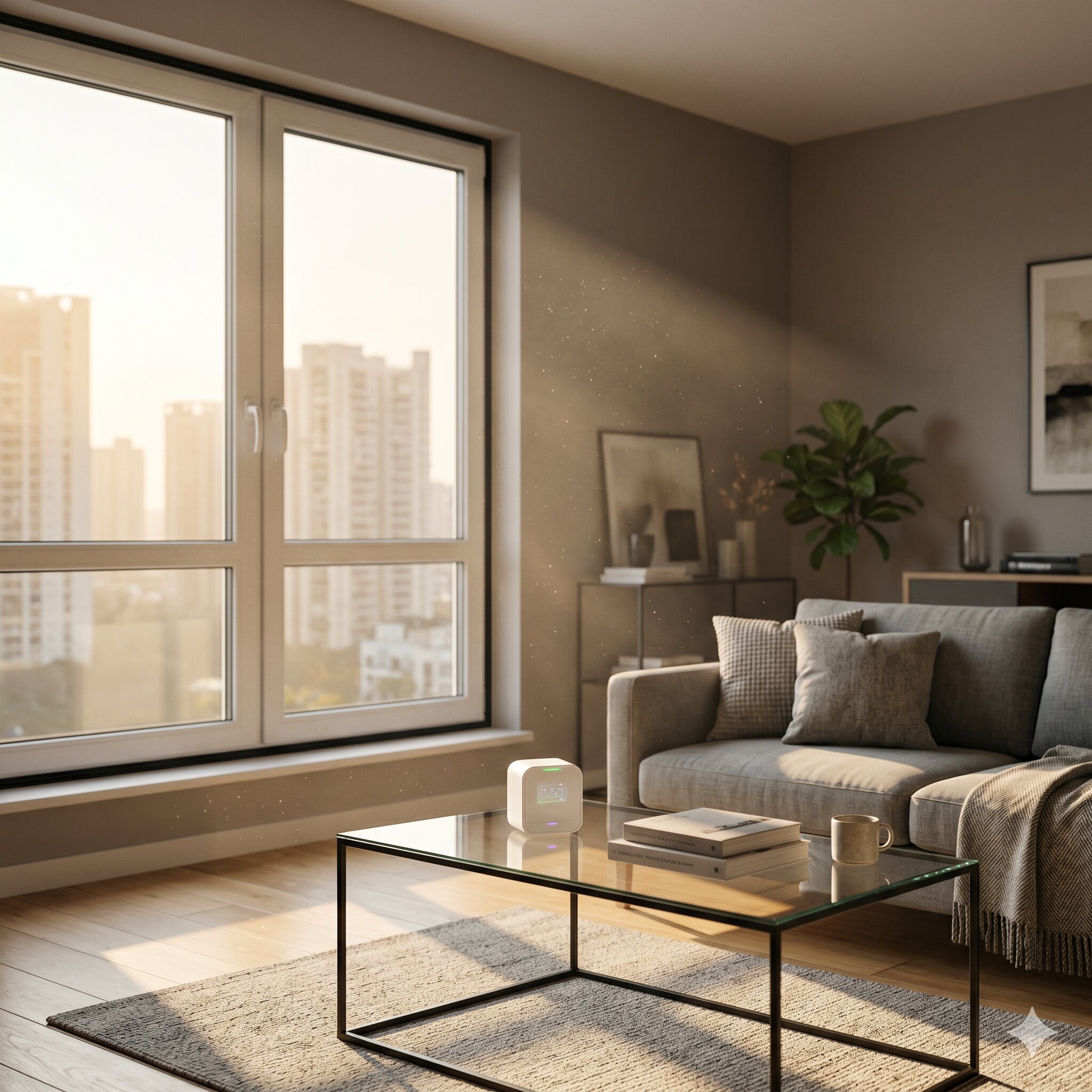
Sealed Homes and Indoor Air: Plan Ventilation Alongside Insulation
Better-sealed windows can improve comfort and reduce uncontrolled outdoor entry. They do not automatically make a home unhealthy. The question is whether indoor sources, moisture and occupied-room ventilation are managed after the building becomes tighter.
An older leaky home is not inherently healthier: uncontrolled incoming air can carry outdoor pollution and create comfort problems of its own.
Airtightness and ventilation are different
Airtightness describes resistance to uncontrolled leakage. Ventilation describes outdoor-air exchange through planned or natural paths. A home can be relatively airtight and still have effective ventilation.
Nominal air changes per hour are airflow divided by room volume. One nominal air change does not mean every molecule of old air has been replaced. A blower-door test measures leakage under an imposed pressure difference; it is not a direct measurement of normal occupied ventilation.
What to check after sealing windows
- Occupied bedrooms: record CO₂ with a suitable instrument and note occupancy and door positions.
- Kitchen: confirm the exhaust captures cooking emissions and can receive replacement air.
- Bathrooms: check extraction and investigate persistent dampness or leaks.
- Other rooms: look for pollutant sources, blocked air paths and equipment that is not maintained.
These checks answer different questions. Lingering smell does not measure air-change rate, and one CO₂ threshold cannot identify the exact leakage of a building.
Choose a ventilation approach for the home
Ventilation design needs to consider outdoor pollution, climate, room connections and comfort. Supply, exhaust and balanced arrangements have different implications. The US Department of Energy’s whole-house ventilation overview explains these categories.
Unfiltered window ventilation can be useful when outdoor air, weather and safety allow. In polluted conditions, filtered outdoor-air supply may be appropriate. Bringing outdoor air indoors also brings a heating, cooling and moisture load; filtration alone does not remove that load.
How aqi0 approaches the assessment
aqi0 installs a standalone whole-home air purifier with its own filtered supply path. We assess external intake placement, room connections, carpet area, floor count and maintenance access. We also discuss kitchen and bathroom exhaust operation.
One unit is specified for up to 2,000 sq ft carpet area, with two units planned for larger homes or multiple floors after assessment. See how the system works and the technical note for conditions and coverage.
For a useful starting record, follow the bedroom CO₂ guide. Do not remove required ventilation openings simply to achieve a lower particle reading.
FAQ
Why don’t builders include ventilation in design?
Indian building codes (NBC 2016) require minimum ventilation in theory but enforcement focuses on window-to-floor-area ratios, not on actual air-change rates. Mechanical ventilation is rarely specified in residential designs. Builders prioritise saleable square footage over invisible infrastructure.
Will running the kitchen and bathroom exhausts solve it?
Partially. Exhausts pull air out, creating slight negative pressure that draws unfiltered outdoor air through every gap. In Delhi this is a poor trade — you remove cooking smoke but pull in road dust and PM2.5. A balanced system (supply + exhaust) works better.
Are old homes actually healthier?
For air quality, often yes. They were less efficient and noisier, but residents experienced fewer trapped-pollutant problems. Modern homes are healthier in other ways (insulation, water quality, electrical safety) — air is the regression.
What’s the air-change rate of my home?
Builders rarely specify it. A blower-door test, increasingly available in India through energy-audit firms, gives a precise number. Cost is typically ₹8,000–15,000 for a residential test.
Will a stronger AC help?
No. An AC recirculates indoor air. It cools but does not ventilate. Adding more AC capacity to a sealed home worsens the air quality problem by reducing the only motivation to open windows.