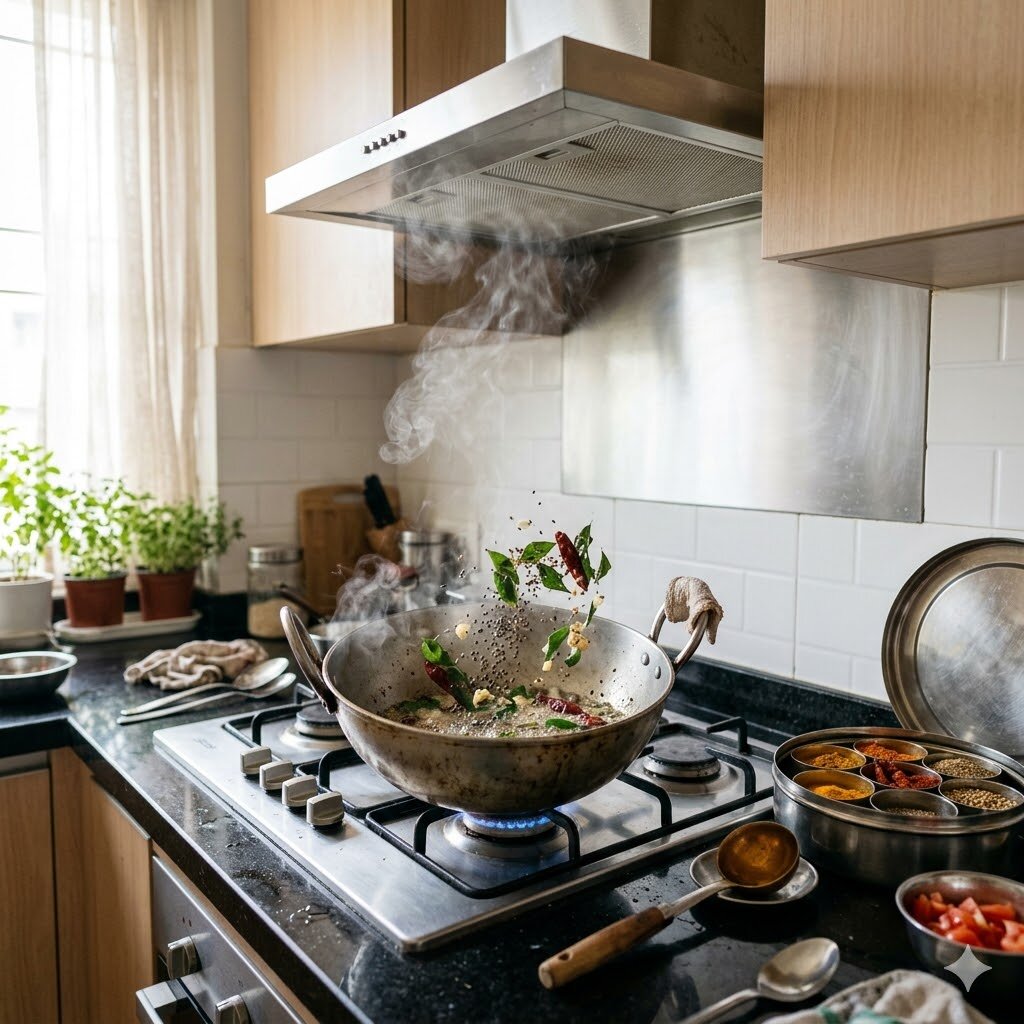
Kitchen Chimney vs Wall Exhaust Fan: Why One Works and the Other Is Mostly Decoration
A correctly installed wall-mounted exhaust fan in an Indian kitchen will remove cooking pollutants in real time. A modern overhead kitchen chimney — particularly the recirculating type that vents back into the kitchen through a carbon filter — often will not. This article explains the physics, what to buy, and why kitchen ventilation matters more than most homeowners realise.
Key numbers
- PM2.5 spike during high-flame Indian cooking: 500–3,000 µg/m³, briefly
- NO₂ produced by a gas burner on full: 100–250 ppb at face height
- WHO 24-hour PM2.5 limit: 15 µg/m³
- Effective extraction rate of a 9-inch wall exhaust fan: 700–900 m³/h
- Effective extraction rate of a recirculating chimney with old filter: sometimes under 100 m³/h
- Recommended kitchen air-change rate while cooking: 15+ air changes per hour
Why kitchen ventilation matters
Indian cooking generates pollutants no other room in the home produces in the same intensity. Tadka (frying spices in hot oil at 200°C+), tandoor-style high-flame cooking, deep frying, and roasting on an open flame all release:
- PM2.5 from oil aerosols and carbonised particles — concentrations during tadka can briefly exceed the worst outdoor air ever recorded
- PM10 from spices and flour dust
- Nitrogen dioxide (NO₂) from gas combustion — irritant to airways, linked to childhood asthma
- Carbon monoxide from incomplete combustion in undersized burners or poorly ventilated kitchens
- Acrolein and formaldehyde from heated cooking oils (especially oils reheated multiple times)
- VOCs from masala — aromatic compounds that linger and react
Three things go wrong when kitchen ventilation is poor:
- The cook gets hit hardest. A homemaker who cooks two meals a day is exposed to spike PM2.5 levels for 40–60 minutes daily. Over years this is a significant cumulative dose.
- Cooking smells spread to the rest of the home. If your living room smells of last night’s dinner at 11 PM, your air is not moving correctly.
- The pollutants don’t just vanish. Aerosolised oil deposits on walls, fabrics, and ceiling fan blades. Cooking VOCs react with indoor ozone and other gases over hours to form secondary pollutants that are sometimes more irritating than the originals.
What a wall-mounted exhaust fan does well
A 9-inch (225 mm) or 12-inch (300 mm) axial exhaust fan, mounted in the wall directly opposite the cooking station, can move 700–900 m³/h. A standard Indian kitchen of about 20 m³ achieves a complete air change every 90 seconds. Cooking pollutants leave the room as fast as they are generated.
The mechanism is simple. The fan creates a low-pressure region behind it. Outside air rushes in through the kitchen door, sweeps across the cooking station, and exits through the wall. As long as the air path is clear (door open, no blocked vents), the pollutants ride along.
Wall exhausts work because they are big, short-ducted, and directly connected to outside.
Why a modern kitchen chimney often disappoints
Modern overhead chimneys come in two types:
1. Ducted chimney (vented to outside). Connected by a flexible aluminium duct to an outside wall or terrace. Catalogue suction ratings of 1,200–1,500 m³/h are common. Real-world performance depends on:
- Duct length and bends. Every 90° bend cuts airflow by 15–25%. A duct with three bends and an 8-metre run delivers maybe 40% of the catalogue rating.
- Filter condition. Mesh and baffle filters at the chimney inlet load up with oil within months. An oil-saturated filter halves airflow.
- Hood positioning. Hoods mounted too high above the cooktop (over 75 cm) capture less than half the rising smoke plume.
A well-installed ducted chimney with short straight ducting and a clean filter is excellent. Most installations are not that.
2. Recirculating chimney (carbon-filter “ductless” type). The chimney pulls smoke up, passes it through a carbon filter, and pushes it back into the kitchen. Marketed as “no ducting required, easy installation.”
This is the type that is mostly decoration:
- A typical residential carbon-filter cartridge holds 200–500 grams of activated carbon. Indian cooking saturates this within 4–8 weeks of daily use.
- Once saturated, the carbon stops adsorbing. Smoke flows through and back into the kitchen.
- Even when fresh, carbon filters capture only the smell-causing organic compounds, not PM2.5. The oil aerosol and particulate matter pass straight through.
- Effective extraction rate, even at advertised settings, is often under 100 m³/h after a few months of use.
If your kitchen chimney recirculates rather than ducts to outside, you are mostly producing fan noise.
What the standard advice gets wrong
Common kitchen ventilation advice — “open a window,” “use the chimney on high while cooking” — assumes the rest of the house is loosely connected and air will move. In a sealed modern Indian apartment, opening one kitchen window without an outlet creates no airflow. The pressure equalises and pollutants stay.
For kitchen ventilation to work, two air paths matter:
- Where dirty air leaves — exhaust fan or ducted chimney
- Where replacement air enters — open kitchen door, or balcony door, or in a positive-pressure home, the fresh air system itself
Without both, no fan does useful work.
The right setup for an Indian kitchen
Ranked by effectiveness for typical Indian cooking:
- Wall-mounted exhaust + ducted overhead chimney + open kitchen door. Best. Wall exhaust handles the room volume; chimney captures the smoke plume directly above the cooktop.
- Ducted overhead chimney alone, with short straight duct, clean filter, plus an open kitchen door. Good if installed correctly.
- Wall-mounted exhaust alone. Better than chimney-only for whole-room ventilation; less efficient at capturing smoke right at the cooktop.
- Recirculating chimney alone. Visual feature, minimal effect.
- Nothing. Pollutants stay in the house.
How kitchen ventilation interacts with a fresh-air system
A positive-pressure fresh-air system holds the rest of the home at 10–25 Pa above outside. The kitchen exhaust becomes the planned exit route for cooking pollutants. The pressure differential plus active exhaust means:
- Air can only move toward the kitchen exhaust, never from kitchen into living areas
- Smoke and odours do not migrate into bedrooms even if the kitchen door is open
- The fresh air system continuously replaces what the kitchen exhaust removes
aqi0’s recommendation: keep the kitchen door closed while cooking, run the kitchen exhaust on high until cooking is finished. Positive pressure does the rest.
FAQ
Should I switch from a recirculating chimney to a ducted one? Yes, if your kitchen layout allows a short outside duct. The performance gap is large.
My chimney is rated 1,500 m³/h. Why does smoke still escape? Catalogue ratings assume ideal lab conditions: no filter, no ducting, no bends. Real installation typically delivers 30–50% of the catalogue number.
How often should I clean the chimney filter? Baffle and mesh filters: every 30–45 days for daily Indian cooking. Carbon filters in recirculating units: replace every 3–6 months, sooner if smells return.
Is induction cooking better for indoor air? Significantly. Induction eliminates NO₂ and CO from gas combustion. PM2.5 from oil aerosols is reduced but not eliminated.
Do I still need kitchen exhaust if I have a fresh-air system? Yes. Fresh-air supply pushes filtered air in; the kitchen exhaust gives cooking pollutants a way out. They work together, not as substitutes.