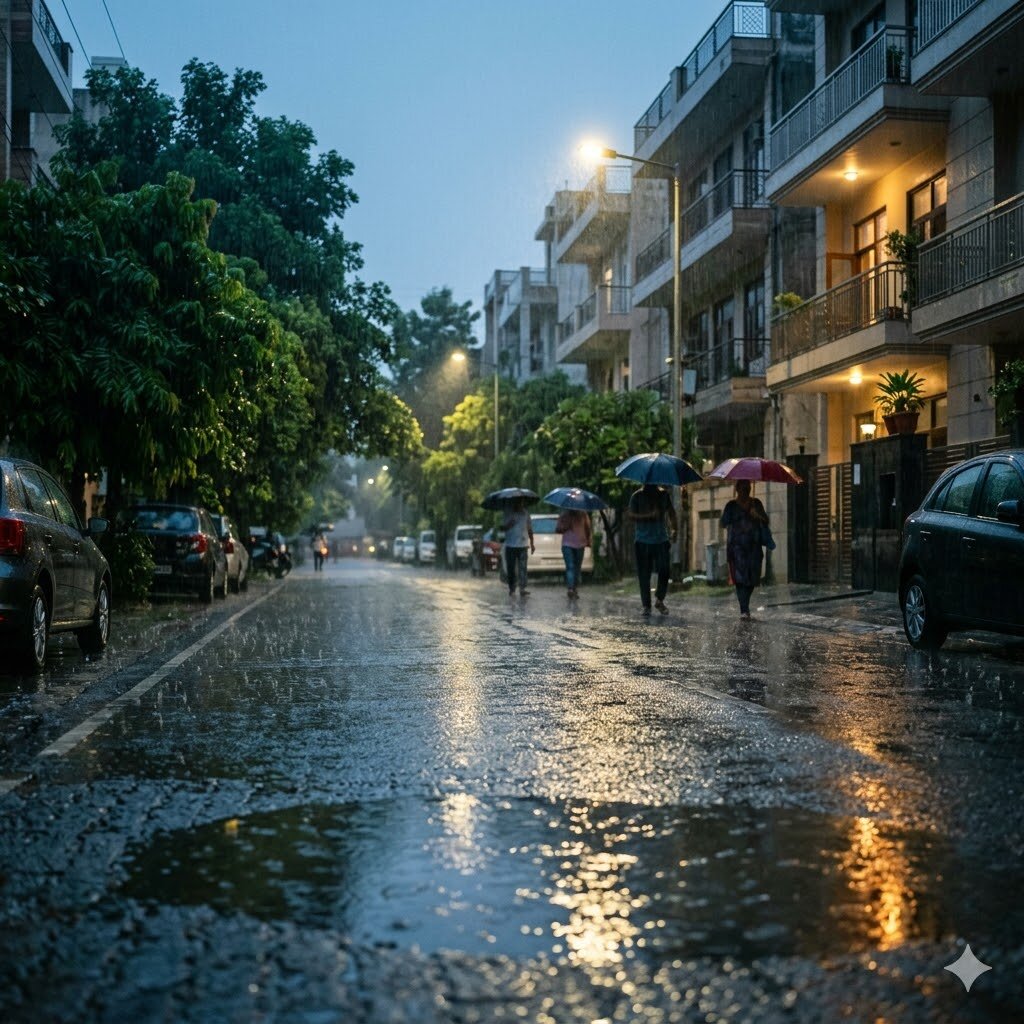
Does Rain Reduce PM2.5? Delhi’s Monsoon Air Explained
Rain can remove both PM2.5 and larger particles from the atmosphere. The claim that monsoon “only washes out PM10” is incorrect. How much pollution remains depends on rainfall, particle properties, wind, sources and atmospheric processes.
How rain removes particles
Particles can be incorporated into cloud droplets and removed when precipitation falls. Falling rain can also collect particles below clouds. These processes behave differently across particle sizes and conditions; one blanket removal percentage cannot describe a Delhi monsoon day. NOAA’s particle wet-deposition overview distinguishes within-cloud and below-cloud removal.
PM10 is not just coarse dust: it includes the smaller PM2.5 fraction. When comparing fine and coarse particles, the coarse fraction is commonly described as PM10–2.5. Neither fraction should be dismissed as irrelevant.
Why the improvement can be temporary
Rainfall can reduce airborne particles, while traffic, combustion and other sources continue adding them. Conditions can change again after a dry spell or a change in wind. A clear view after rain is welcome, but visibility is not a complete air-quality measurement.
The extent of seasonal improvement varies by station and year. Claims that every monsoon day remains a fixed multiple of a WHO guideline require a dated dataset and the correct averaging period. A monthly average cannot establish the concentration on each individual day.
Should you open the windows after rain?
Check current local pollution and indoor conditions. Outdoor air may offer a useful ventilation opportunity, but rain alone does not guarantee it is suitable. Nearby exhaust, smoke, dust and humidity also matter.
If you compare indoor and outdoor particle readings, allow for sensor differences and placement. Moisture can affect some consumer optical sensors. Do not interpret a single spike beside an open, wet window as a reliable measure of the whole home.
Manage moisture separately
A particle filter is not a dehumidifier. Supplying outdoor air can bring moisture into the home, and positive pressure does not guarantee prevention of mould. Fix leaks, dry damp materials and use appropriate moisture control. Bathroom exhaust remains useful for removing moisture at its source. See EPA’s guide to mould and moisture.
Adjust filtration using measurements and maintenance needs rather than a calendar-only rule. Review ventilation independently of PM2.5, especially in occupied bedrooms.
For aqi0, installation and operation should account for the home’s actual conditions; see the technical note. Continue with Delhi air quality through the year or reading AQI apps.
FAQ
If monsoon air is good, why do I still get sick?
Cold and flu seasonality, mould exposure from indoor dampness, allergen profiles change. “Better air” doesn’t eliminate respiratory illness.
Should I switch off my fresh-air system in monsoon?
No. The system continues to maintain low indoor PM2.5 and positive pressure (which keeps humid outdoor air from infiltrating through gaps and growing mould inside walls). The electricity cost is the same.
Why are some monsoon days bad?
A break in the monsoon (dry spells of 4–7 days) lets pollution accumulate without washout. AQI can spike toward late-monsoon if there’s a long dry break.
Does monsoon clean indoor air too?
Indirectly — if you open windows. Sealed homes see no monsoon benefit indoors. With windows shut, indoor PM2.5 depends entirely on infiltration rate and indoor sources.
Is the monsoon-cleaner-air pattern stable?
Historically yes; climate change makes monsoon timing and intensity more variable. The window of relief may shift or shrink over coming decades.