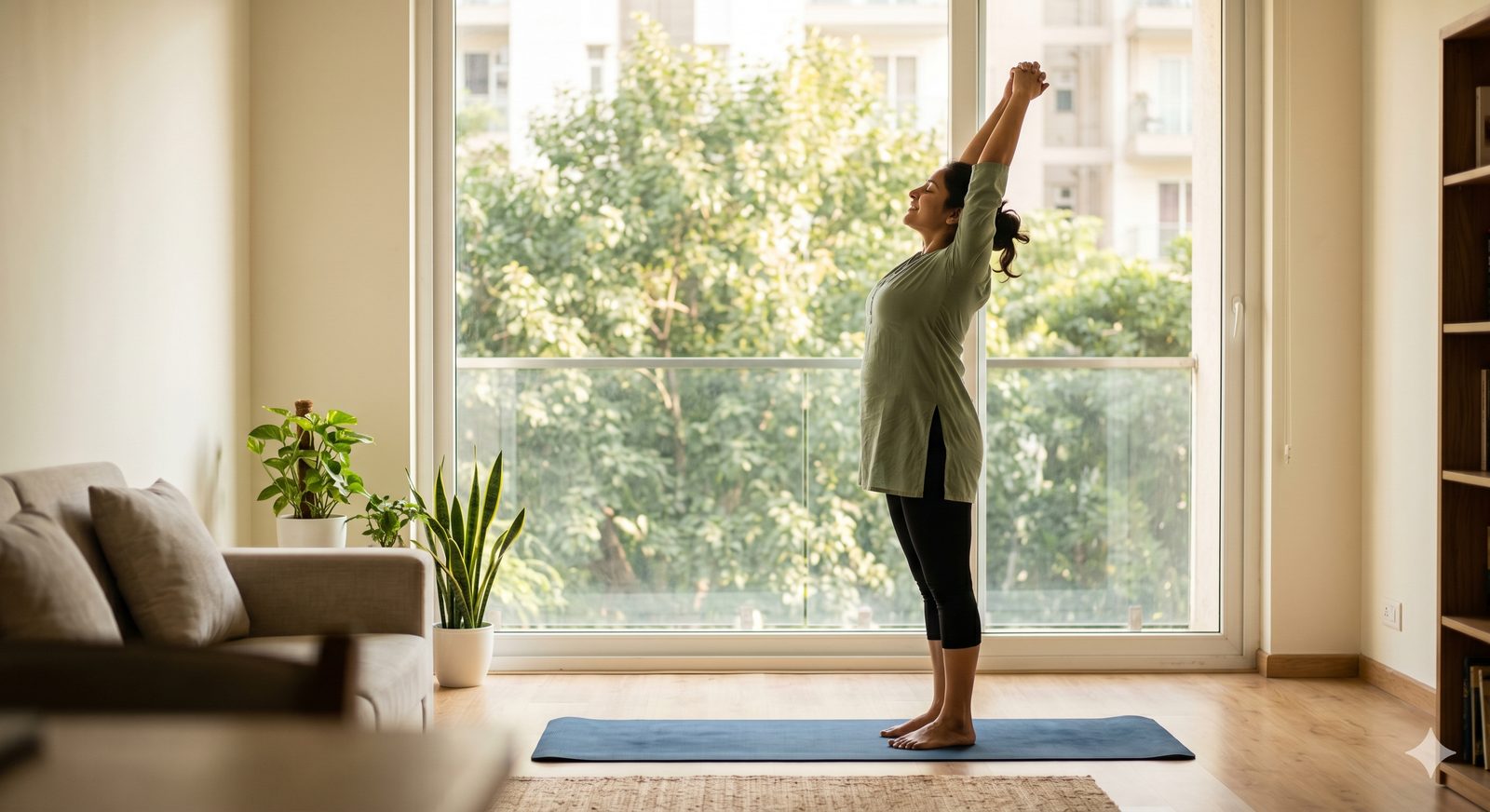
Indian woman doing morning yoga in a bright apartment with greenery through the balcony window

Year-Round Yoga at Home

Most Indian yogis quietly stop home practice from October to February. The mat goes away, pranayam pauses, the morning routine breaks. The reason isn’t motivation — it’s the air. Indoor PM2.5 in a typical Delhi NCR apartment in winter sits at 60-150 µg/m³ even with the windows shut, and deep breathing in that air actively works against the practice. When indoor PM2.5 holds under 15 µg/m³ across the home continuously, the seasonal pause disappears. The practice is the same exercise in November as it is in May.

Watch · 8-min version what year-round home practice looks like when the air supports it.

The seasonal pause

If you practise yoga at home in Delhi NCR, look honestly at your last twelve months. Most regular practitioners follow a quiet pattern:

Most practitioners don’t register this as a pollution problem. It shows up as fatigue, as inconsistency, as “winter is just like that”. The room feels stale, the slow breath feels harder to hold, the post-session fatigue is real, and the mat doesn’t come out as often.

The reason is the air. Specifically, three things at once.


Why air shapes the practice

1. Deeper breaths in dirty air deliver more pollution

Asana and pranayam involve longer, slower, deeper breathing than ordinary respiration. Tidal volume rises. So does the PM2.5 dose per minute.

The arithmetic is simple:

PM2.5 dose = breathing rate × tidal volume × concentration × duration

Ordinary resting breathing is roughly 12 breaths/min × 500 mL = 6 L/min of air. A 30-minute slow pranayam session at 6 breaths/min × 1.5 L = 9 L/min, and that’s during the slow phases. In active asana the minute volume climbs further. Over a 25-minute session in a room at 80 µg/m³ PM2.5, the cumulative particulate dose reaching the alveoli can be 4-6× higher than the same time spent at rest in the same room.

That number doesn’t appear on any AQI app. The app measures concentration, not dose. The dose is what reaches your lungs.

2. The closed-room CO₂ trap

To shut out the polluted air outside, you close every window. To run the purifier efficiently, you keep the door shut. By minute 15 of a 30-minute session in a closed 12 × 12 ft yoga room, indoor CO₂ has climbed from around 600 ppm to 1,200+ ppm. By minute 30 it’s at 1,500+ ppm.

Above 1,000 ppm, decision-making and cognitive scores drop measurably (Allen et al, Harvard TH Chan / SUNY Upstate, 2016). Above 1,500 ppm, the slow-breath state becomes harder to hold — the body wants more breath, the mind feels less calm. Pranayam ends up fighting itself.

3. The PM2.5 hangover

The post-session fatigue most home practitioners feel after winter sessions isn’t training fatigue. It’s the body processing a 30-minute pulse of inhaled fine particulate. Sub-2.5 micron particles cross the lung-blood barrier into the bloodstream (Brook et al, 2010). The grogginess is physiological, not psychological.


What clean indoor air actually changes

When whole-home indoor PM2.5 holds under 15 µg/m³ continuously, and CO₂ is vented below 1,000 ppm, the practice doesn’t pause for the season. Three things shift at once:

This is not a motivational shift. It’s a removal of friction.


Family practice across generations

A common pattern in NCR homes: parents practise yoga, grandparents do their own routine in their own room, children sometimes join, sometimes don’t. Most of the time the practice scatters across rooms because air-quality concerns push everyone toward whichever space has a working purifier.

When the air is the same room-to-room — PM2.5 < 15 µg/m³ across the entire home, no isolated pockets — multi-generational practice becomes natural. A parent on the living room mat. A four-year-old attempting child’s pose alongside, off-form and joyful. A grandparent doing chair-supported breathwork in their bedroom or in the same room. Nobody coughing through a slow exhale.

This matters more for older practitioners than it sounds. Lung capacity declines with age, and tolerance for particulate exposure drops faster than it does for younger lungs. A 65-year-old doing pranayam in 80 µg/m³ accumulates damage faster than a 35-year-old in the same room. Clean indoor air removes that age penalty.


How to measure your practice room

Before changing anything, measure. The simple version:

  1. Get a PM2.5 + CO₂ monitor — ₹3,000-5,000 on Amazon, any Indian brand that reads both numbers.
  2. Run it through one full session — start to finish, in the room where you practise, with the door and windows set the way you usually keep them.
  3. Note four values: - Starting PM2.5 - Ending PM2.5 - Starting CO₂ - Ending CO₂

If your starting PM2.5 is above 15 µg/m³, your practice is being shaped by particulate. If your ending CO₂ is above 1,200 ppm, the closed-room CO₂ effect is in play. Most NCR home practitioners doing this exercise for the first time are genuinely surprised by both numbers.

The question isn’t whether to take air seriously. It’s whether the answer is to gate the practice (skip winter) or to fix the room (year-round).


What “fixing the room” actually means

Three options, ranked.

Option 1: Run a HEPA purifier in the practice room

A correctly-sized HEPA purifier in a closed practice room can hold PM2.5 under 30 µg/m³, sometimes under 15. Limits: it doesn’t reduce CO₂, it requires the door to stay shut (which traps CO₂), and only one room is clean. Family practice in the same air becomes harder, and grandparent or child practice in another room is back to ambient indoor PM2.5.

Option 2: Crack a window for ventilation

Tempting, but worse than it sounds. Cracking a window in NCR October-February pulls in outdoor air at 200-400+ µg/m³. The CO₂ drops but the particulate climbs — your room PM2.5 goes from 60 to 150+ in minutes. Net loss for the practice.

Option 3: Whole-home positive-pressure ventilation

A fresh air system pulls outdoor air through H13 HEPA filtration before it enters the home and pressurises the entire space, so polluted air can’t infiltrate. PM2.5 under 15 µg/m³ across every room. CO₂ continuously vented under 1,000 ppm. The practice room is clean, the kitchen is clean, the bedroom is clean — every morning of the year, including November and December.

This is the only option where year-round home yoga is actually the same exercise as outdoor yoga in May.


FAQ

Is outdoor yoga better than indoor yoga?

In the right season and place, yes — early-morning yoga in a Himalayan ashram or a coastal town is unbeatable. In NCR, outdoor 6 AM yoga from October to February is worse than indoor with clean air. PM2.5 outdoors during winter inversions hits 300-500 µg/m³ at sunrise.

Will a yoga studio handle this?

Some do, some don’t. Studios sealed with a purifier face the same CO₂ trap as your home. Studios that ventilate naturally pull in outdoor PM2.5. Few studios measure both numbers continuously. Ask before committing to a season of classes.

Does the time of day matter?

Yes. PM2.5 in NCR peaks 5-9 AM and 7-11 PM during temperature inversions. The traditional 6 AM yoga slot is the worst PM2.5 window of the day for most of winter. Clean indoor air with a fresh air system flattens this — 6 AM is the same as 11 AM, every day.

What about kapalabhati and other rapid-breathing practices?

Kapalabhati is rapid forced exhalation — high breathing rate, high tidal volume. Done in 80 µg/m³ air, it delivers a particulate dose faster than ordinary cardiovascular exercise. If you do kapalabhati daily, indoor air quality matters more than for most practices.

Is an HRV or ERV worth it for a yoga room?

Probably overkill for India. HRV/ERV systems with heat recovery are over-engineered for India’s mild winters. A positive-pressure fresh air system delivers the same air-quality outcome with simpler engineering and lower cost.

Does meditation alone (no asana, no pranayam) need clean air?

Less critical than asana or pranayam, but still meaningful for daily practitioners. Seated meditation runs at near-resting respiration, so the dose effect is smaller. The CO₂ effect remains — a closed meditation room with one practitioner pushes CO₂ above 1,000 ppm in 20-30 minutes, which subtly works against sustained calm.


Want year-round practice in your home?

aqi0 installs across Gurugram, South Delhi, Noida, and Faridabad. Every install includes a WiFi monitor that reads PM2.5 and CO₂ — so you can verify the practice room is at < 15 µg/m³ and < 1,000 ppm continuously, every morning of the year.

WhatsApp +91 96676 72740  •  [email protected]