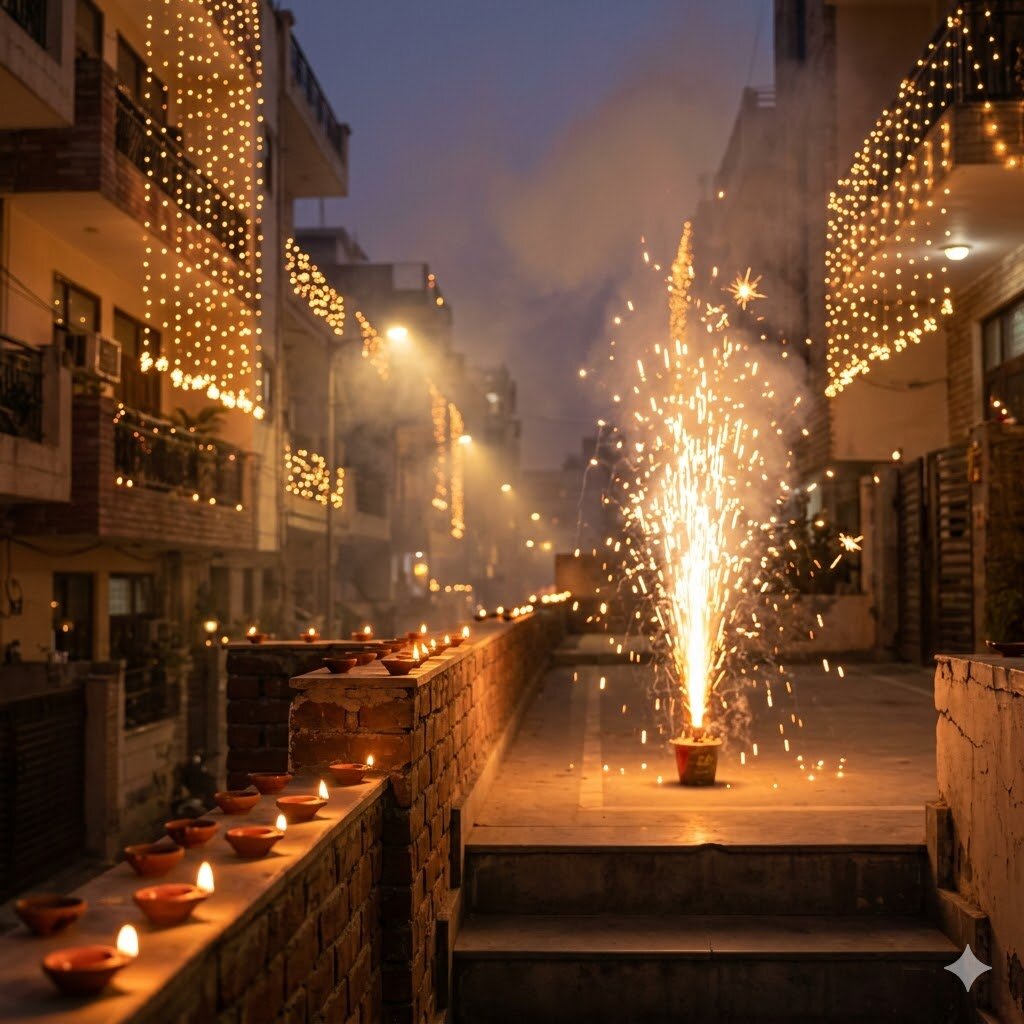
Green Firecrackers: Lower Emissions, Still Air Pollution
“Green” firecrackers are designed to reduce emissions compared with conventional products. The label does not mean no smoke, no noise or no injury risk, and it does not establish that a product may legally be sold or used in your location.
What the emissions claim means
In a December 2025 CSIR announcement, the Government of India described CSIR formulations with approximately 30–40% lower particulate emissions than conventional crackers. That is a comparison of emissions from formulations, not a prediction of the percentage reduction in Delhi’s outdoor AQI. Source: PIB’s CSIR announcement.
Actual neighbourhood concentrations depend on how many products are used, where and when they are used, other pollution sources and weather. AQI is an index with pollutant-specific breakpoints; it does not fall by the same percentage as one source’s emissions.
Why a label is not enough
A product description should be supported by the applicable authorised identification and verification process. Packaging colour alone proves nothing. Certification and permission to use a product are separate questions.
Firecracker restrictions can differ by jurisdiction and date. Before any purchase or use, check the current state or local order and applicable court directions. A permission window reported for a previous Diwali is not permission for the next one. This article does not publish a standing permitted-use timetable.
How to plan for a smoke episode
Follow local air-quality advisories and check the latest readings. Avoid creating additional indoor particles from candles, incense or other burning. If smoke is entering through open windows, close those openings when practical and use available particle filtration.
Keep necessary cooking extraction and ventilation functioning, with suitable replacement air. Do not switch off required exhaust merely to preserve pressure. If the home becomes hot or poorly ventilated, address those conditions too; “keep every window shut for 48 hours” is not suitable universal advice.
Check indoor PM2.5 and equipment condition during and after the episode. Particle filters do not remove every gas in smoke. People with an existing care plan should follow it; indoor equipment is not a substitute for medical care when symptoms occur.
What aqi0 can claim
aqi0 filters particles from supplied outdoor air. Its performance depends on the installation, operation, filter condition and indoor sources. Neither H13 filtration nor the brand name guarantees symptom-free sleep or an unchanged indoor reading through every firework event. Refer to the technical note for the actual performance commitment and conditions.
For practical preparation, read reducing PM2.5 at home and indoor candles and incense.
FAQ
Are green crackers safe?
Safer per unit than conventional. Not safe in absolute terms. Burning anything indoors or in concentrated quantity outdoors still produces meaningful health-relevant emissions.
How do I know if a cracker is actually a green cracker?
PESO (Petroleum and Explosives Safety Organisation) certification + a QR code on packaging. Without these, assume conventional. Visible green-label crackers are increasingly common in regulated markets but counterfeiting is reported.
Did the 5-day window in 2025 reduce pollution?
Partial. Compliance with green-only and timing restrictions was uneven. AQI on Diwali night was elevated but lower than uncontrolled years.
Should Diwali fireworks be banned entirely?
Public-health argument for yes; livelihood, cultural, and enforcement arguments for no. Different reasonable people reach different answers; this is genuinely contested policy.
Are sparklers and phuljhari included in the ban?
Generally permitted under “green” classification with restrictions. Specific rules vary by state and year.