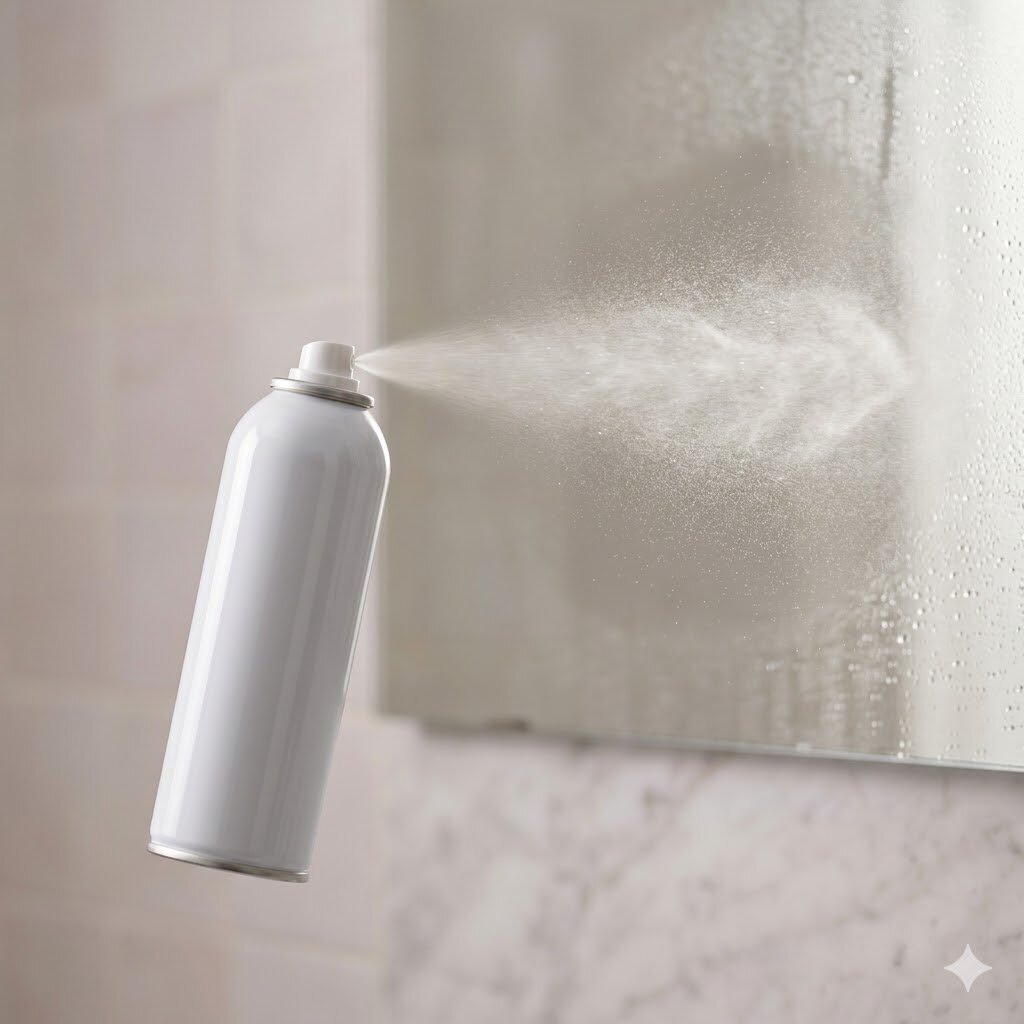
The Two-Second Spike: What an Aerosol Deodorant Does to Your Bathroom Air
Spray an aerosol deodorant for two seconds in a 4 m³ bathroom and the VOC concentration in that room climbs by several thousand micrograms per cubic metre within thirty seconds. The cloud takes 5–15 minutes to dissipate without ventilation. The chemistry includes alcohols, fragrance VOCs, propellants like butane, and in some products, trace benzene — a Group 1 human carcinogen with no safe exposure threshold. Independent testing has found benzene contamination up to 17.7 ppm in some body spray products. This page is about what’s in the can, what happens when you press the nozzle, and what to use instead.
Key numbers
- 17.7 and 17.4 ppm — peak benzene concentrations found in some body spray products (Valisure 2021)
- Group 1 carcinogen — IARC classification for benzene (no safe threshold; leukaemia link)
- 5.3–125 mg/L — typical VOC concentration in spray household products (benzene, toluene, styrene, methyl ethyl ketone, butyl acetate)
- Butane, isobutane, propane — common propellants; the butane-propelled products had the highest benzene contamination
- ~4 m³ — volume of a typical Indian bathroom (8’ × 8’ × 8’)
What’s in the can
An aerosol deodorant has four ingredient classes:
1. Active ingredient (often missing in body sprays). Aluminium chlorohydrate or aluminium zirconium compounds in antiperspirants. Body sprays without antiperspirant action contain none of these.
2. Fragrance. A blend of dozens to hundreds of VOC compounds. Legally disclosed only as “fragrance” or “perfume.” Linalool, limonene, benzyl acetate, eugenol and similar terpenes and esters predominate.
3. Solvent / carrier. Ethanol, isopropanol, or denatured alcohol — to keep the fragrance dissolved and quick-drying on skin.
4. Propellant. Butane, isobutane, propane — to pressurise the can. The propellant is essentially LPG with a fragrance added; it’s the source of the “wet” feeling on skin and the immediate cloud in the air.
The benzene problem comes from the propellant. Butane production sometimes carries trace benzene as a contaminant; this benzene ends up in the can and is released with every spray. Aerosols using alcohol propellant (rather than hydrocarbon propellants like butane) have much lower benzene contamination.
What happens when you spray
Trace a single 2-second spray:
- 0 seconds: Nozzle releases ~0.2–0.5 g of pressurised mixture. About 90% is propellant (butane), 10% is fragrance + carrier.
- 0–2 seconds: Propellant flash-evaporates, leaving fine fragrance droplets suspended in air. The “cloud” you see is fragrance + remaining solvent.
- 2–30 seconds: Cloud disperses through the room. Local VOC concentration near the can is several thousand µg/m³.
- 1–5 minutes: Without ventilation, VOC levels remain elevated. With windows shut and fans off, smell lingers.
- 15–60 minutes: Concentration decays back toward room baseline, depending on infiltration rate.
- 1+ hours: Residual fragrance compounds adsorb onto walls, fabrics, towels and continue to slowly re-emit.
For two-second spray once daily, the cumulative exposure to the person spraying is meaningful but not extreme. For the heavier users (multiple sprays, multiple products, all in a small unventilated bathroom), it adds up.
The benzene finding
In 2021, the independent US testing lab Valisure ran chromatographic analysis on aerosol antiperspirants and body sprays. The findings:
- Multiple major-brand products contained measurable benzene
- Worst contamination: 17.7 ppm in one batch; 17.4 ppm in another
- Pattern: products with butane propellant > products with alcohol propellant
- Outcome: Procter & Gamble, Unilever and others issued voluntary recalls of specific deodorant and dry shampoo SKUs
Benzene contamination in personal care products is generally a manufacturing issue (impure propellant), not an intentional ingredient. But because there is no safe exposure threshold for benzene, even trace contamination contributes to lifetime cumulative dose.
The Indian context
Aerosol body sprays are a major category in Indian men’s grooming. Axe, Wild Stone, Set Wet, Park Avenue, Engage and similar brands account for hundreds of crores in annual sales. Specific Indian batches have not been publicly tested for benzene at the level Valisure did in the US, but propellant sourcing is global. Conservative working assumption: trace benzene is plausible in Indian aerosols using butane propellant.
A second Indian-specific factor: bathroom size and ventilation. Indian bathrooms are typically smaller than US or European ones (~4 m³ vs. ~8 m³), with weaker exhaust ventilation. The same 2-second spray produces double the concentration spike in an Indian bathroom.
Third factor: frequent re-spraying. Indian heat and humidity often prompt multiple sprays per day, sometimes multiple products (deodorant + body spray + cologne). Cumulative daily exposure can be 3–6 times a single application.
What can be done
Five interventions, in order of effort and effectiveness:
1. Switch to a non-aerosol form. Roll-ons, stick deodorants, gel formulations all deliver the same active ingredients without aerosol propellant. Zero benzene-from-propellant risk. Zero spray cloud. Most of the same brands offer non-aerosol options.
2. Try alum (फिटकरी). Alum stone is a natural mineral salt deodorant. ₹10–50 for a stone that lasts 1–4 years. Wet skin, rub stone gently on underarms after shower. Antibacterial action prevents the bacteria that cause body odour. See alum as natural deodorant for the full guide.
3. If using aerosols, spray outside. Step outside the bathroom (balcony, near a window) for the actual application. Reduces both your peak inhalation and the residual indoor pollutant.
4. Ventilate immediately after. Run the bathroom exhaust for 10 minutes after spraying. Or open a window. Or both.
5. Avoid spraying near children, especially infants. Children’s lower body weight and developing systems make per-kg dose higher. Asthmatic children should not be in a room when aerosols are sprayed.
What aqi0’s fresh-air system does for this
A positive-pressure fresh-air system:
- Continuously dilutes ambient indoor VOCs by 70–90% from sealed-home baseline
- Does not fully eliminate the spray-second spike (an instantaneous 5,000 µg/m³ spike near the can is local and brief)
- Substantially reduces residual VOC concentration in the hours after spraying
- Drops baseline indoor VOC during the rest of the day
The system doesn’t replace the source-elimination argument. Spray less, switch products, or both — that’s where the biggest gain comes from.
FAQ
Are all aerosol deodorants benzene-contaminated? No. The Valisure testing found specific brands and batches with measurable benzene; others had levels at or below detection. The risk is variable by batch and by propellant choice (butane vs. alcohol).
Is one daily spray a real health risk? Cumulative risk over decades is the right frame. A single spray is not acutely harmful. The 365 sprays per year × 30 years = 11,000 sprays produce a meaningful integrated exposure.
Are roll-ons VOC-free? Mostly. Roll-ons contain fragrance VOCs but no propellant; the VOC release is slower and lower. Far cleaner indoor air profile than aerosols.
What about “aluminium-free” deodorants? Removes the antiperspirant active ingredient (aluminium chlorohydrate or zirconium compounds) but says nothing about VOC content of the fragrance or propellant. Read the full ingredient profile.
Why do brands keep using aerosol if there’s a risk? The form factor (quick application, satisfying spray sound, large coverage area) is consumer-preferred and historically associated with masculine grooming. Reformulation lags consumer demand.