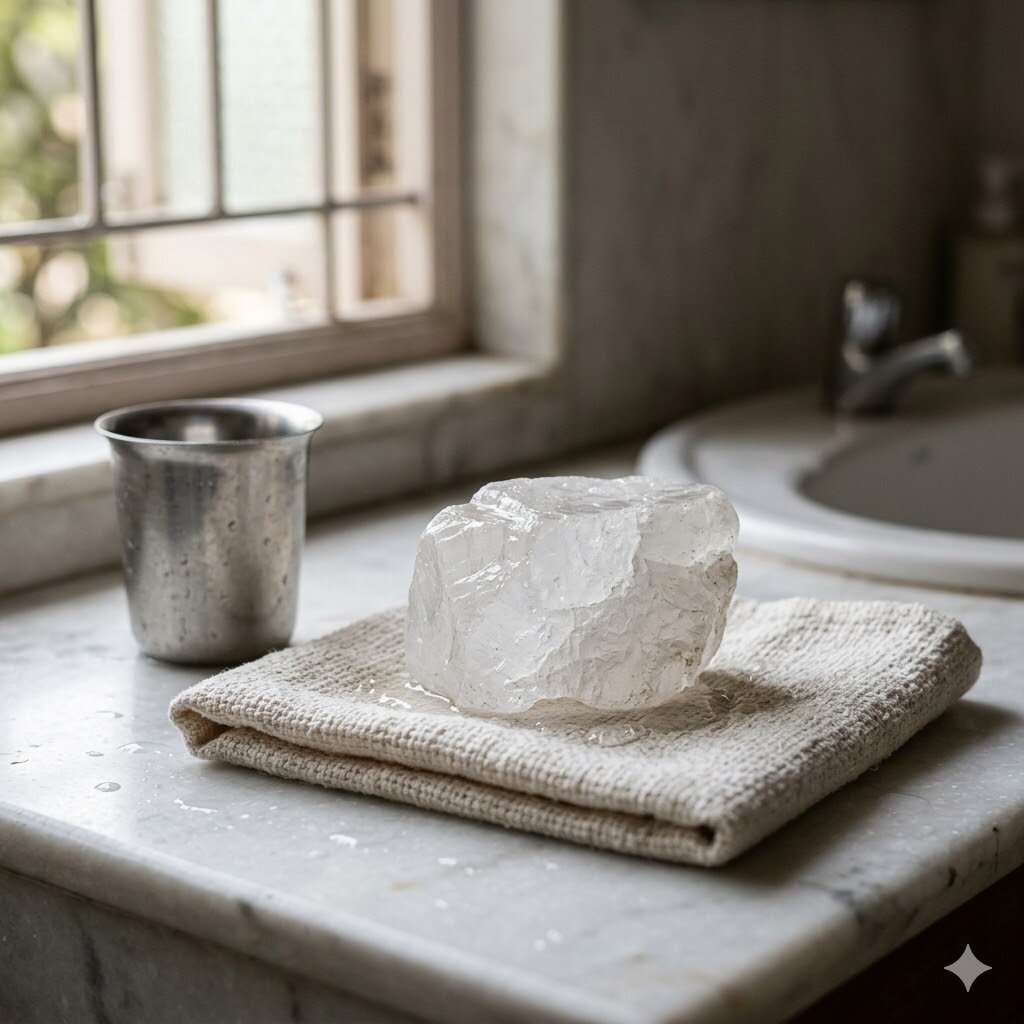
Alum (Fitkari) Deodorant: Ingredients and Air-Quality Claims
A non-spray deodorant avoids creating a spray cloud during application. That can be a practical reason to consider a stick, roll-on or alum product. It does not prove that one formulation is best for every person or that it produces no emissions.
Alum is not aluminium-free
Potassium alum and ammonium alum both contain aluminium. The word “ammonium” does not make an alum stone aluminium-free; PubChem’s ammonium alum record identifies its composition.
Read the actual product ingredients rather than relying on “crystal” or “natural” on the front label. Fragrance, packaging and formulation may differ between products sold as fitkari deodorants.
Skin suitability is a separate question
Natural ingredients can still cause irritation or contact dermatitis. The American Academy of Dermatology explains that natural and clean-labelled skin products can cause reactions too.
Use a product intended for the skin and follow its directions. Do not treat persistent burning, itching or rash as a necessary “detox”. Stop using a product that causes irritation and seek appropriate advice if symptoms continue. This article does not recommend applying raw material to broken or freshly irritated skin.
What changes when you stop spraying?
The application method changes: a solid or roll-on does not disperse a pressurised aerosol into the room. However, a fragranced non-spray product can still release volatile ingredients. There is no basis here for a guaranteed zero-VOC claim, a fixed four-year lifespan or a precise number of cans replaced.
For indoor-air purposes, compare the need for fragrance, the application method and the label instructions. For odour or sweating problems, choose an appropriate personal-care product with professional advice when needed.
Keep the household decision simple
Avoid spraying into a poorly ventilated small room or toward another person. Maintain bathroom ventilation and investigate persistent odours at their source rather than covering them with fragrance.
Read aerosol deodorants and indoor air and room fresheners for the air-quality questions. aqi0 provides home air-treatment equipment, not personal-care products or dermatological treatment.
FAQ
Is alum safe for sensitive skin?
For most people, yes — far gentler than most chemical deodorants. Some users with very sensitive skin experience mild dryness; resolves with reduced application frequency.
Does it stain clothes?
No, properly applied (thin film, air-dried) it does not stain. Heavy application can leave white residue that washes out.
Can I use it after waxing or shaving?
Yes — it’s a traditional after-shave astringent. It may sting briefly on broken skin.
Is “natural” deodorant marketing the same as alum?
Often not. Many “natural deodorant” products are baking-soda + coconut-oil sticks with essential oil fragrance. They work for some people but contain other VOCs (essential oils). Pure alum stone is the strictest minimal-ingredient option.
Does it work in Indian summer humidity?
Yes — it has been the default Indian summer deodorant for centuries. Heavy sweating is normal; you don’t smell.
Will it work during heavy workouts?
For most users, yes. For very heavy sweating (combat sports, marathon running), some users prefer to combine alum with talcum powder or a separate antiperspirant.