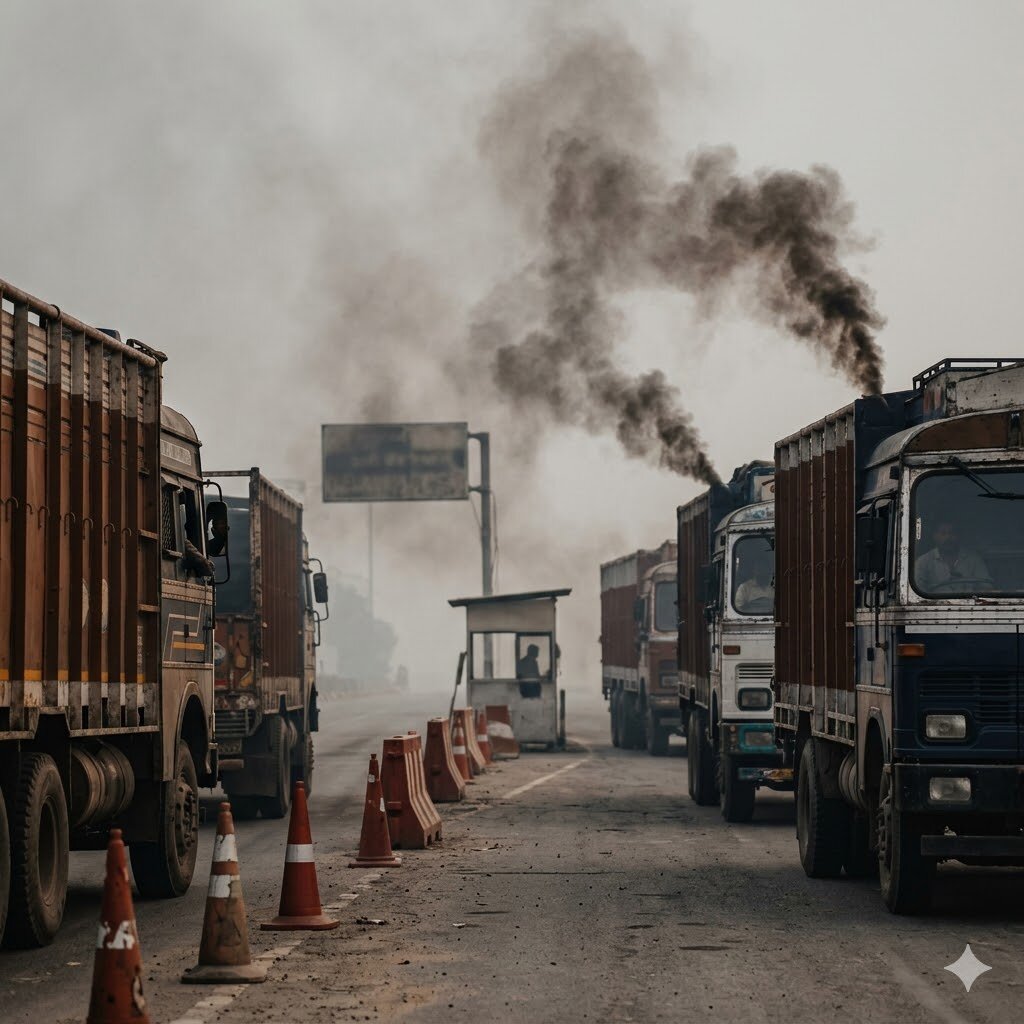
Delhi Truck Traffic and Air Pollution Near Your Home
Truck and other traffic emissions can affect air near busy roads. But it is inaccurate to attribute every overnight PM2.5 rise in Delhi to freight or to claim that every station peaks at 3 am.
Why night-time readings can rise
Traffic patterns, other emissions, wind and atmospheric mixing all change over the day. Weak overnight mixing can allow pollution to accumulate even when traffic volume is lower than during the day. The concentration recorded at a station reflects their combined effect.
A single hourly chart cannot identify a source. Establishing the freight contribution requires traffic and emissions information alongside an appropriate source analysis. See Delhi’s source-apportionment guide.
Distance helps describe the setting, not a guarantee
Near-road pollution depends on the pollutant, traffic, wind, terrain and buildings. The US EPA’s near-roadway guide explains why the affected distance varies. There is no universal setback at which every Delhi road becomes clean.
When assessing a room, look beyond the sector name: road orientation, idling or loading areas, window position and ventilation intake location are useful details. A high floor or a green view does not certify low exposure.
Particles and gases need different attention
Traffic-related air pollution includes more than PM2.5. Particle filtration cannot be used as evidence that all exhaust gases have been removed. Odour is not a reliable quantitative test either.
A household particle monitor can help show whether indoor PM2.5 rises at particular times. Record cooking, windows and equipment settings alongside it. Repeated patterns can inform a site assessment, but they do not identify the chemical source by themselves.
What to do in a road-facing home
- Assess whether the air intake is near an exhaust outlet, idling area or other concentrated source.
- Compare readings in the occupied bedroom across several ordinary days.
- Maintain filtration and inspect unintended leakage without blocking required ventilation.
- Use current local pollution information for walks and exercise instead of assuming afternoon is always cleaner.
Freight-entry rules and emergency restrictions change. Check current CAQM orders and the relevant traffic authority if you need to plan vehicle movement; a household air guide should not be treated as a transport permit.
How aqi0 assesses the setting
The system supplies filtered outdoor air through a standalone intake and supply path. Intake placement, layout and exit paths need assessment. Positive pressure does not mean zero infiltration under every condition, and a PM2.5 reading does not demonstrate removal of every traffic pollutant.
Read the technical note or the Gurugram location checklist before planning an installation.
FAQ
Why don’t more trucks use the bypass expressways?
Toll costs and route economics. The EPE and WPE charge tolls; the inner-city corridor is “free” to a truck driver but generates substantial external cost in the form of pollution and congestion.
Are EV trucks coming to Delhi?
Slowly. Heavy-duty EV trucks are commercially available but expensive. Light commercial EV fleets (delivery vehicles) are growing fastest. Full freight electrification is a 10–15 year project.
Does the diesel ban mean no diesel vehicles in Delhi?
No. The 1 November 2025 restriction applies to commercial vehicles. Private diesel cars (BS6) remain permitted. Specific rules vary; check the GRAP stage in effect.
How clean is BS6 diesel really?
Cleaner than BS4 by a wide margin, but not zero-emission. Real-world emissions exceed type-approval limits in many cases, especially for commercial vehicles with damaged emission controls.
Should I avoid living near a main road?
If you can, yes — the exposure differential is real and well-documented. If not, indoor air protection 24/7 is the controllable lever.