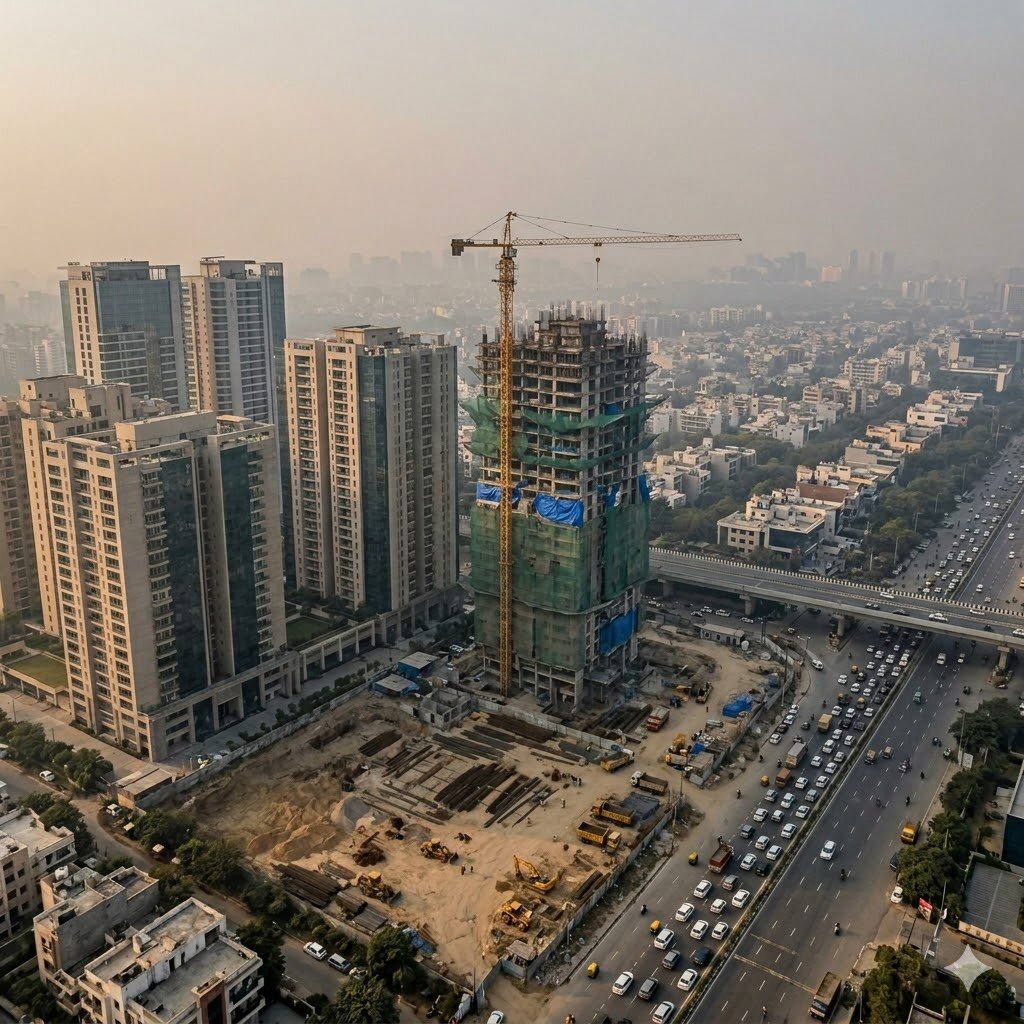
Construction Dust in Delhi NCR: What Residents Can Do
Excavation, demolition, material handling, cutting and vehicles on dusty access roads can raise particle levels around a construction site. The effect at a home depends on the activity, controls, wind and distance—not simply whether the address is in Delhi or Gurugram.
Visible dust is only part of the picture
Construction produces a range of particle sizes. PM10 includes particles within the smaller PM2.5 fraction; it is not a synonym for all visible dust. A household PM2.5 monitor also does not identify the chemical composition of those particles.
Cutting or grinding some silica-containing materials can generate respirable crystalline silica. Worker exposures require appropriate task controls and assessment. An ordinary air-quality monitor cannot measure silica specifically or demonstrate that a cutting task is safe. Source: CDC/NIOSH on silica and worker health.
Ask about controls at the source
For work in or beside your building, discuss how the contractor will contain dust, control it during cutting, cover materials and loads, and clean access areas without repeatedly throwing dust into the air. These questions are more useful than relying on a visible misting machine alone.
Construction requirements and GRAP restrictions can change. Check the applicable project requirements and current orders through CAQM and the relevant local authority. This guide does not certify a site’s legal compliance or provide a fixed schedule of permitted work.
Make a useful record of a recurring problem
Record the date, time, location and visible activity. Photograph from a safe, permitted location. Note whether dust reaches your windows or common areas and whether the issue recurs. Share the record with building management and the appropriate pollution-control authority when needed.
A simultaneous indoor PM2.5 increase is useful context, but it does not by itself prove which source caused it. Cooking and other indoor activities can also produce a spike.
Reduce entry without compromising ventilation
Keep windows facing an active dust plume closed when practical, and inspect damaged seals. Do not block required ventilation or combustion-air openings. Plan replacement air for exhaust rather than sealing every path indiscriminately.
Clean deposited household dust using methods that minimise resuspension. For renovation inside the home, separate the work area and agree a dust-control and cleanup plan before work starts. Room filtration is a supporting measure, not a substitute for controlling the work itself.
What filtered fresh air can—and cannot—establish
aqi0 filters particles from the outdoor air it supplies. The home still needs an appropriate intake location, airflow distribution and maintenance. Its H13 filter classification is not an occupational silica clearance certificate, nor a guarantee that every room will have the same reading during nearby construction.
See the technical note and practical indoor PM2.5 guide for the next steps.
FAQ
Why don’t builders just enclose construction sites better?
Cost. Proper enclosure adds 1–3% to construction cost. Without enforcement, builders compete on price by skipping it.
Is construction dust worse than vehicle exhaust?
Different problems. Construction dust is heavier on PM10 and contains crystalline silica. Vehicle exhaust is finer (PM2.5 and ultrafine) and contains different toxics (NOx, PAHs, benzene). For lung deposition deep in the alveoli, vehicle exhaust is generally worse per microgram of mass.
Can I see PM2.5 from construction?
The visible dust is mostly PM10 and larger. The PM2.5 invisible to the eye is what reaches the deep lung. Don’t trust the visual.
Is the air better at night near construction?
Yes, substantially. Major dust-generating activities (excavation, cutting, RMC pours) happen during daylight hours.
Does GRAP help?
The Graded Response Action Plan halts non-essential construction during severe AQI episodes. It helps for the few days a year it’s in effect; doesn’t address the year-round baseline.