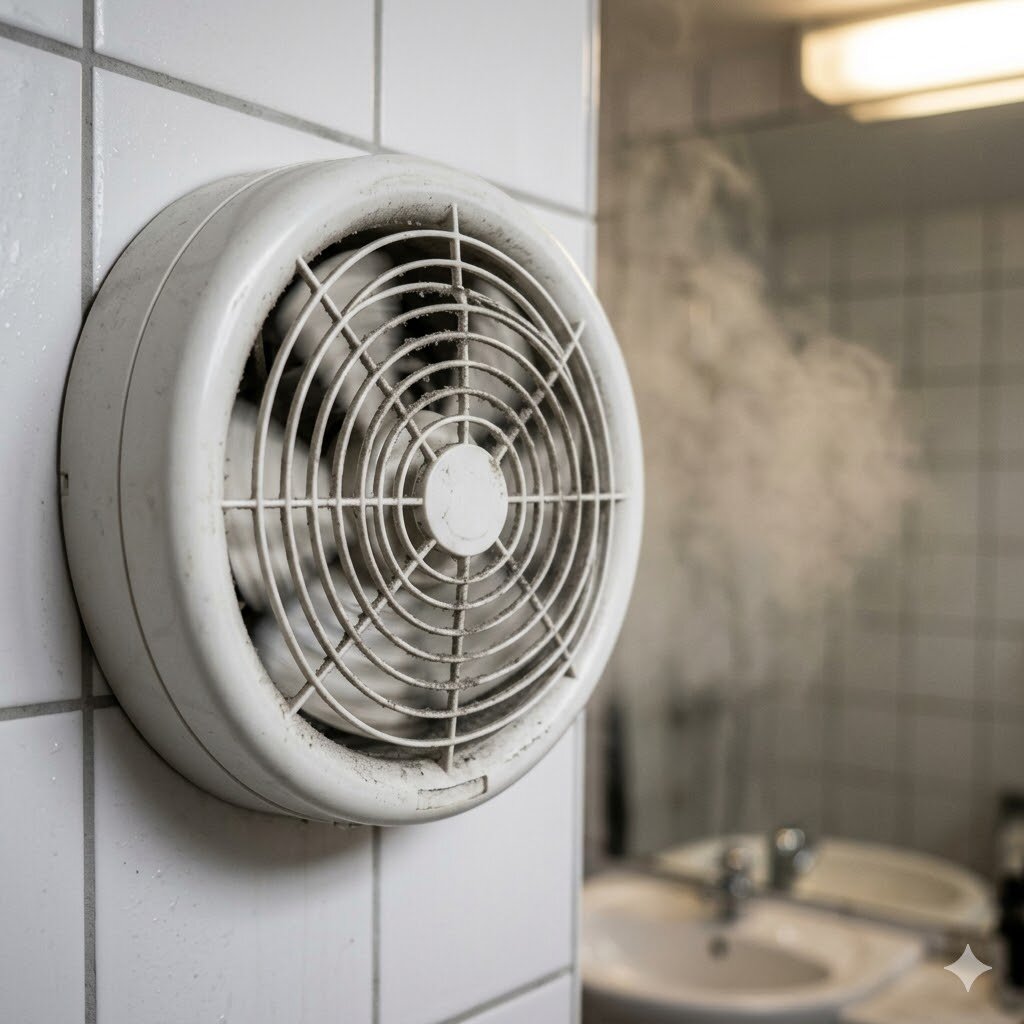
Bathroom Exhaust Fan Test: What a Tissue Can Tell You
A tissue held near a bathroom exhaust diffuser can indicate inward air movement. It cannot measure airflow in m³/h, confirm that the duct reaches outdoors, or prove that moisture is being removed adequately.
A simple check from a safe position
With the fan running, hold a small tissue near the diffuser without releasing it or allowing it into moving parts. Keep hands away from the fan. Do not climb on wet surfaces or open the electrical housing for this check.
Observe whether the tissue is drawn toward the diffuser. Repeat with the bathroom door in its usual position and then slightly open. A clear difference may indicate that the replacement-air path deserves inspection. It does not establish a particular door-gap size or tell you to cut the door.
No noticeable draw is a reason to investigate. Strong attraction still is not a calibrated airflow measurement.
What to ask an installer to inspect
- Is the diffuser or fan dirty or obstructed?
- Does the duct discharge to the intended outdoor terminal?
- Are there crushed sections, restrictive bends or a blocked damper?
- Can replacement air reach the room with the door in normal use?
- Does the installed fan deliver the required airflow against that duct resistance?
Do not access a high external outlet yourself. Isolate power before any maintenance permitted by the manufacturer’s instructions; use a qualified person for wiring or internal repairs.
Dampness needs more than a fan check
Condensation after showering, leaks and persistently wet materials are different problems. Record where moisture appears and whether surfaces dry during normal use. A functioning fan does not rule out a plumbing leak.
Run the fan according to its design and instructions, including humidity controls where fitted. Some systems are designed for continuous ventilation, so a blanket rule to switch every bathroom fan off after a few minutes is inappropriate. EPA’s remodeling guidance distinguishes local exhaust from whole-home ventilation.
In a home with filtered fresh air
Supply and exhaust must work together under real operating conditions. A whole-home supply does not guarantee that every bathroom airflow is correct or that moisture can never migrate. Check the system with bathroom and kitchen exhausts operating normally.
See sealed-home ventilation and aqi0’s technical note for the wider planning questions. A PM2.5 monitor is not a moisture or carbon-monoxide safety test.
FAQ
Why is my bathroom always damp even with the exhaust on?
The exhaust is moving less air than it appears. Run the tissue test. The most likely causes are duct blockage, fan blade dust, or no replacement air path under the door.
Should the exhaust run during the whole shower?
Yes, plus 5–10 minutes after. The fan needs to clear residual humidity, not just operate during peak emission.
Is a window better than an exhaust?
On low-AQI days, an open window provides ventilation but no extraction force. The window doesn’t pull humidity out; it lets it move slowly. An exhaust + barely-cracked window is the best of both. In Delhi winter, keep the window closed and trust the exhaust.
My ceiling fan in the bathroom blows the steam around. Does that count?
No. A ceiling fan moves air within the room but does not exhaust it. Without an extraction path to outside, the humidity stays.
Does turning the bathroom exhaust on full-time help indoor air quality?
Without a fresh-air supply, no — it pulls in unfiltered outdoor PM2.5 through cracks. With a fresh-air supply, modest continuous running is fine.