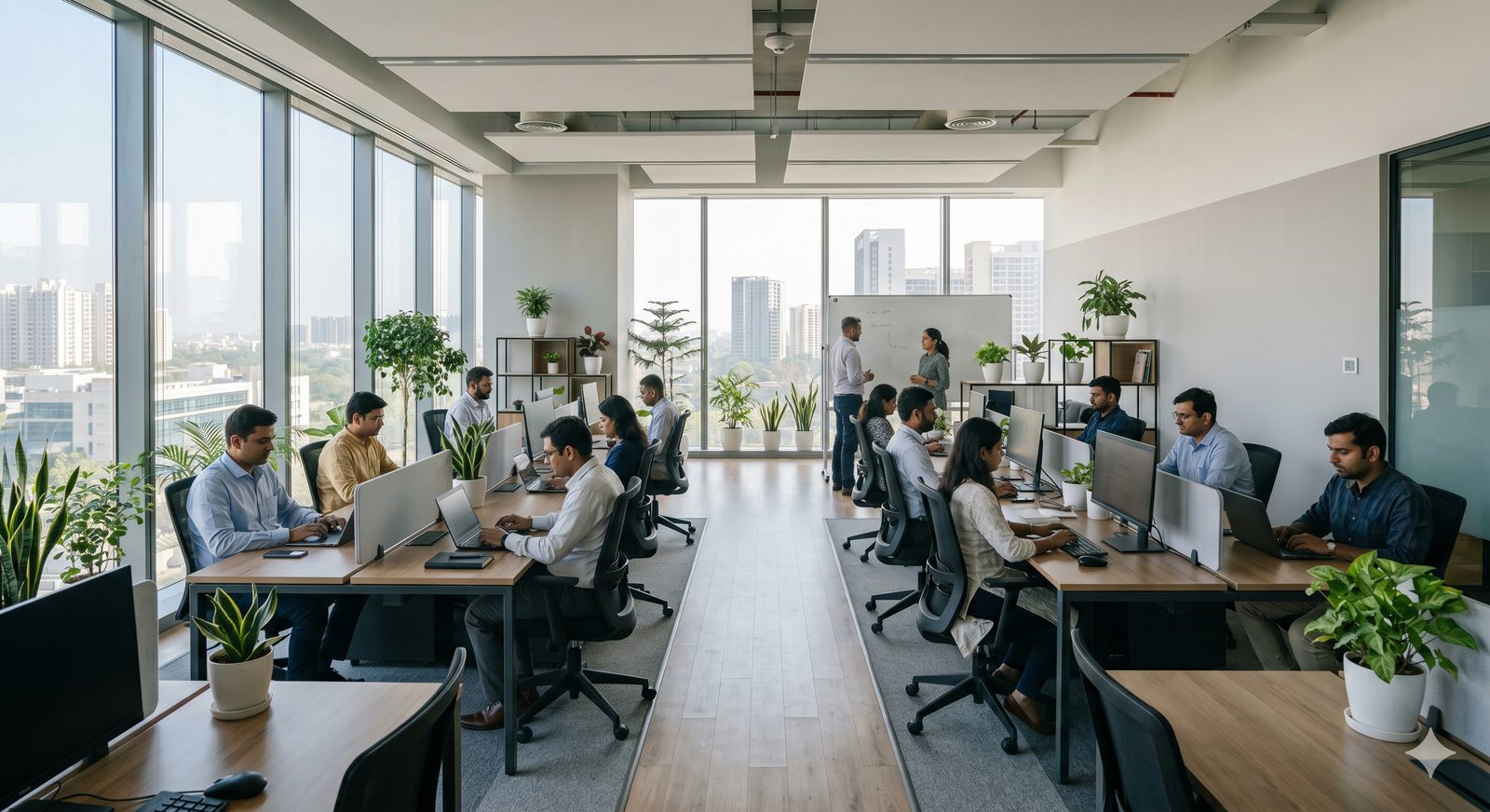
Office Ventilation Systems for Indian Workplaces
Plan filtered outdoor-air supply for the people and rooms using your workplace. aqi0 assesses the floor plan, occupancy and installation access before proposing a standalone system.
Start with occupancy and the existing system
Meeting rooms may have very different occupancy from open desks. Treat cabins, meeting rooms and open areas as separate assessment zones rather than sizing an entire office only by square footage.
CDC recommends maintaining building ventilation in line with applicable codes and guidance. A retrofit should be assessed alongside the existing system. CDC ventilation guidance.
What to share for an assessment
- Peak and typical occupancy by room
- Working hours and meeting schedules
- Possible external intake positions and nearby power points
- Access for exterior work and filter servicing
Include the site location and proposed intake positions. The assessment should identify airflow routes, access constraints, electrical requirements and the paths for air to move through and leave the occupied rooms.
What aqi0 provides
aqi0 is a standalone filtered fresh-air system with its own intake and supply path. HVAC integration is not currently offered.
aqi0 supplies H13 HEPA-filtered outdoor air through a positive-pressure system. The proposed unit count and airflow depend on the assessed space. Review the system specifications and technical note before discussing site-specific work.
Particle filtration and outdoor-air supply are separate functions. A PM2.5 monitor does not establish CO₂ levels or overall indoor-air quality. Our CO₂ guide explains why a single ppm threshold cannot establish a fixed change in productivity.
Agree on how performance will be checked
Before installation, agree which rooms will be measured, under what occupancy and operating conditions, and how readings will be logged. Specify the measurements and acceptance conditions in the proposal rather than relying on a universal result for every building.
Keep the original readings and repeat the same checks after installation. Identify who will review the logs, arrange maintenance and respond if performance changes.
Pricing and maintenance
Standard system pricing is ₹82,600, fully installed, per unit. A workplace or campus proposal needs a site-specific unit count and scope of work. Confirm installation access, any non-standard work and the care plan in the quote.
The optional aqi0 AQI/PM2.5 monitor is ₹4,000, sold separately. A CO₂ investigation requires an appropriate separate measurement. Maintenance access and filter servicing should be planned with the facilities team.
Chat with us
Send the office location, floor plan and occupancy details. We will discuss suitability, scope and scheduling before a proposal is finalised.
Email [email protected] or call +91 96676 72740.
FAQ for facilities and HR leads
Does this replace our existing HVAC?
No. It complements. Most modern office HVACs are cooling-only and recirculate. aqi0 provides the ventilation and filtration layer — pulling clean outdoor air in continuously so the HVAC has fresh air to circulate rather than the same stale air all day.
Will employees notice it?
By design, no. After week one, the system runs in the background and staff stop noticing it. What they DO notice over time: less afternoon fatigue, fewer headaches, better focus in long meetings. Many offices report this informally before they look at the numbers.
Can we monitor performance?
Yes. The aqi0 WiFi monitor is sold separately at ₹4,000, and monitors ordered for an installation feed a real-time dashboard. Facilities admin can see AQI and PM2.5 per zone. Alerts can be configured for threshold breaches.
What happens during summer?
The system runs year-round. Summer indoor PM2.5 is lower (30-60 µg/m³ typical) but CO₂ control remains critical in occupied offices regardless of season. The system matters every working day.
How is this different from a single-room purifier on each floor?
Single-room recirculating air purifiers reduce PM2.5 within their room but cannot reduce CO₂ — they only recirculate the air that’s already inside. The CO₂ keeps climbing. aqi0 addresses both at once by introducing fresh, filtered outdoor air.
What about co-working spaces with multiple tenants?
We work with co-working operators (WeWork-style and independent) on building-level installations. Pricing scales with floor area; the system is invisible to individual tenants but lifts the air quality everyone shares.