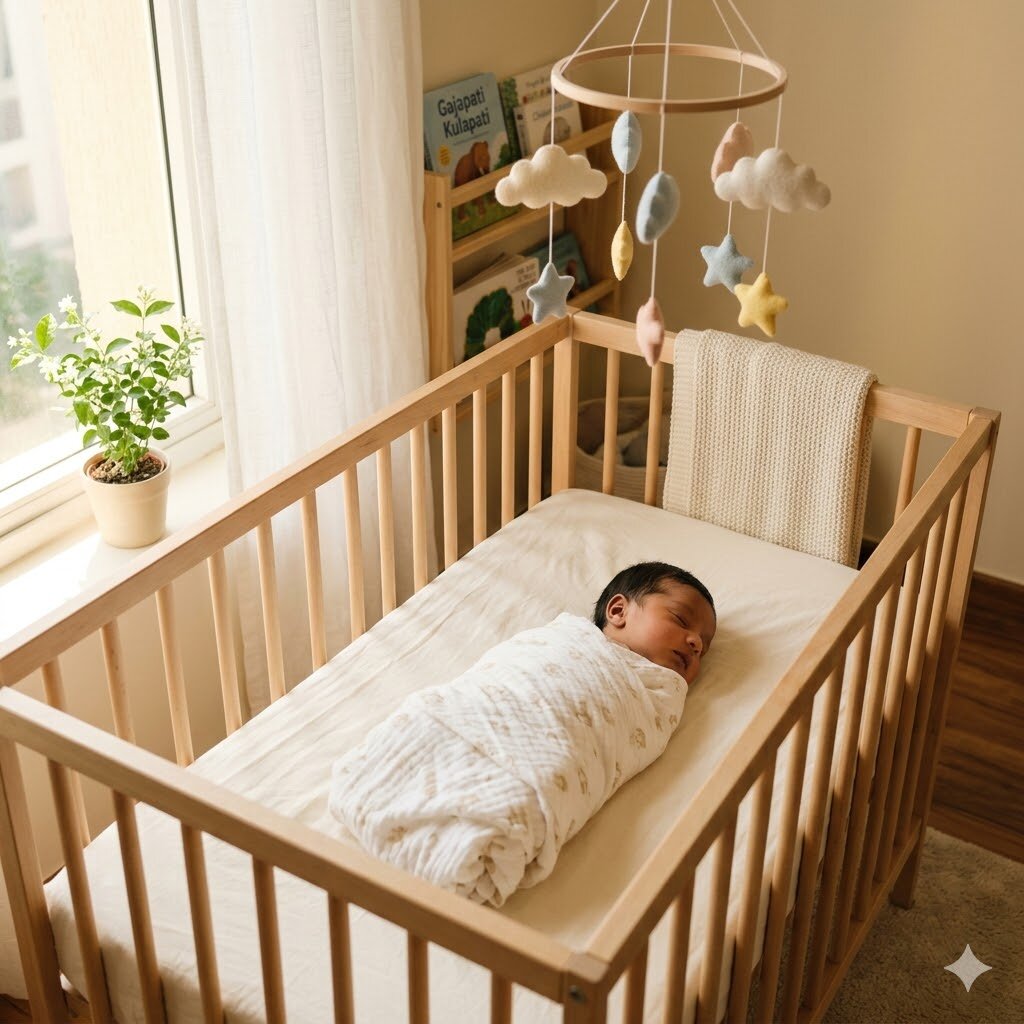
Indoor Air for a Newborn: Practical Planning for Delhi NCR
Preparing a home for a newborn includes thinking about indoor sources, the rooms the family uses and how any air-treatment equipment will be maintained. It does not require predicting a baby’s future health from the city’s annual pollution average.
Infant safety comes first
Do not put a mask or respirator on a baby or a child under two. CDC guidance identifies a suffocation risk for this age group. CDC mask safety guidance.
Do not drape a cover over a pram to improvise an air filter. Keep equipment, cables and loose filter materials away from the baby’s sleep space, and follow the paediatrician’s and product manufacturer’s safety advice.
If a baby has trouble breathing, is unusually difficult to wake, or is not feeding normally, seek medical help promptly. An air-quality reading cannot determine whether a baby is well.
Plan around the actual rooms
List where the baby and caregiver will spend time. Note room size, windows, usual door positions and nearby cooking or other sources. There is no universal daily timetable that establishes every baby’s exposure.
| Before choosing equipment | What to record |
|---|---|
| Rooms used | Sleeping, feeding and daytime spaces |
| Existing equipment | Settings, location and filter condition |
| Service access | Who can safely clean or replace filters |
| Measurements | Room, time and units shown by the monitor |
A PM2.5 monitor measures particles. It does not monitor breathing, oxygen, infant sleep safety or every pollutant. The optional aqi0 monitor measures AQI/PM2.5 and does not measure CO₂.
Discuss outdoor plans with the paediatrician
Use current local pollution advisories and individual clinical advice, especially for a premature baby or a child with a health condition. Avoid a universal PM2.5 cutoff, a rigid month-by-month outdoor schedule or advice to relocate based on a product article.
CDC’s children and smoke guidance discusses the additional vulnerability of children during smoke events. Its advice is not a guarantee that any particular home device makes an exposure safe.
Assess the home installation
If considering filtered outdoor-air supply, check intake placement, how air reaches the rooms in use, cooling requirements, access and maintenance. aqi0 supplies a standalone whole-home air purifier; review the technical note for suitability and conditions.
Keep the filter-care schedule available to whoever handles upkeep. Product performance should be assessed through environmental measurements, without promises about fewer infant illnesses or developmental gains.
Read the parent’s air-quality guide for a simple room log and questions for childcare settings.
FAQ
Is it too late to start at month 6?
No. Every month of protected exposure helps. The developmental window doesn’t close abruptly.
Should I get a paediatrician with air-quality awareness?
Increasingly possible in NCR. AIIMS, Apollo, Max, Fortis paediatric departments are aware. Ask specifically about respiratory monitoring during routine visits.
Are smaller babies more vulnerable?
Yes, modestly. Pre-term and low-birth-weight babies have less respiratory reserve. Protection matters more.
What about visitors who smell of cigarettes or perfume?
Politely ask them to wash hands and change clothes before holding the baby. Smoking visitors should not smoke before the visit at all.
Should the baby’s car seat be a high-end one for filter reasons?
Car cabin air-quality is a separate problem. See new car smell VOCs. For Indian conditions, upgrade the car’s cabin filter to HEPA + carbon and ventilate the car before each drive.