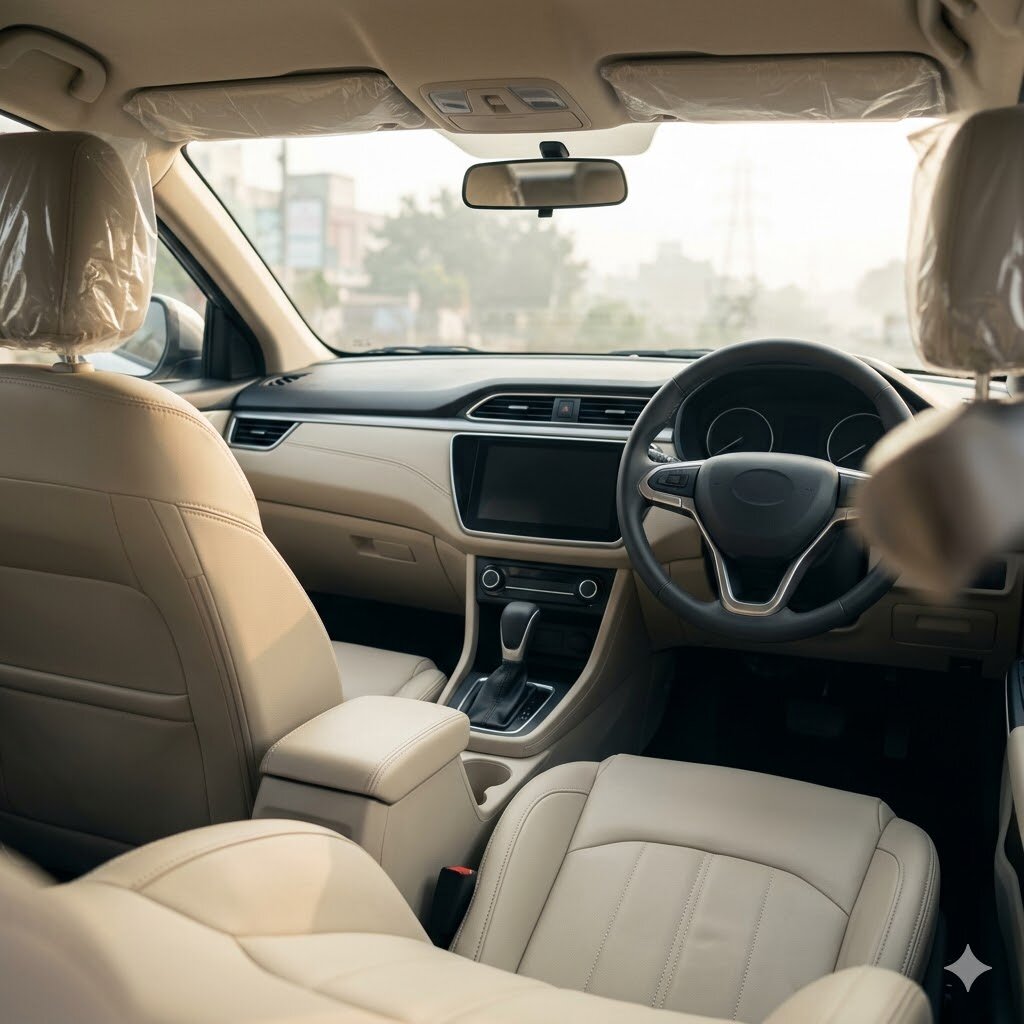
New Car Smell and Cabin Air: Practical Questions for Owners
New-car odour can come from interior materials, adhesives and finishes. Its strength does not tell you the concentration of every compound or establish a personal health risk. Vehicle materials, temperature, age and ventilation differ.
Read study findings in their setting
A measurement in one model under a particular temperature and ventilation condition should not be presented as the result for every car sold in India. Likewise, an exposure model is not a prediction of illness for an individual owner.
There is no universal basis here for saying all new cabins contain the same 150 compounds, that most are carcinogens, or that exactly 80% of emissions end after three months.
Ask the dealer useful questions
Request the owner’s guidance on cabin ventilation and the installed filter. If the manufacturer publishes interior-emissions testing, check the model, conditions, pollutants and test date. A “premium” or “vegan” interior description is not an emissions certificate.
For a persistent unusual smell, have the vehicle inspected. Do not assume every smell is normal material off-gassing; fuel, exhaust, dampness or an electrical problem calls for the appropriate service response.
Use ventilation for the conditions
Follow the vehicle’s instructions for outside-air and recirculation modes, including demisting. Consider nearby traffic and outdoor pollution as well as cabin comfort. Do not compromise visibility or road safety to follow a fixed ventilation schedule.
Never leave a child or pet in a parked vehicle while airing or cooling it. Do not run the engine in an enclosed garage to operate ventilation. Avoid improvised “bake-out” or chemical odour treatments.
Check filter compatibility before upgrading
Use a filter specified as compatible with the vehicle and follow the service schedule. A higher-resistance filter can affect airflow; a HEPA label alone does not establish suitability. Ask what any activated-carbon stage is tested to remove and for how long.
Passive charcoal pouches are not proof of cabin-wide gas control. Added air fresheners can mask the original smell rather than explain it.
Keep home and vehicle claims separate
aqi0’s whole-home air purifier is a building installation, not a vehicle-cabin product. For home materials and fragrance questions, see VOCs in homes and room fresheners. For the car, use model-specific instructions and qualified servicing.
FAQ
Is the new car smell carcinogenic?
The smell includes specific Group 1 carcinogens (formaldehyde, benzene). Cumulative dose over a few months of new-car ownership is small relative to lifetime exposure from other sources, but not zero. Reducing exposure is sensible, particularly for children.
Can I “bake out” my new car?
The technique — parking in full sun with windows closed for several days to force outgassing, then airing out — works partially. It accelerates the emission curve but doesn’t reduce total emitted mass. Some studies show ~30% reduction in 6-month-out cabin VOCs after a controlled bake-out.
Should I avoid new cars with pregnant women or infants?
Reducing exposure is sensible. Practical recommendations: ventilate heavily before each drive, use fresh-air AC mode, upgrade cabin filter, and avoid long sessions in the parked closed car during the first three months.
Does this affect commercial vehicles too?
Yes. Buses, trucks, and shared taxi fleets have the same interior chemistry. Cumulative exposure for professional drivers is significant.
Will government regulations change this?
China has formaldehyde and TVOC standards for car cabins. The EU has similar limits. India does not yet have mandatory cabin air-quality standards for new vehicles. AIS (Automotive Industry Standard) updates discussed in 2024 may add such standards by 2027.