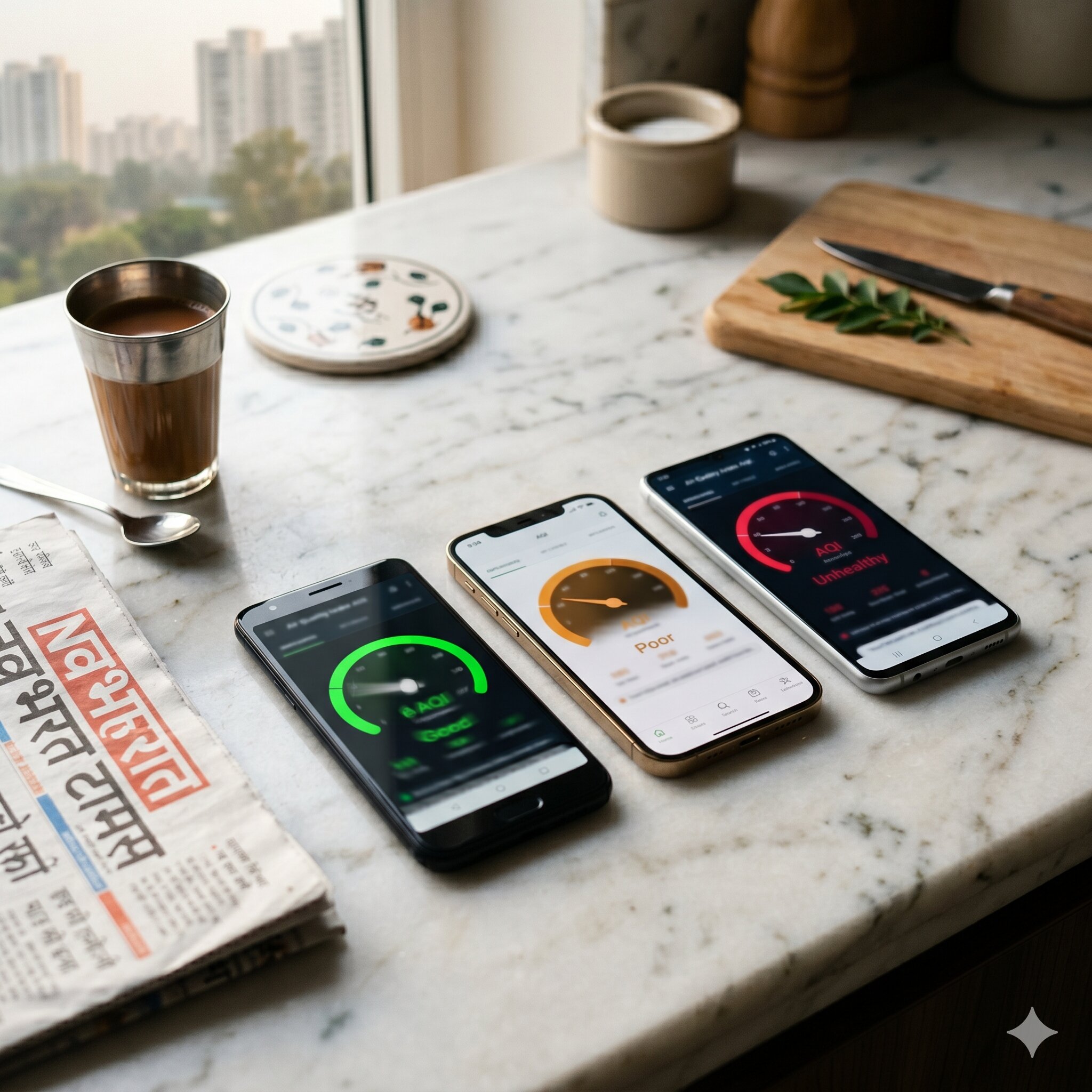
Why AQI Apps Show Different Numbers in India
Two apps can show different AQI numbers for the same city without either sensor being broken. They may use different scales, monitoring stations, averaging periods or pollutants. Start with those differences before treating the higher or lower number as correct.
Check these five details
| Detail | What to compare |
|---|---|
| AQI scale | Indian National AQI, US AQI or another index |
| Station | Exact station name and location, rather than the city label |
| Timestamp | Latest update, time zone and whether data is stale |
| Averaging period | Hourly concentration, rolling average, daily AQI or forecast |
| Pollutant | PM2.5 alone or an overall index incorporating other pollutants |
India’s National AQI and the US AQI have different concentration breakpoints and category names. An AQI of 100 on one scale is not interchangeable with 100 on the other. The US EPA also changed its particle AQI breakpoints in 2024, so older conversion charts may be out of date. See EPA’s explanation of that update.
Compare PM2.5 in micrograms per cubic metre
For a like-for-like particle comparison, look for PM2.5 in µg/m³, using the same station and averaging period. A concentration is not an AQI score. Nor can an overall AQI always be converted back into PM2.5: another pollutant may be driving it.
For example, a fresh hourly measurement and a daily average can differ substantially during a short smoke event. AirNow’s current US AQI uses its NowCast method; AirNow explains how current and daily AQI differ.
Which reading should you use?
Use a nearby official monitoring station and its local advisory as a starting point. India’s CPCB air-quality portals provide official monitoring access. Check neighbouring stations when one reading looks unusual or has stopped updating.
A nearby consumer sensor can add local detail, but proximity does not establish accuracy. Placement, humidity, calibration and maintenance affect readings. A city average may miss the conditions beside your road or construction site; one balcony sensor does not establish a city-wide trend.
Keep a consistent source for your own comparison log: station, date, time, pollutant, concentration and scale. Do not average unlike AQI scores together.
Your bedroom is a separate measurement
An outdoor app cannot verify indoor air quality. Indoor particles depend on outdoor entry, cooking and other sources, filtration and room layout. Use an indoor PM2.5 monitor to follow indoor trends. Assess ventilation separately with a suitable CO₂ monitor; a low PM2.5 reading does not show that CO₂ is low.
Read PM2.5 levels and averaging periods and bedroom CO₂ measurement for the next steps.
FAQ
Which is the “right” AQI?
Neither is wrong; they answer different questions. Indian AQI answers “how does this compare to Indian regulations.” US AQI answers “how does this compare to US regulations.” Neither perfectly answers “is this safe for my health” — that requires WHO context.
Why does IQAir often show worse readings than CPCB?
For the same concentration, IQAir’s US scale typically produces a higher AQI in the lower ranges. This is methodology, not a “stricter” measurement.
Are the underlying PM2.5 readings the same across apps?
Mostly yes if they’re pulling from the same monitoring stations. Different apps may average across slightly different station networks or apply different temporal smoothing.
Can I trust crowd-sourced low-cost sensor readings?
Individual sensors drift. Aggregated networks (IQAir, WAQI) usually reconcile via cross-station comparisons. For your own home indoor monitor, calibrate against a known reference periodically.
Should I use the Indian or American scale?
For Indian regulatory and policy purposes: Indian. For health-protective decisions: US (tighter breakpoints). For absolute health context: refer to WHO µg/m³ values, not any AQI scale.