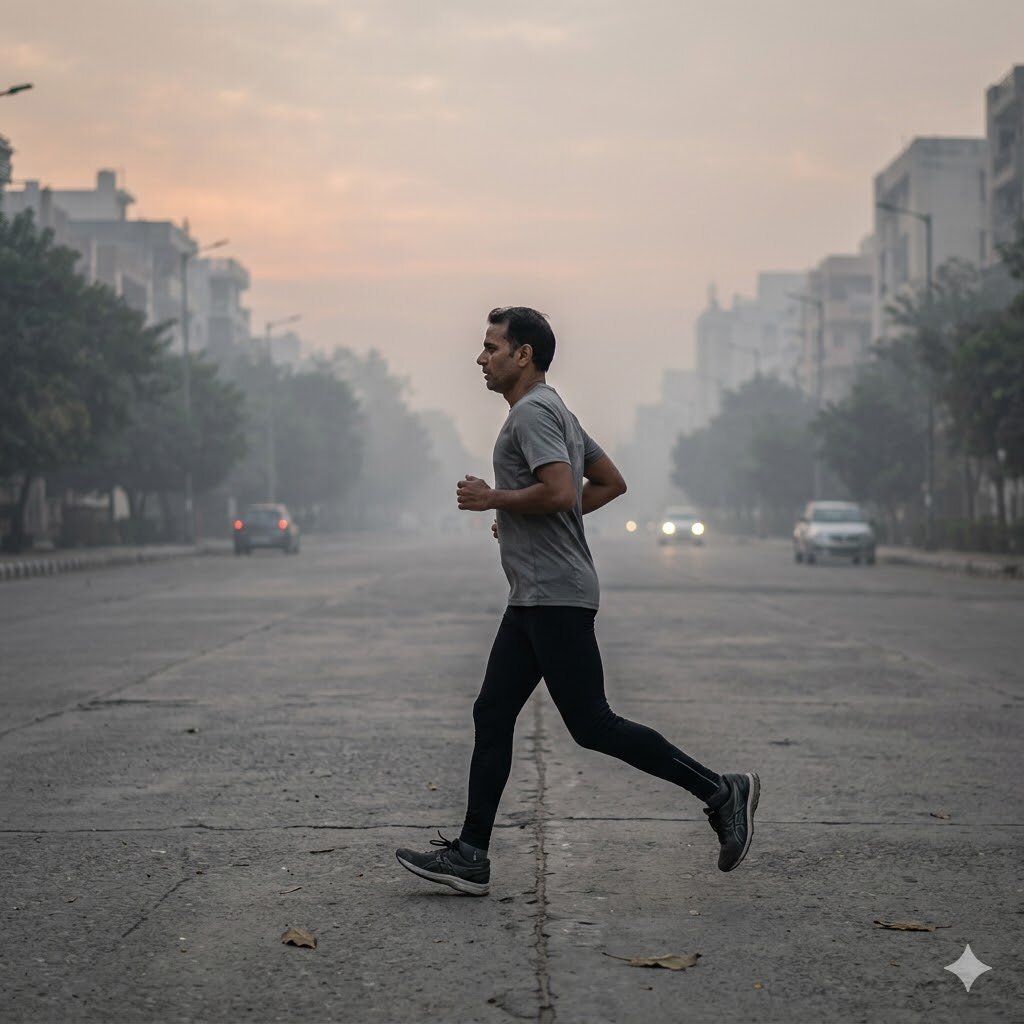
Olympic-Medal Poverty: Why Air Pollution May Be Costing India Sporting Medals
India sends one of the largest national contingents to every Olympic Games and routinely returns home with one of the worst per-capita medal counts. The standard explanations — training infrastructure, sports culture, funding — are real and important. A factor that rarely makes the headline analysis: an entire generation of Indian athletes grew up inhaling PM2.5 levels ten to twenty times the WHO guideline, during the exact years when their lungs were still developing. The result is a population-wide ceiling on aerobic capacity that no amount of post-18 training can fully erase.
Key numbers
- 10–15% — typical shortfall in FVC for Indian adults vs. GLI-2012 Caucasian reference (Agarwal & Salvi, European Respiratory Journal, 2020)
- VO₂ max — the gold-standard measure of aerobic capacity, bounded by lung function and cardiac output
- 5 µg/m³ — WHO annual PM2.5 guideline
- 95–110 µg/m³ — Delhi NCR’s actual annual PM2.5 in recent years
- 3.5 years — average life expectancy India loses to PM2.5 (AQLI 2025); 11.9 years for Delhi specifically
How lung capacity sets the ceiling on aerobic performance
Endurance sport — running, cycling, swimming, rowing, racquet sports past 90 seconds of play — is ultimately a contest of oxygen delivery. The maximum rate at which an athlete can absorb oxygen, VO₂ max, is the single best predictor of endurance performance. It is bounded by three factors:
- Pulmonary function — how much air the lungs move, and how efficiently oxygen crosses into the blood
- Cardiac output — how much blood the heart pumps per minute
- Peripheral oxygen extraction — how efficiently the muscles use delivered oxygen
Training improves all three, but the absolute ceilings on each are partly genetic and partly developmental. The lung’s alveolar count is largely set by age 5; lung size continues to grow through the teen years. PM2.5 exposure during this window provably reduces final adult lung capacity.
A child growing up in Mysore, Coorg or rural Himachal — outdoor PM2.5 around 15–25 µg/m³ — finishes adolescence with measurably better lung function than a child growing up in Delhi NCR at 95+ µg/m³. The same training programme produces different VO₂ max ceilings.
What Indian sports medicine has actually documented
Three observations from Indian sports physiology research:
1. Indian endurance athletes start with smaller lungs. Studies comparing Indian elite endurance athletes to European peers, after adjusting for height, age and sex, consistently find lower absolute FVC and FEV1. The ratio (FEV1/FVC) is normal; the absolute volumes are not.
2. Track athletes from polluted cities under-perform peers from clean ones. Indian national-team distance runners disproportionately come from Kerala, Karnataka, parts of Tamil Nadu and the North East — regions with lower lifetime PM2.5 exposure. They do not predominantly come from Delhi, Lucknow or Patna despite those cities having larger populations and more sports infrastructure.
3. Symptom prevalence is high. Indian school sports programmes report unusually high rates of exercise-induced bronchospasm in NCR children, often misdiagnosed as poor fitness or asthma. The underlying mechanism — airway hyperreactivity from chronic PM2.5 exposure — is well established.
The countries that win endurance medals
A short list of dominant endurance-sport nations and their average urban PM2.5:
| Country | Urban PM2.5 (annual, µg/m³) | Dominant endurance event |
|---|---|---|
| Norway | ~5–7 | Cross-country skiing, distance running |
| Sweden | ~6 | Skiing, biathlon |
| New Zealand | ~6 | Rowing, distance running, triathlon |
| Kenya | ~10–15 (Eldoret) | Distance running |
| Ethiopia | ~25 (Addis Ababa) | Distance running |
| Japan | ~10 | Marathon |
| India | ~50 (national avg.) | — |
Altitude (Eldoret, Addis Ababa) is the other relevant factor — and a known endurance advantage. But the clean-air pattern is striking. The only consistent low-pollution outlier with limited endurance success is China, where major-city PM2.5 is lower than India’s but still well above WHO levels.
What air-quality protection could change in a generation
A child born in NCR in 2026 will turn 18 in 2044. Two scenarios:
Scenario A — status quo. Annual PM2.5 stays at 95–110 µg/m³ through the child’s developmental window. Final adult FVC is, on average, 10–15% below GLI-Caucasian peers and similarly below Indian peers from low-pollution regions. VO₂ max ceiling caps endurance ability regardless of training.
Scenario B — clean air at home, 24/7. The same child grows up with indoor PM2.5 held below 10 µg/m³ via mechanical ventilation, with outdoor exposure managed during commute and play. Lung development is closer to the curve a Kenyan or Norwegian child experiences. The trained adult VO₂ max ceiling sits 5–10% higher.
Scenario B is not theoretical. It is achievable with existing technology and Indian middle-class budgets. It does not fix the school commute, sports practice, or air at the local park — those need policy change. But it covers 8–14 hours per day of the developmental window.
For one child this is a marginal upgrade. For a generation it is a population shift in athletic ceilings.
Beyond the elite athlete
The argument doesn’t only matter for medallists. Three larger implications:
1. Public health. The same lung-capacity gap that limits Olympic medals contributes to higher cardiovascular and respiratory disease incidence across the whole population.
2. Workforce productivity. Aerobic capacity correlates with daily energy, fatigue resistance, and cognitive endurance. The population-level impact is invisible because nobody compares the alternative.
3. Quality of life. Climbing stairs without breathlessness is a function of lung capacity. So is hiking, dancing for an evening, or playing with children at sustained pace.
What changes if Indian cities clean their air
Slow improvements are happening: Delhi recorded a record 209 days of “good–moderate” AQI in 2024 (Delhi Government, PIB release). Bharat Stage VI emission norms, LPG cooking transition, and Metro expansion all help. The trajectory is positive but slow. At current improvement rates, Delhi will reach WHO-compliant air around the turn of the next century.
For the children born today, that timeline is too late to affect their own development. Indoor air protection is the only intervention that operates on the relevant timescale.
FAQ
Are Kenyan and Ethiopian runners successful because of clean air or altitude? Both. Altitude increases red blood cell production, raising oxygen-carrying capacity. Clean air ensures the lungs that deliver oxygen develop fully. The combination is hard to replicate.
Can a Delhi-born athlete compete at world level? Yes, individuals can and do. The argument is about averages and ceilings. Outliers exist in every system; the question is whether the system as a whole produces enough of them.
Does training at sea level in clean air help an adult athlete? Yes, but the gain from training-environment air quality is smaller than the gain from developmental-window air quality. Adult lungs are mostly fully formed.
Is masking during outdoor training useful? For peak-AQI days in Delhi, yes — a well-fitted N95 reduces inhaled load significantly. For continuous training, masks reduce ventilation efficiency and become impractical. Indoor training in filtered air is the better option for serious athletes.
Why don’t Indian sports governing bodies talk about this? Probably for the same reason public health discussions don’t talk about it enough — it points to a politically uncomfortable explanation that can’t be fixed by changing coaches.