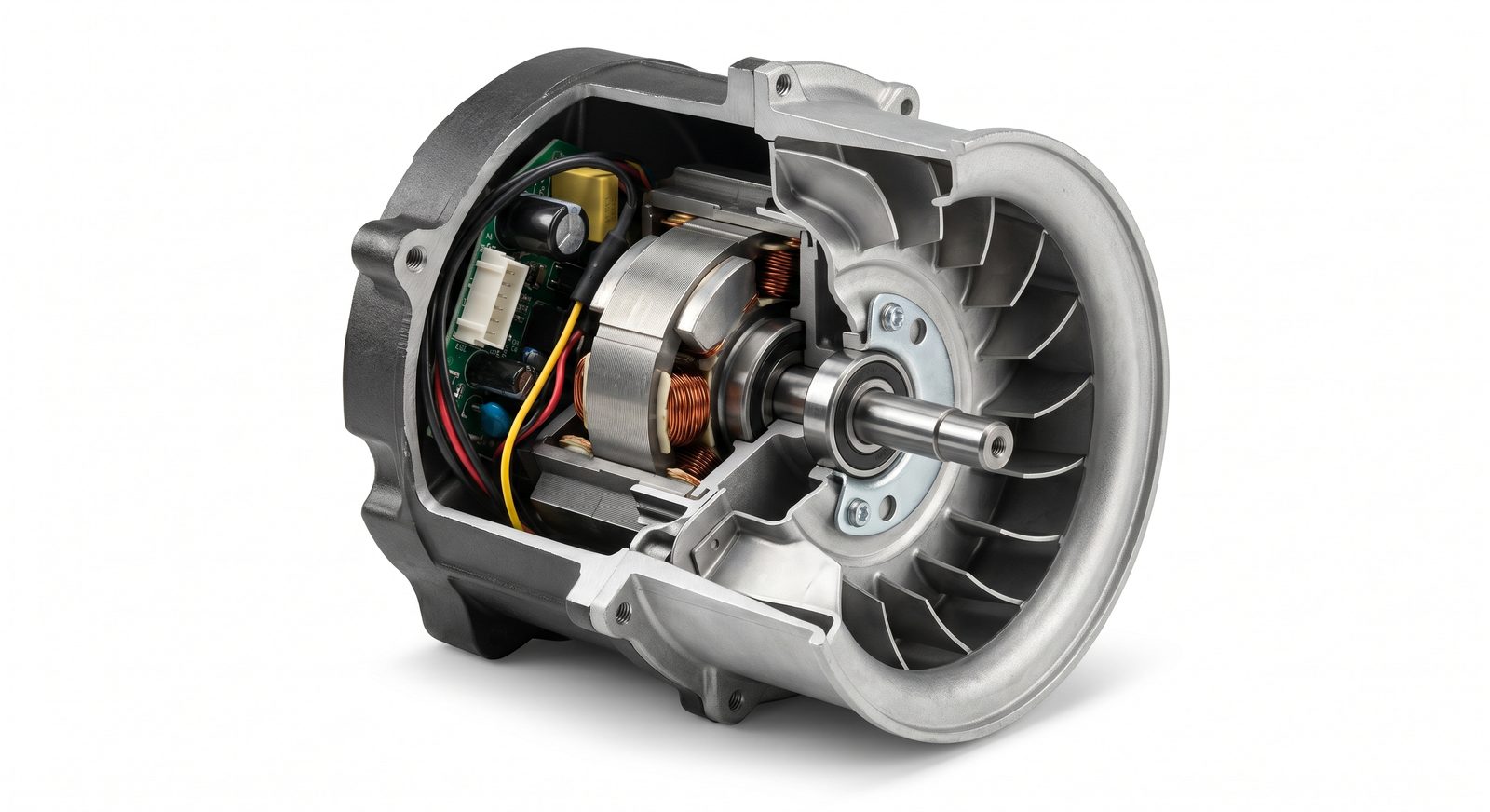
EC Fan vs AC Fan — Which One Belongs in a Fresh Air System?
The fan is the heart of a fresh air system. A fresh air system runs 24 hours a day, every day of the year, for at least four years before the motor is meaningfully aged. Two motor families dominate this category — AC induction and EC (Electronically Commutated). They look similar from the outside. Inside, they are entirely different machines, with a 3× gap in efficiency, a 2× gap in lifespan, and a measurable gap in noise. This page explains the difference and why aqi0 chose EC for every install.
Key idea in one paragraph
An AC induction fan is the standard, hundred-year-old industrial workhorse — cheap, robust, but fixed-speed and energy-hungry. An EC (Electronically Commutated) fan is essentially a brushless DC motor with the electronics built in, fed by AC mains but running on DC internally. For a fresh air system that operates 24/7 and needs variable speed for changing AQI conditions, the EC fan is the only sensible choice: roughly one-third the power draw, longer life, quieter, soft-start, infinite speed control. The AC fan still has a place — but not inside your home, behind a wall, running through the night.
Key numbers
- ~30 W — power draw of the aqi0 EC fan at normal operating speed (500 m³/h effective airflow)
- 80–120 W — power draw of an AC induction fan delivering the same airflow
- 40,000 hours — design life of a typical EC backward-curved centrifugal fan (≈ 4.5 years of 24/7 operation)
- 15,000–25,000 hours — design life of a comparable AC induction fan at the same duty cycle
- ₹2,100 vs ₹7,000 — annual electricity cost at 24/7 operation, EC vs AC, at ₹8/unit
- 0–10 V — analogue speed-control range on the aqi0 potentiometer; equivalent AC fans typically offer only 2–3 fixed taps
What is an AC fan?
AC stands for alternating current — the standard 230 V, 50 Hz supply that comes out of every Indian power point. An AC induction motor uses that alternating current directly to drive the rotor.
The mechanism is elegant and old. Stator windings around the rotor produce a rotating magnetic field, synchronised to the 50 Hz mains. The rotor — a passive metal squirrel cage — is dragged along by the magnetic field. The rotor’s speed lags the magnetic field’s speed by a small percentage; this “slip” is what generates the torque.
The strengths of an AC induction motor: simple, mechanically robust, no electronics inside the motor, very low manufacturing cost. The weaknesses: it runs at one or two preset speeds tied to the mains frequency, wastes 30–50% of the input power as heat (slip and copper losses), and the rotor itself heats up under load, accelerating bearing wear.
Most ceiling fans, exhaust fans, and inline duct fans you can buy at a hardware shop in India are AC. So are the fans inside most cheap room air purifiers.
What is an EC fan?
EC stands for electronically commutated. An EC motor is a brushless DC motor with the commutation electronics built into the motor housing. From the outside, an EC fan looks identical to an AC fan and plugs into the same 230 V, 50 Hz mains. But inside the unit, the AC is immediately rectified to DC, and the rotor is driven by precisely timed pulses from a microcontroller.
This single change — moving commutation from a mechanical rotating field to electronic switching — fixes most of the AC fan’s problems at once:
- No slip. The rotor speed is set by the electronics, not by the mains. The motor can spin at any speed from 0% to 100% with the same efficiency.
- No rotor heating. A permanent-magnet rotor with electronic commutation produces almost no waste heat in the rotor itself. Bearings stay cooler. Lifespan extends.
- No 50 Hz hum. Mechanical vibration tied to the mains frequency is the dominant sound source in cheap AC motors. EC motors operate on DC internally; the only audible component is the airflow itself.
- Soft start. EC motors ramp from 0 to operating speed over a couple of seconds. AC fans hit full torque the instant the switch closes, with corresponding inrush current and start-up wear.
- Variable speed for free. EC fans accept an analogue 0–10 V or PWM signal and respond linearly. aqi0 wires this to a wall potentiometer; the customer turns a knob, the fan dials in any speed from minimum to maximum.
The numbers that matter for a fresh air system
Most fan comparisons stop at “EC is more efficient.” For a fresh air system, that single fact compounds across multiple axes.
1. Electricity cost over 24/7 operation
At the same airflow (~500 m³/h effective):
| Motor type | Continuous draw | Yearly kWh | Cost @ ₹8/unit |
|---|---|---|---|
| EC backward-curved centrifugal | ~30 W | ~263 | ~₹2,100/year |
| AC induction (equivalent) | ~100 W | ~876 | ~₹7,000/year |
Over a 10-year ownership window, the EC fan saves roughly ₹49,000 in electricity alone. That is more than the entire AMC cost of an aqi0 system across the same period.
2. Motor lifespan
EC motors are rated for 40,000 hours of continuous operation (≈ 4.5 years 24/7). At the end of design life, brushless commutation has nothing to wear except bearings. Comparable AC induction motors of similar build quality are typically rated 15,000–25,000 hours — bearing wear is faster because the rotor itself generates heat. For a fresh air system designed to run continuously, the EC fan is the only one that survives without a mid-life replacement.
3. Noise
The dominant noise in a wall-mounted AC fan is 50 Hz hum — a low-frequency vibration locked to the mains frequency. It is present at every speed and persists even when the airflow itself is quiet. EC fans operate on DC internally; this hum is structurally impossible.
The remaining noise — turbulence at the impeller blades — exists in both. But because EC fans use backward-curved centrifugal impellers (chosen for their inherent acoustic profile), and because EC speed control lets you run the fan slower than its rated maximum most of the time, total radiated noise is meaningfully lower in normal use. aqi0 customers describe the system at normal speed as “comparable to a ceiling fan on speed 2” — audible only when you make a deliberate effort to listen.
4. Variable speed for changing AQI
On a moderate day (outdoor AQI 150), 500 m³/h is plenty of fresh air for a 2–4 BHK home. On a peak-AQI day (Diwali night, stubble-burning week, outdoor AQI 400+), you want to dial up airflow to keep indoor PM2.5 below 15 µg/m³. The EC fan handles this with a knob turn from 4–5 V to 6 V on the aqi0 potentiometer. An AC fan would force you into preset 2-speed or 3-speed jumps, with everything between them inaccessible.
5. Heat output behind the wall
A 100 W AC induction motor running 24/7 dumps roughly 50–70 W of waste heat into the unit enclosure. That heat raises the internal temperature of the fan housing, accelerates capacitor and bearing wear, and in a Delhi summer can push enclosure surface temperatures uncomfortably high. A 30 W EC fan, by contrast, dumps only ~6–10 W of waste heat — a tenth of the thermal load on the enclosure.
Why aqi0 uses EC
aqi0’s product brief is simple: a fresh air system that runs 24/7 for years without complaint. Every design choice traces back to that brief — and at the fan motor, EC was the only choice that survived a serious engineering review.
The fan we specify is an EC backward-curved centrifugal model, ~700 m³/h rated and ~500 m³/h effective after typical filter resistance. At normal operating voltage (4–5 V on the potentiometer), it draws ~30 W. At peak (6 V), it draws ~40 W. The design life is 40,000 hours of continuous operation, which translates to 4.5 years 24/7 — and we cover the fan under a 1-year no-questions-asked warranty, with replacement at cost afterwards.
The honest case for AC fans
AC induction fans are not obsolete. They are the right choice when:
- The duty cycle is intermittent (a kitchen exhaust fan that runs 30 minutes a day)
- Cost matters more than efficiency (a ₹1,500 ceiling fan)
- Variable speed is not required (a fixed-speed shop ventilator)
- Manufacturing scale is so large that EC electronics are unjustifiable per unit
AC fans become the wrong choice when:
- The duty cycle is continuous (a fresh air system, a server-room cooler, a clean-room fan)
- Variable speed matters (your fresh air system needs to ramp up on bad-AQI days)
- Acoustic budget is tight (the unit is inside a home, near sleeping or working people)
- Lifetime cost matters more than upfront cost (electricity dominates total cost of ownership)
A fresh air system meets every condition in the second list and none in the first. That is why the engineering decision is closed.
Frequently asked questions
Is an EC fan the same as a DC fan?
Functionally, yes. An EC fan is a brushless DC motor with the rectifier and commutation electronics integrated into the motor housing so that it accepts AC mains as input and converts internally to DC. From a circuit standpoint, the rotor sees DC. From an installation standpoint, the customer plugs into a normal Indian 230 V socket.
Will an EC fan work on Indian voltage?
Yes. The aqi0 EC fan accepts 230 V, 50 Hz Indian mains directly. The integrated rectifier handles the conversion. Voltage tolerance is wide (typically 100–277 V across global EC fan ranges), which means it survives Indian voltage fluctuations better than a fixed-tap AC motor.
Why is the EC fan so much more expensive?
Per unit, an EC fan costs roughly 3–5× more than an equivalent AC fan, because the integrated electronics (rectifier, microcontroller, MOSFETs, sensors) add real BOM cost. For a single ceiling fan, that gap doesn’t make sense. For a fresh air system running 24/7 for 5–10 years, the electricity savings alone repay the difference in under 18 months. After that, the EC fan keeps saving money every year.
Do EC fans need maintenance?
The motor itself is sealed and brushless — no service required. Bearings are the only wearing component, and at 40,000-hour ratings they typically outlive the rest of the unit. The integrated electronics are also sealed and rated for the same lifespan. In aqi0’s AMC, fan maintenance is zero touch — we replace the filter, clean the housing, and the fan keeps running.
What does “backward-curved centrifugal” mean?
Centrifugal fans throw air outward from the centre using curved blades. The blade curvature can lean forward (in the direction of rotation) or backward (against the direction of rotation). Backward-curved blades are quieter, more efficient at high pressures, and self-limiting in power draw — meaning they don’t overload the motor when the filter clogs slightly. This is exactly the behaviour you want in a fresh air system, where filter resistance increases steadily between AMC visits.
Can I tell from the spec sheet which fan is in a product?
Look for the words “EC fan,” “Electronically Commutated,” “BLDC,” or “DC fan” in the technical specifications. If the spec sheet only says “axial fan,” “centrifugal fan,” or “AC motor,” it is almost certainly an AC induction fan. Premium air-handler products tend to advertise EC explicitly because the cost premium is meaningful; budget products rely on the marketing word “energy efficient” without committing to a motor type.
Related reading
- What Is a Fresh Air System? — the full product definition, with the fan as one of seven components
- Positive Pressure Ventilation, Explained — With a Bicycle Tyre — the physics the fan enables
- Product specifications — the full aqi0 spec, fan and otherwise
- FAQ — installation, AMC, filters, pricing
Get a quote
Call +91 96676 72740 or WhatsApp wa.me/919667672740 for a free site survey across Gurugram and South Delhi. The fan, ducting, install, and bracket are included in the ₹70,000 + GST (₹82,600 all-in) price.