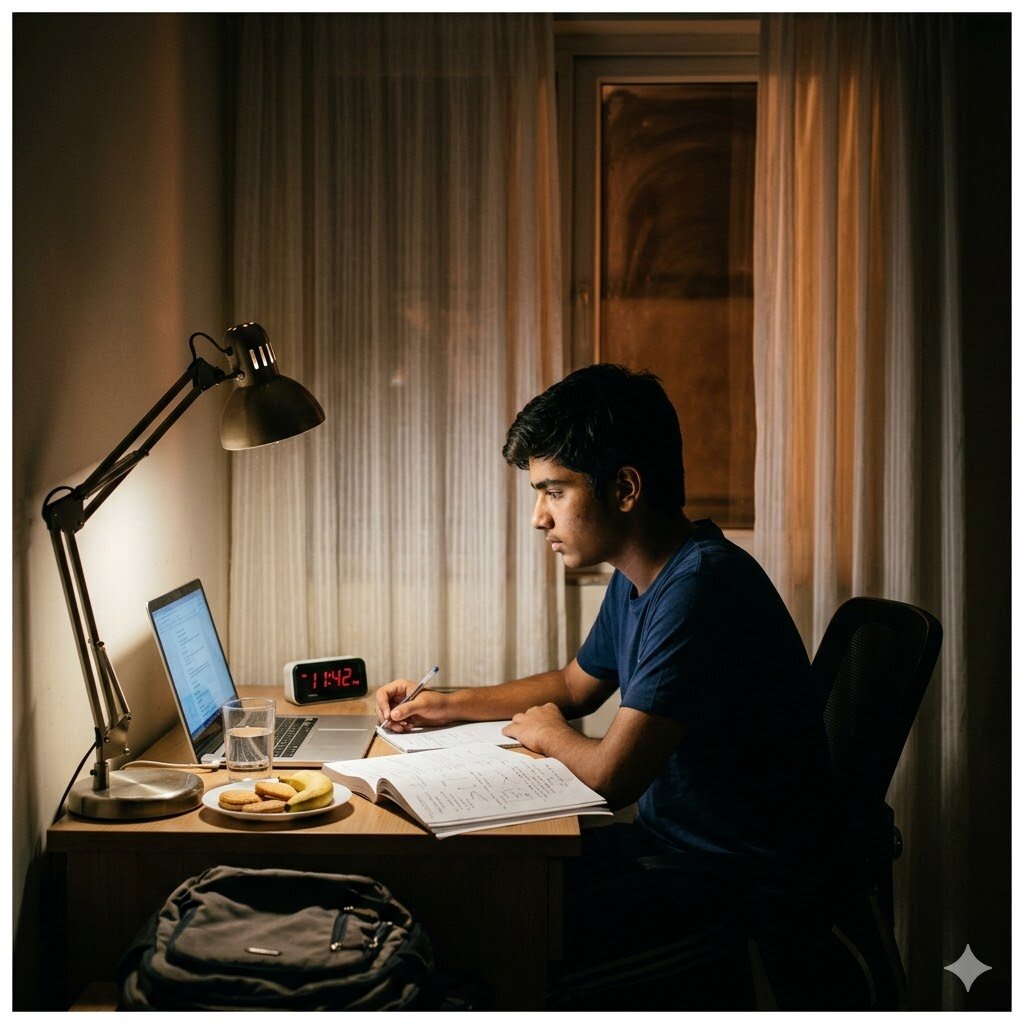
Indian child doing homework at a desk — second-hour focus and indoor CO₂

Why Your Child Loses Focus in the Second Hour of Homework — It’s Not Screen Time

A 10-year-old sits at a desk in a closed bedroom doing homework. After 60–90 minutes, attention drifts, mistakes multiply, and the standard parental diagnosis is “too much YouTube” or “needs a break.” Both may be true. There is also a third explanation that consumer CO₂ monitors make easy to verify: by the second hour, indoor CO₂ in a sealed study room often exceeds 1,200 ppm, well into the range where multiple controlled studies have shown measurable drops in cognitive performance, including in children. This page covers the school and classroom evidence, what it means for homes, and what a parent can actually change.

Key numbers

What the school research has shown

Three major streams of evidence:

1. Direct classroom intervention studies. Several controlled trials in real schools have increased ventilation rates while measuring student performance. Result: when outdoor-air supply rose from ~1.7 to ~6.6 L/s per pupil, the number of correct answers improved across multiple tasks:

(Bakó-Biró et al. / multiple European school studies, summarised in PMID 25866236.)

2. Cross-sectional achievement studies. A large analysis of California elementary classrooms (Mendell et al.) found students passing standardised math and reading tests at higher rates in better-ventilated classrooms. Each 2.1 L/s per pupil increase in ventilation was associated with +2.9% math passage rate and +2.7% reading passage rate.

3. Quasi-experimental natural experiments. A 2022 working paper using ventilation system breakdowns as an instrumental variable found CO₂ spikes causing 0.25–0.4 SD drops in test scores — a large effect, comparable to a year’s worth of typical learning gain.

Eight out of eleven systematic-review-eligible studies reported statistically significant improvements in at least some performance measure with increased ventilation or lower CO₂.

Why children are more affected than adults

Two reasons:

1. Higher minute ventilation per kilogram of body weight. Children breathe more air per kilogram of body weight than adults. A 10-year-old in a sealed bedroom processes more CO₂-laden air relative to their size than the same room would do to an adult.

2. Still-developing prefrontal cortex. The brain regions responsible for sustained attention, working memory and executive function are still maturing through adolescence. They are likely more sensitive to environmental perturbations like CO₂ and VOC exposure, though the literature is younger here than for adults.

The combined effect: a study room that gives an adult mild mental fog gives a child a measurable performance hit.

A typical Indian study scenario

Two parents, one child, one closed bedroom, evening study. The room is roughly 30 m³ (12 × 12 × 9 ft). The window is shut (winter cold, summer heat, or PM2.5). The door is shut to keep the TV noise out.

CO₂ trajectory over a 2-hour study session, with the child alone:

Time Approx. CO₂
0 min (door just closed) 500 ppm
15 min 700 ppm
30 min 950 ppm
60 min 1,300 ppm
90 min 1,600 ppm
120 min 1,800 ppm

Add a parent or a sibling and the curve rises ~70% faster.

By the second hour, the child is working in air that the WHO indoor guideline and the Berkeley / Harvard cognitive studies place firmly in “measurable performance impairment” territory. The frustration the child feels — and the parent observes — is partly a CO₂ signal.

What about Indian classrooms

Indian classrooms are not separately well-studied for CO₂, but a few indicators:

The performance hit at population scale is plausibly large. To our knowledge no large-scale Indian government-school IAQ measurement programme exists.

What a parent can do

1. Measure first. A ₹3,000–5,000 CO₂ monitor (Aranet4, Qingping, generic NDIR Chinese units) settles the question in one study session. Place it on the desk and watch the trace.

2. Crack the door. In a non-AC home or during AQI-tolerable months (Jul–Sep monsoon in NCR), keep the study-room door open. Cross-ventilation through the rest of the home brings CO₂ down 200–400 ppm.

3. Use short breaks strategically. A 5-minute break every 25–30 minutes (Pomodoro-style) is good for attention regardless. If the child leaves the study room during the break — opens the door, walks around — they reset the CO₂ floor each time.

4. Avoid stacking pollutants. Don’t burn incense, mosquito coils, or scented candles in study spaces. These add VOCs on top of CO₂; the Harvard CogFx study showed additive cognitive effects.

5. Year-round answer: mechanical ventilation. A positive-pressure fresh-air system holds the whole home — including study and bedrooms — at outdoor-equivalent CO₂ (~500–700 ppm) and filtered PM2.5. The child gets fresh-air-equivalent indoor air during all study time without weather or AQI constraints.

What schools should do (and rarely do)

Three changes most Indian schools could implement immediately:

1. Measure. Place CO₂ monitors in every classroom for a one-week audit. Most administrators have never seen the data.

2. Set a 1,000 ppm cap. Once measured, define an action threshold (e.g., 1,200 ppm sustained) at which a teacher opens the door or briefly the windows.

3. Specify mechanical ventilation in new builds. Most new private schools are sealed for AC. Adding fresh-air ventilation (mechanical, filtered for Indian outdoor conditions) is a one-time cost that pays back in measurable learning.

FAQ

Is the effect big enough to matter? 0.25–0.4 SD on a standardised test, per the strongest study, is a full year’s worth of typical learning. The effect on day-to-day homework is smaller but cumulatively significant.

My child has ADHD. Does this matter more? The general principle — attention is harder in poor indoor air — likely matters more for children with attention regulation differences, though specific studies in ADHD populations are limited.

Should I get a tutor instead of fixing the air? Both. Tutoring addresses content; air quality addresses the working conditions. They stack.

Is opening a window safe in Delhi? On low-AQI days, yes. On bad days, no — you trade CO₂ for PM2.5. This is why mechanical ventilation, which filters incoming air, is the year-round answer.

What about during exams? School exam halls are a worst case: high occupancy, doors shut, hours of sustained mental load. Schools that open windows when weather and AQI permit are advantaging their students; schools that don’t are not.